Department of Nutrition, Institute of Basic Medical Sciences, University of Oslo, 0372 Oslo, Norway.
Øvrebø Nutrition, 0550 Oslo, Norway.
Nutrients. 2018 Nov 23;10(12):1822. doi: 10.3390/nu10121822.
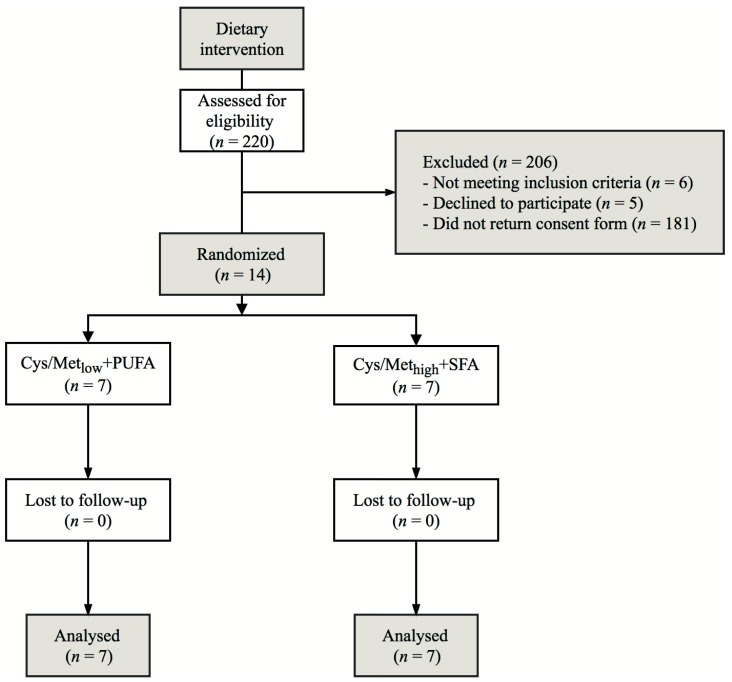
Dietary and plasma total cysteine (tCys) have been associated with adiposity, possibly through interaction with stearoyl⁻CoA desaturase (SCD), which is an enzyme that is involved in fatty acid and energy metabolism. We evaluated the effect of a dietary intervention with low cysteine and methionine and high polyunsaturated fatty acids (PUFAs) on plasma and urinary sulfur amino acids and SCD activity indices. Fourteen normal-weight healthy subjects were randomized to a seven-day diet low in cysteine and methionine and high in PUFAs (Cys/Met + PUFA), or high in saturated fatty acids (SFA), cysteine, and methionine (Cys/Met + SFA). Compared with the Cys/Met + SFA group, plasma methionine and cystathionine decreased (-values < 0.05), whereas cystine tended to increase ( = 0.06) in the Cys/Met + PUFA group. Plasma total cysteine (tCys) was not significantly different between the groups. Urinary cysteine and taurine decreased in the Cys/Met + PUFA group compared with the Cys/Met + SFA group (-values < 0.05). Plasma SCD-activity indices were not different between the groups, but the change in cystine correlated with the SCD-16 index in the Cys/Met + PUFA group. A diet low in methionine and cysteine decreased plasma methionine and urinary cysteine and taurine. Plasma tCys was unchanged, suggesting that compensatory mechanisms are activated during methionine and cysteine restriction to maintain plasma tCys.
饮食和血浆总半胱氨酸(tCys)与肥胖有关,可能通过与硬脂酰⁻辅酶 A 去饱和酶(SCD)相互作用,SCD 是一种参与脂肪酸和能量代谢的酶。我们评估了低半胱氨酸和蛋氨酸、高多不饱和脂肪酸(PUFA)饮食干预对血浆和尿硫氨基酸和 SCD 活性指数的影响。14 名正常体重健康受试者随机分为 7 天低半胱氨酸和蛋氨酸、高多不饱和脂肪酸(Cys/Met+PUFA)饮食组,或高饱和脂肪酸(SFA)、半胱氨酸和蛋氨酸(Cys/Met+SFA)饮食组。与 Cys/Met+SFA 组相比,Cys/Met+PUFA 组血浆蛋氨酸和胱硫醚降低(-值<0.05),而胱氨酸则有增加趋势(=0.06)。两组间血浆总半胱氨酸(tCys)无显著差异。与 Cys/Met+SFA 组相比,Cys/Met+PUFA 组尿半胱氨酸和牛磺酸减少(-值<0.05)。两组间血浆 SCD 活性指数无差异,但 Cys/Met+PUFA 组胱氨酸变化与 SCD-16 指数相关。低蛋氨酸和半胱氨酸饮食降低了血浆蛋氨酸和尿半胱氨酸和牛磺酸。血浆 tCys 无变化,提示在蛋氨酸和半胱氨酸限制期间,激活了补偿机制以维持血浆 tCys。