Departamento de Psicología Social, Universidad de Valencia, Avda. Blasco Ibáñez, 13., 46010 Valencia, Spain.
Departamento de Psicología de la Salud, Universidad Miguel Hernández de Elche, Avda. De la Universidad s/n, Edificio Altamira, 03202 Elche (Alicante), Spain.
Int J Environ Res Public Health. 2018 Nov 24;15(12):2634. doi: 10.3390/ijerph15122634.
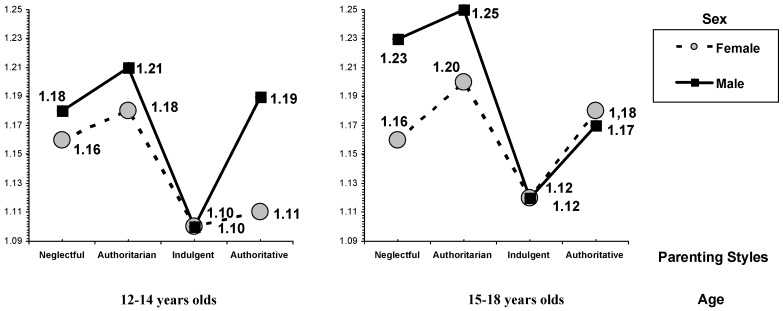
The aim of the present study was to analyze the relationship between the parenting styles-authoritative, indulgent, authoritarian, and neglectful-and reactive and proactive school violence among peers. These analyses were also performed by sex and age groups. The sample consisted of 2399 Spanish adolescents (50.2% male), aged between 12 and 18 years, mean (M) = 14.69, standard deviation () = 1.82. A multivariate analisys of variance (MANOVA, 4 × 2 × 2) was applied, considering parenting style, sex, and age group (12⁻14 and 15⁻18 years) as independent variables to analyze the possible effects of interaction. Reactive, proactive, and pure violence were the dependent variables. The results showed the main effects of parenting styles, sex, and age, as well as an interaction between sex, age, and parenting styles. The interpretation of the findings suggested that the authoritarian parenting style was related to greater engagement in proactive and reactive violent behaviors. In relation to the effect of the interaction between sex, age, and parenting styles, it was observed that adolescents from indulgent families, of both sexes and in any of the studied age groups, obtained lower scores in proactive violence. The discussion highlights the importance of affection and warmth for well-adjusted children's behavior.
本研究旨在分析父母教养方式(权威型、纵容型、专制型和忽视型)与同伴间反应性和主动性校园暴力之间的关系。这些分析还按性别和年龄组进行。样本由 2399 名西班牙青少年(50.2%为男性)组成,年龄在 12 至 18 岁之间,平均(M)= 14.69,标准差()= 1.82。采用多元方差分析(MANOVA,4×2×2),将父母教养方式、性别和年龄组(12⁻14 岁和 15⁻18 岁)作为自变量,分析可能存在的交互作用影响。反应性、主动性和单纯性暴力是因变量。结果显示,父母教养方式、性别和年龄均存在主效应,以及性别、年龄和父母教养方式之间存在交互作用。研究结果表明,专制型教养方式与更多的主动性和反应性暴力行为有关。关于性别、年龄和父母教养方式之间交互作用的影响,观察到来自纵容家庭的青少年,无论性别和研究中的任何年龄组,在主动性暴力方面的得分都较低。讨论强调了情感温暖对儿童行为适应的重要性。