Saleh Leila S, Bryant Stephanie J
Department of Chemical and Biological Engineering, University of Colorado, 3415 Colorado Avenue, Boulder, CO 80303, USA.
BioFrontiers Institute, University of Colorado, 3415 Colorado Avenue, Boulder, CO 80303, USA.
Drug Discov Today Dis Models. 2017 Summer;24:13-21. doi: 10.1016/j.ddmod.2018.04.002. Epub 2018 May 18.
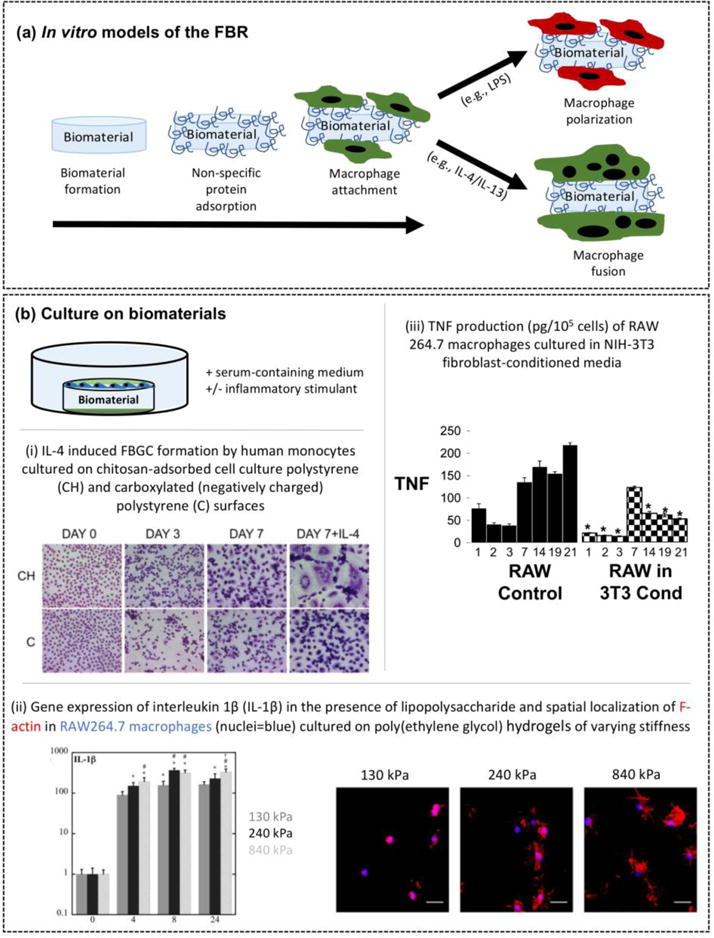
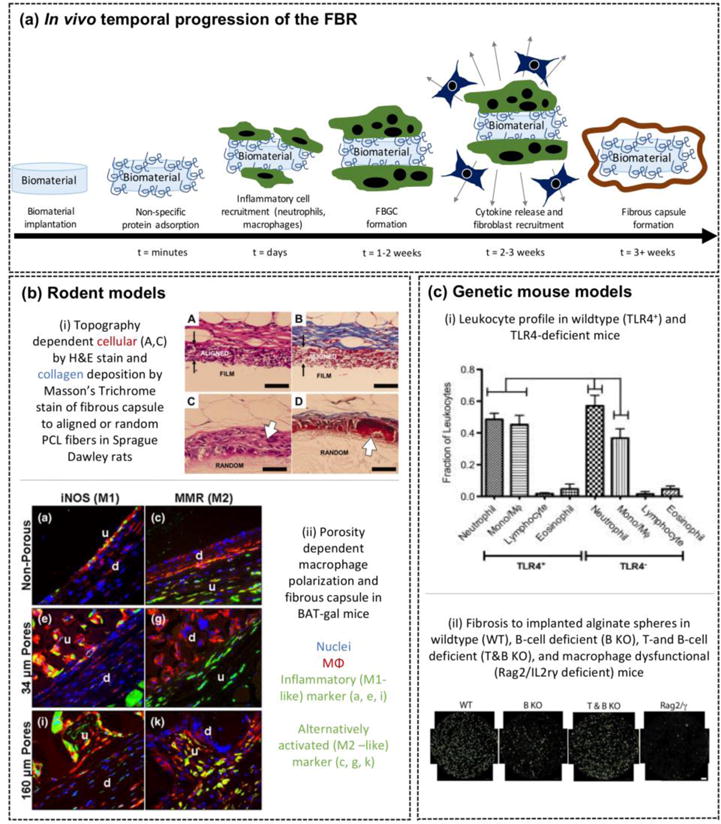
The foreign body response (FBR) occurs ubiquitously to essentially all non-biological materials that are implanted into higher organisms. The FBR is characterized by inflammation followed by fibrosis and is mediated largely by macrophages. While many current medical devices tolerate the FBR, the FBR is responsible for many asceptic device failures and is hindering advancements of new devices that rely on device-host communication to function. To this end, and models are critical to studying how a biomaterial, via its chemistry and properties, affect the FBR. This short review highlights the main and models that are used to study the FBR. models that capture macrophage interrogation of a biomaterial and evaluation of macrophage attachment, polarization and fusion are described. models using rodents, which provide a relatively simple model of the complex FBR process, and human-relevant nonhuman primate models are described. Collectively, the combination of and models will help advance our fundmental understanding of the FBR and enable new biomaterials to be developed that can effectively modulate the FBR to achieve a desire device-host outcome.
异物反应(FBR)普遍发生于植入高等生物体内的所有非生物材料。FBR的特征是炎症继之以纤维化,主要由巨噬细胞介导。虽然目前许多医疗设备能够耐受FBR,但FBR却是许多无菌设备故障的原因,并且阻碍了依赖设备与宿主通信来发挥功能的新设备的发展。为此,[具体模型名称1]和[具体模型名称2]模型对于研究生物材料如何通过其化学性质和特性影响FBR至关重要。本简短综述重点介绍了用于研究FBR的主要[具体模型名称1]和[具体模型名称2]模型。描述了能够捕捉巨噬细胞对生物材料的探查以及评估巨噬细胞附着、极化和融合的[具体模型名称1]模型。描述了使用啮齿动物的[具体模型名称2]模型,其提供了相对简单的复杂FBR过程模型,以及与人类相关的非人类灵长类动物模型。总体而言,[具体模型名称1]和[具体模型名称2]模型的结合将有助于推进我们对FBR的基础理解,并使能够有效调节FBR以实现理想的设备与宿主结果的新型生物材料得以开发。