Huang Ngan F, Serpooshan Vahid, Morris Viola B, Sayed Nazish, Pardon Gaspard, Abilez Oscar J, Nakayama Karina H, Pruitt Beth L, Wu Sean M, Yoon Young-Sup, Zhang Jianyi, Wu Joseph C
Stanford Cardiovascular Institute, Stanford University School of Medicine, Stanford, 94305, CA, USA.
Department of Cardiothoracic Surgery, Stanford University School of Medicine, Stanford, 94305, CA, USA.
Commun Biol. 2018 Nov 21;1:199. doi: 10.1038/s42003-018-0202-8. eCollection 2018.
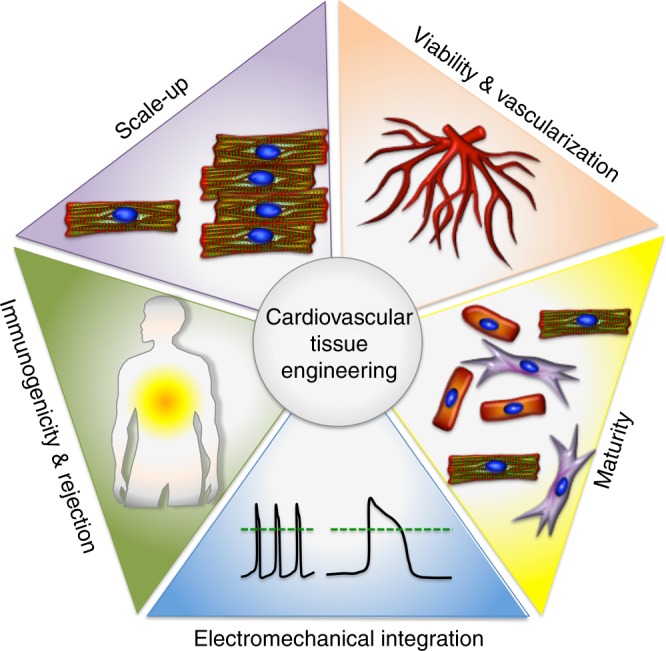
Although tissue engineering using human-induced pluripotent stem cells is a promising approach for treatment of cardiovascular diseases, some limiting factors include the survival, electrical integration, maturity, scalability, and immune response of three-dimensional (3D) engineered tissues. Here we discuss these important roadblocks facing the tissue engineering field and suggest potential approaches to overcome these challenges.
尽管利用人类诱导多能干细胞进行组织工程是治疗心血管疾病的一种有前景的方法,但一些限制因素包括三维(3D)工程组织的存活、电整合、成熟度、可扩展性和免疫反应。在此,我们讨论组织工程领域面临的这些重要障碍,并提出克服这些挑战的潜在方法。