Callahan Edward, Bly Randall, Johnson Kaalan, Aghdasi Nava, Hannaford Blake, Moe Kris, Sardesai Maya G
Department of Otolaryngology-Head and Neck Surgery, University of Washington School of Medicine, Seattle, Washington, USA.
Department of Engineering, University of Washington, Seattle, Washington, USA.
OTO Open. 2017 Nov 8;1(4):2473974X17738959. doi: 10.1177/2473974X17738959. eCollection 2017 Oct-Dec.
To determine whether wrist motion measured by a smartphone application can be used as a performance metric for a simulated airway procedure requiring both wrist and finger dexterity. We hypothesized that this accelerometer application could detect differences between novices and experienced surgeons performing simulated cricothyrotomy.
Academic medical center.
Prospective pilot cohort study.
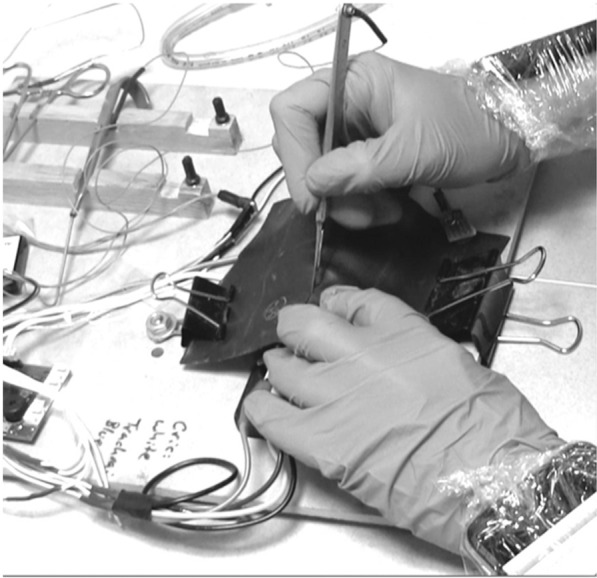
Voluntary surgeons and nonsurgeons were recruited. After viewing a training video, smartphones with accelerometer applications were attached to both wrists while subjects performed a cricothyrotomy on a validated task trainer. Procedure time and motion parameters, including average resultant acceleration (ARA), total resultant acceleration (TRA), and suprathreshold acceleration events (STAEs), were collected for dominant and nondominant hands. Subjects were stratified by prior experience. Blinded experts scored each performance using Objective Structured Assessment of Technical Skills (OSATS), and tests were used to compare performance.
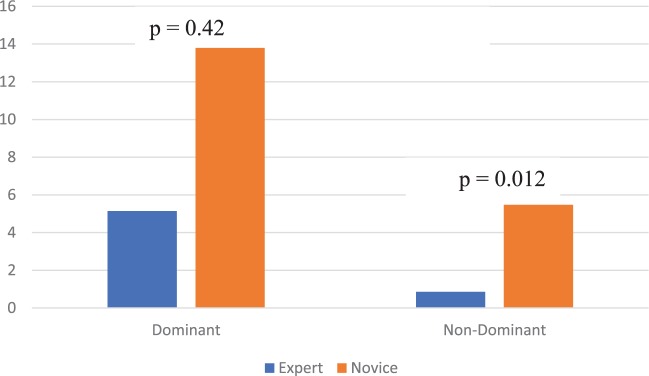
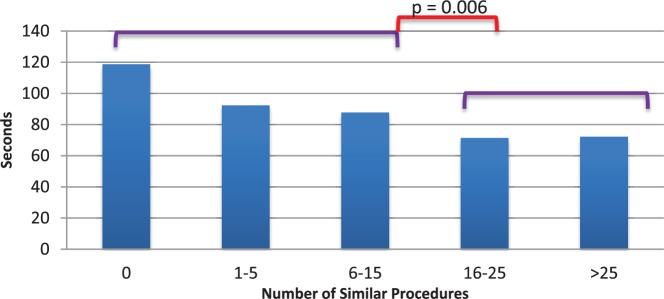
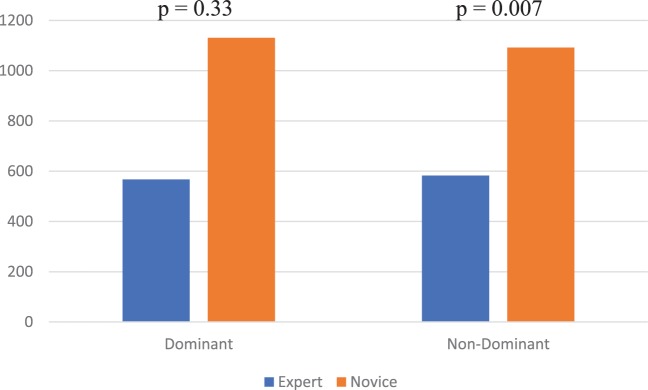
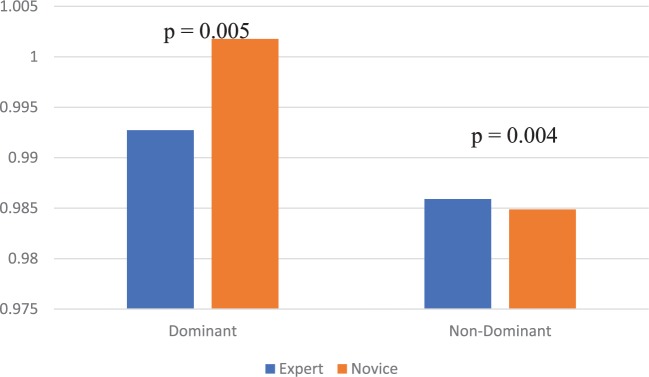
Thirty subjects were enrolled. Median age was 26 years, and 20 subjects were male. In the dominant hand, significant differences were seen between novice and experienced surgeons in TRA ( = .005) and procedure time ( = .006), while no significant differences were seen in STAEs ( = .42) and ARA ( = .33). In the nondominant hand, all variables were significantly different between the 2 groups: STAEs ( = .012), ARA ( = .007), TRA ( = .004), and procedure time ( = .006).
Wrist motion measured by a low-cost smartphone application can distinguish between novice and experienced surgeons performing simulated airway surgery. This tool provides cost-effective and objective performance feedback.
确定通过智能手机应用程序测量的手腕运动是否可以用作需要手腕和手指灵活性的模拟气道手术的性能指标。我们假设这种加速度计应用程序可以检测新手和有经验的外科医生在进行模拟环甲膜切开术时的差异。
学术医疗中心。
前瞻性试点队列研究。
招募了志愿外科医生和非外科医生。在观看培训视频后,在受试者在经过验证的任务训练器上进行环甲膜切开术时,将装有加速度计应用程序的智能手机连接到两只手腕上。收集优势手和非优势手的手术时间和运动参数,包括平均合成加速度(ARA)、总合成加速度(TRA)和超阈值加速度事件(STAEs)。受试者按既往经验分层。由盲法专家使用客观结构化技能评估(OSATS)对每次表现进行评分,并使用测试来比较表现。
招募了30名受试者。中位年龄为26岁,20名受试者为男性。在优势手中,新手和有经验的外科医生在TRA(P = .005)和手术时间(P = .006)方面存在显著差异,而在STAEs(P = .42)和ARA(P = .33)方面没有显著差异。在非优势手中,两组之间的所有变量均存在显著差异:STAEs(P = .012)、ARA(P = .007)、TRA(P = .004)和手术时间(P = .006)。
通过低成本智能手机应用程序测量的手腕运动可以区分进行模拟气道手术的新手和有经验的外科医生。该工具提供了具有成本效益的客观性能反馈。