Ju Peng, He Yunhong, Wang Min, Han Xiuxun, Jiang Fenghua, Sun Chengjun, Wu Chi
Institute of Marine Science and Technology, Shandong University, 72 Binhai Road, Qingdao 266237, China.
Key Laboratory of Marine Bioactive Substances and Analytical Technology, Marine Ecology Center, The First Institute of Oceanography, State Oceanic Administration (SOA), 6 Xianxialing Road, Qingdao 266061, China.
Nanomaterials (Basel). 2018 Nov 26;8(12):976. doi: 10.3390/nano8120976.
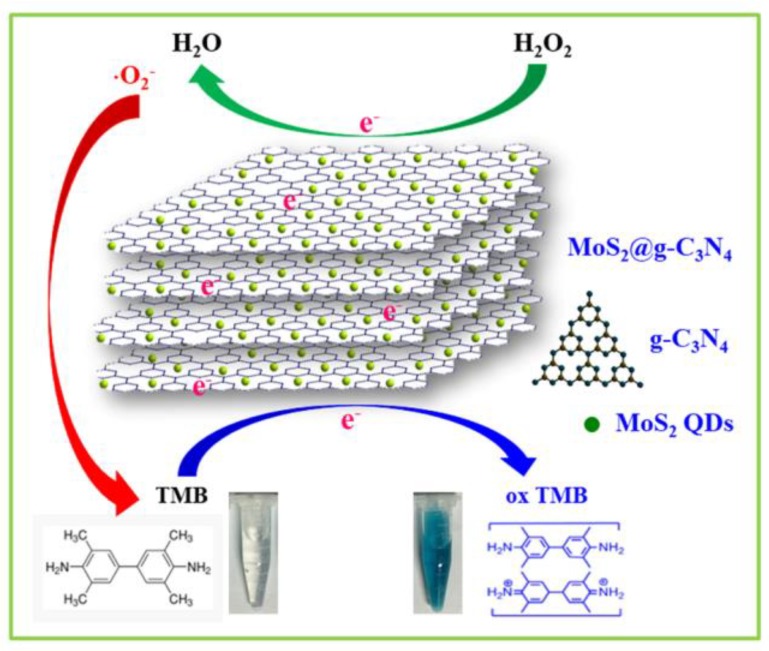
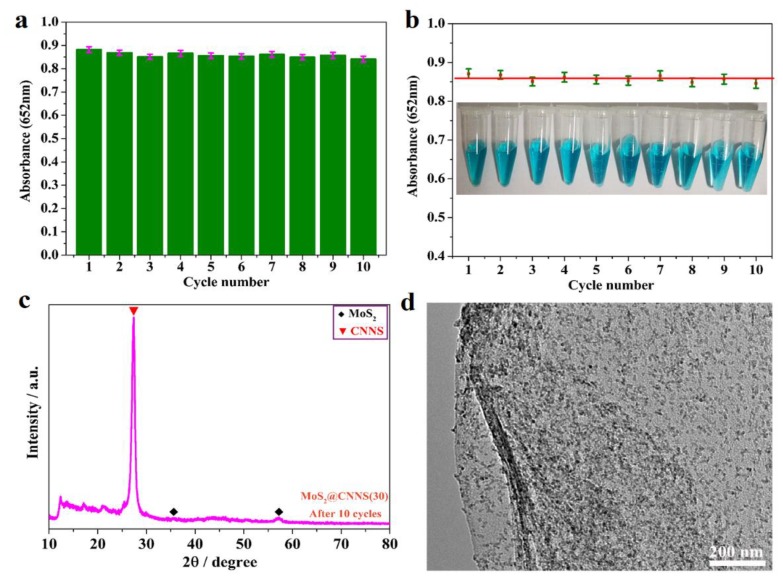
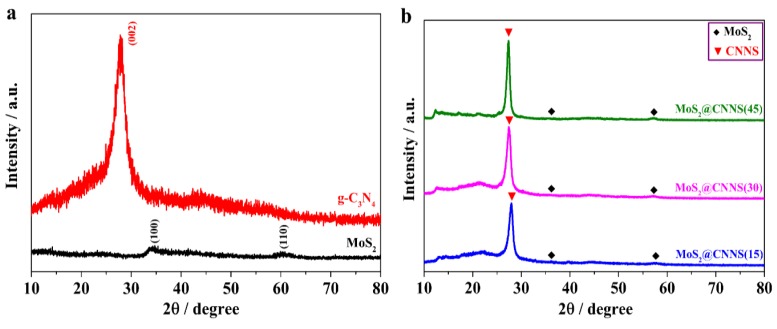
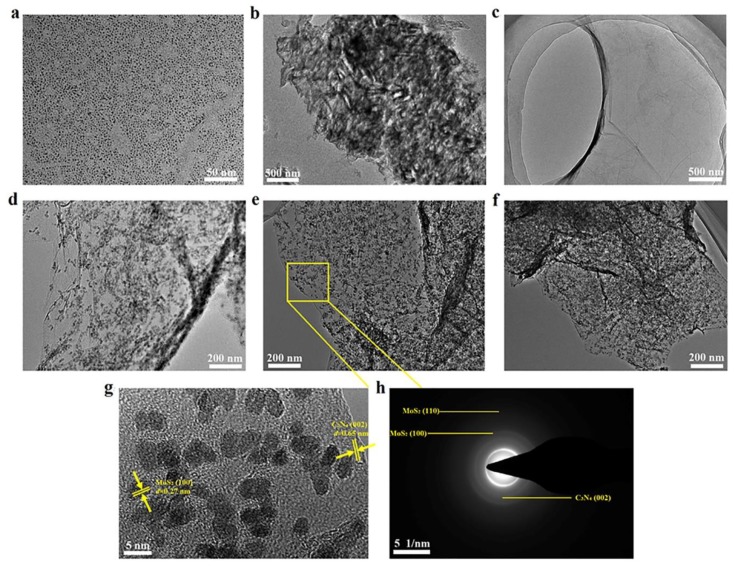
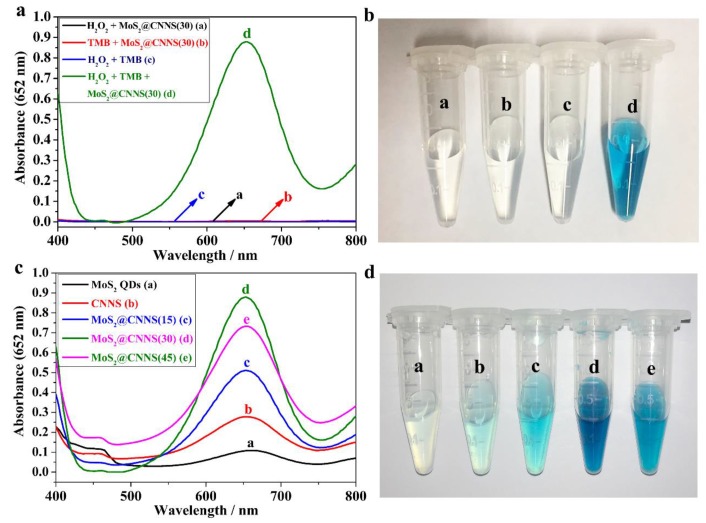
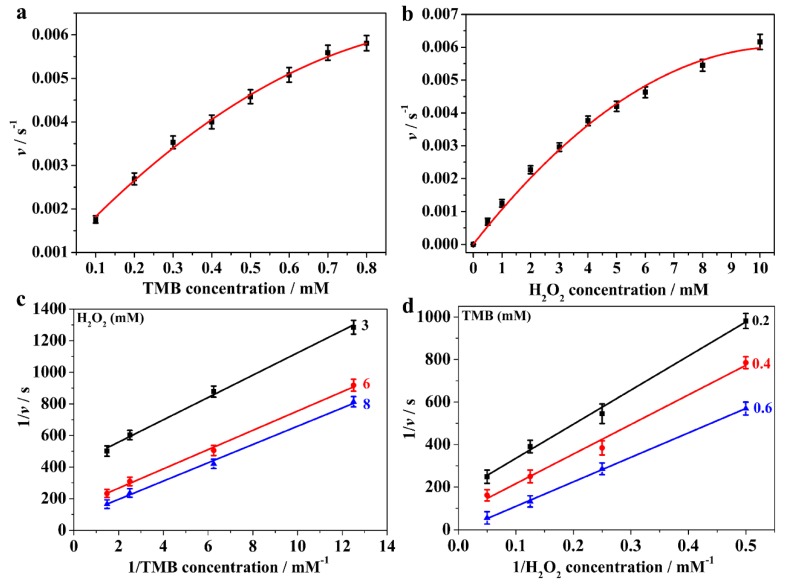
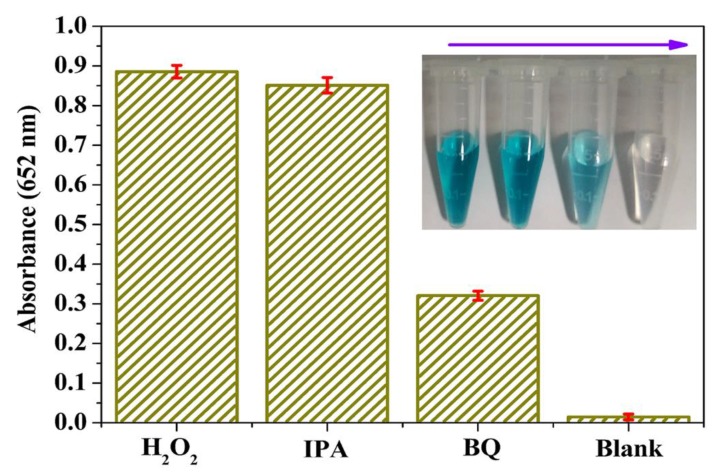
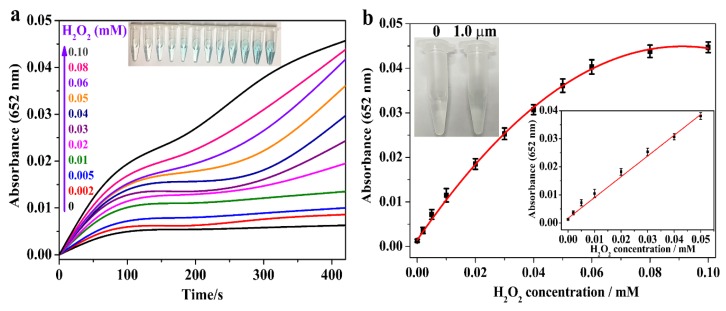
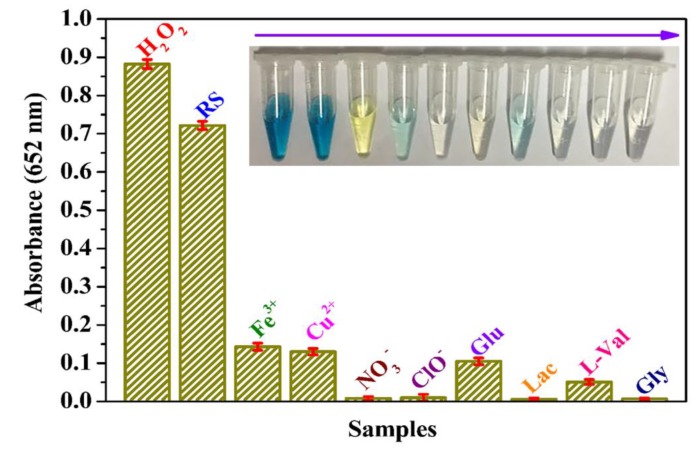
MoS₂ quantum dots (QDs) functionalized g-C₃N₄ nanosheets (MoS₂@CNNS) were prepared through a protonation-assisted ion exchange method, which were developed as a highly efficient biomimetic catalyst. Structural analysis revealed that uniformly-dispersed MoS₂ QDs with controllable size and different loading amount grew in-situ on the surface of CNNS, forming close-contact MoS₂@CNNS nanostructures and exhibiting distinct surface properties. Compared to MoS₂ QDs and CNNS, the MoS₂@CNNS nanocomposites exhibited a more than four times stronger peroxidase-like catalytic activity, which could catalyze the oxidation of 3,3',5,5'-tetramethylbenzidine (TMB) in the presence of H₂O₂ to generate a blue oxide. Among the MoS₂@CNNS nanocomposites, MoS₂@CNNS(30) was verified to present the best intrinsic peroxidase-like performance, which could be attributed to the more negative potential and larger specific surface area. A simple, rapid and ultrasensitive system for colorimetric detection of H₂O₂ was thus successfully established based on MoS₂@CNNS, displaying nice selectivity, reusability, and stability. The detection limit of H₂O₂ could reach as low as 0.02 μM. Furthermore, the kinetic and active species trapping experiments indicated the peroxidase-like catalytic mechanism of MoS₂@CNNS. This work develops a novel, rapid, and ultrasensitive approach for visual assay of H₂O₂, which has a potential application prospect on clinical diagnosis and biomedical analysis.
通过质子化辅助离子交换法制备了二硫化钼量子点(QDs)功能化的石墨相氮化碳纳米片(MoS₂@CNNS),并将其开发为一种高效的仿生催化剂。结构分析表明,尺寸可控且负载量不同的均匀分散的二硫化钼量子点原位生长在石墨相氮化碳纳米片表面,形成紧密接触的MoS₂@CNNS纳米结构,并表现出独特的表面性质。与二硫化钼量子点和石墨相氮化碳纳米片相比,MoS₂@CNNS纳米复合材料表现出超过四倍的更强类过氧化物酶催化活性,其可以在过氧化氢存在下催化3,3',5,5'-四甲基联苯胺(TMB)氧化生成蓝色氧化物。在MoS₂@CNNS纳米复合材料中,MoS₂@CNNS(30)被证实具有最佳的固有类过氧化物酶性能,这可归因于其更负的电位和更大的比表面积。基于MoS₂@CNNS成功建立了一种简单、快速且超灵敏的过氧化氢比色检测系统,该系统具有良好的选择性、可重复使用性和稳定性。过氧化氢的检测限可低至0.02 μM。此外,动力学和活性物种捕获实验表明了MoS₂@CNNS的类过氧化物酶催化机制。这项工作开发了一种用于过氧化氢可视化检测的新颖、快速且超灵敏的方法,在临床诊断和生物医学分析方面具有潜在的应用前景。