University of Pittsburgh Medical Center, University of Pittsburgh Physicians, Department of Neurology, Department of Medicine, Pittsburgh, Pennsylvania.
Merck & Co, Kenilworth, New Jersey.
Int J Radiat Oncol Biol Phys. 2019 Mar 15;103(4):878-886. doi: 10.1016/j.ijrobp.2018.11.008. Epub 2018 Nov 27.
To evaluate the toxicity and efficacy of adjuvant temozolomide (TMZ) and irinotecan (CPT-11) for 12 months after concurrent chemoradiation in patients with newly diagnosed glioblastoma (GBM).
Trial RTOG 04-20, a single-arm, multi-institutional phase 2 trial, was designed to determine the efficacy and toxicity of concomitant TMZ and radiation therapy (RT) followed by adjuvant TMZ combined with CPT-11 given for 12 cycles compared with historical controls of adjuvant TMZ alone given for 6 cycles.
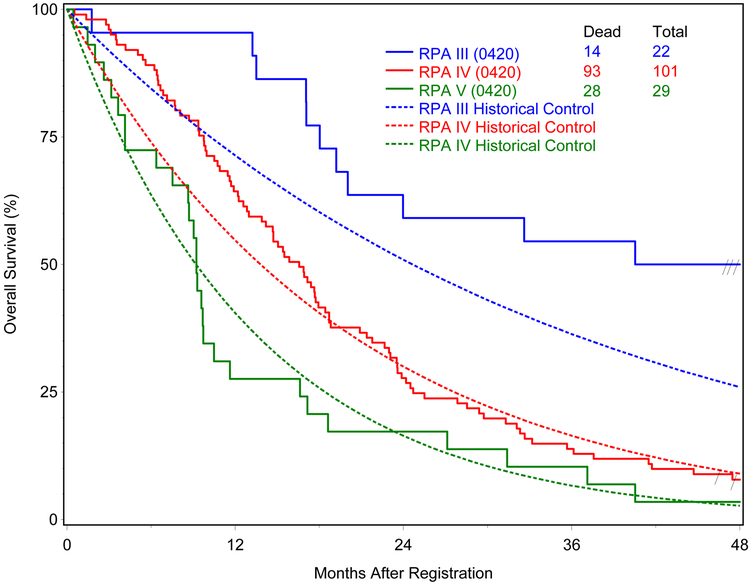
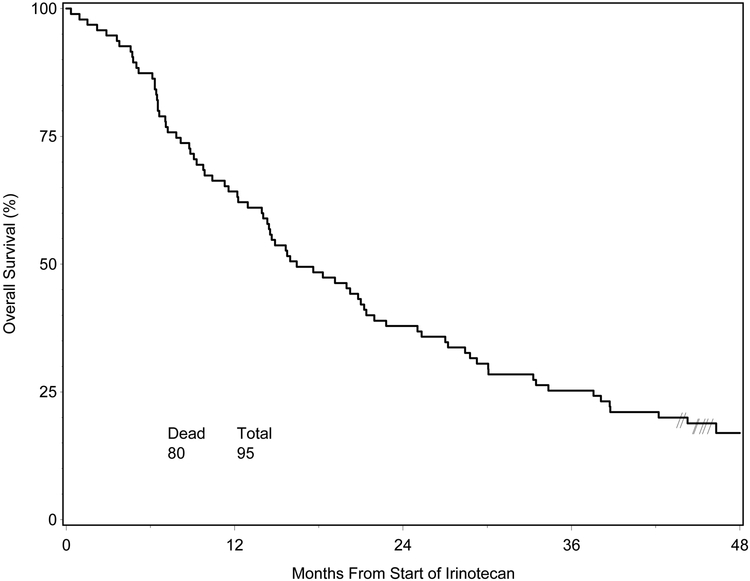
A total of 170 patients were enrolled, 152 of whom were eligible. Adjuvant CPT-11 combined with TMZ was more toxic than expected. A higher rate of hematologic and gastrointestinal toxicities was more frequently noted with the combination regimen compared with adjuvant TMZ alone. Grade 3/4 hematologic toxicity was 38% compared with 14% reported in the Stupp trial. After an early interim analysis, the adjuvant CPT-11 dose was reduced to 100 mg/m on days 1 and 5 for the first cycle. CPT-11 dose escalation proceeded over the first 3 cycles if tolerated. Median overall survival for all eligible patients was 16.9 months compared with 13.7 months of the historical control (P = .03). Post hoc subgroup analysis suggested an improvement in overall survival for patients with Radiation Therapy Oncology Group recursive partitioning analysis class 3, although improvement was limited to 22 patients (14% of eligible patients).
Although irinotecan and TMZ for 12 cycles given after chemoradiation for patients with newly diagnosed glioblastoma significantly improved median survival compared with historical control data at the time the study was conducted, the historical control median survival time of 13.7 months does not represent the current benchmark for this patient population. Treatment intensification does prolong overall survival compared with the current standard.
评估替莫唑胺(TMZ)和伊立替康(CPT-11)在新诊断胶质母细胞瘤(GBM)患者同步放化疗后辅助治疗 12 个月的毒性和疗效。
试验 RTOG 04-20 是一项单臂、多中心的 2 期试验,旨在确定同期 TMZ 和放疗(RT)后辅助 TMZ 联合 CPT-11 治疗 12 个周期的疗效和毒性,与单独辅助 TMZ 治疗 6 个周期的历史对照相比。
共入组 170 例患者,其中 152 例符合条件。辅助 CPT-11 联合 TMZ 的毒性高于预期。与单独辅助 TMZ 相比,联合方案更常出现血液学和胃肠道毒性。3/4 级血液学毒性为 38%,而 Stupp 试验报告为 14%。在早期中期分析后,辅助 CPT-11 剂量在第 1 周期减少至 100mg/m,第 1 和第 5 天。如果耐受,CPT-11 剂量在头 3 个周期内逐渐增加。所有合格患者的中位总生存期为 16.9 个月,而历史对照为 13.7 个月(P=0.03)。事后亚组分析表明,对于放射治疗肿瘤学组递归分区分析 3 级患者,总生存期有所改善,尽管改善仅限于 22 例患者(合格患者的 14%)。
尽管替莫唑胺和伊立替康在新诊断胶质母细胞瘤患者放化疗后辅助治疗 12 个周期,与研究时的历史对照数据相比显著提高了中位生存期,但历史对照的中位生存期为 13.7 个月,并不代表当前这一患者群体的基准。与目前的标准相比,治疗强化确实可以延长总生存期。