School of Public Health, Curtin University, Kent Street, GPO Box U1987, Perth, WA, 6845, Australia.
Telethon Kids Institute, The University of Western Australia, PO Box 855, West Perth, WA, 6872, Australia.
Global Health. 2018 Nov 29;14(1):121. doi: 10.1186/s12992-018-0440-z.
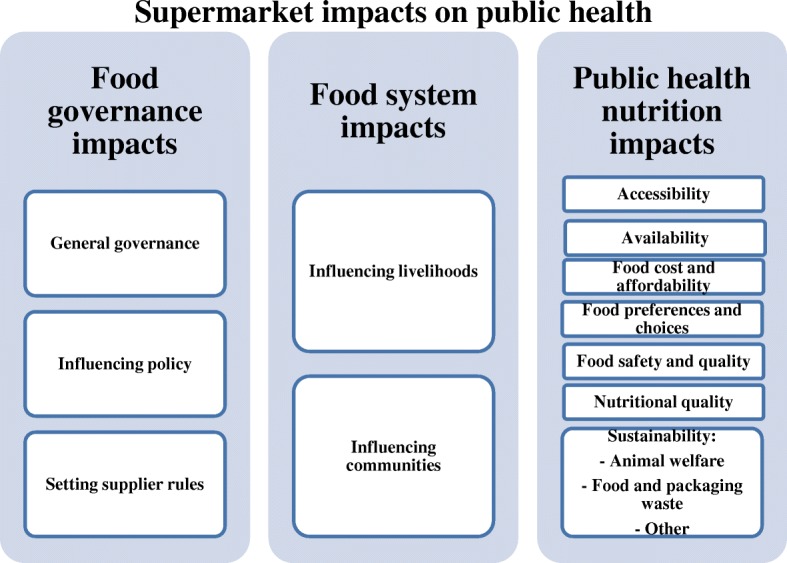
Supermarkets have unprecedented political and economic power in the food system and an inherent responsibility to demonstrate good corporate citizenship via corporate social responsibility (CSR). The aim of this study was to investigate the world's largest and most powerful supermarkets' publically available CSR commitments to determine their potential impact on public health.
The world's largest 100 retailers were identified using the Global Powers of Retailing report. Thirty-one supermarkets that published corporate reports referring to CSR or sustainability, in English, between 2013 and 2018, were included and thematically analysed.
Although a large number of themes were identified (n = 79), and there were differences between each business, supermarket CSR commitments focused on five priorities: donating surplus food to charities for redistribution to feed the hungry; reducing and recovering food waste; sustainably sourcing specific ingredients including seafood, palm oil, soy and cocoa; governance of food safety; and growing the number of own brand foods available, that are made by suppliers to meet supermarkets' requirements.
CSR commitments made by 31 of the world's largest supermarkets showed they appeared willing to take steps to improve sustainable sourcing of specific ingredients, but there was little action being taken to support health and nutrition. Although some supermarket CSR initiatives showed promise, the world's largest supermarkets could do more to use their power to support public health. It is recommended they should: (1) transparently report food waste encompassing the whole of the food system in their waste reduction efforts; (2) support healthful and sustainable diets by reducing production and consumption of discretionary foods, meat, and other ingredients with high social and environmental impacts; (3) remove unhealthful confectionery, snacks, and sweetened beverages from prominent in-store locations; (4) ensure a variety of minimally processed nutritious foods are widely available; and (5) introduce initiatives to make healthful foods more affordable, support consumers to select healthful and sustainable foods, and report healthful food sales as a proportion of total food sales, using transparent criteria for key terms.
超市在食品系统中拥有前所未有的政治和经济实力,通过企业社会责任(CSR)展示良好的企业公民身份是其固有责任。本研究旨在调查全球最大、最具影响力的超市公开的企业社会责任承诺,以确定其对公众健康的潜在影响。
使用《全球零售力量报告》确定了全球最大的 100 家零售商。选择了 2013 年至 2018 年间发表过企业报告,涉及企业社会责任或可持续性,并以英文出版的 31 家超市进行研究,并对其进行主题分析。
尽管确定了大量主题(n=79),并且每个企业之间存在差异,但超市的企业社会责任承诺主要集中在五个优先事项上:将剩余食物捐赠给慈善机构,以重新分配给饥饿人群;减少和回收食物浪费;可持续采购特定成分,包括海鲜、棕榈油、大豆和可可;食品安全治理;增加自有品牌食品的数量,这些食品由供应商根据超市的要求生产。
全球 31 家最大超市的企业社会责任承诺表明,它们似乎愿意采取措施改善特定成分的可持续采购,但在支持健康和营养方面几乎没有采取行动。尽管一些超市的企业社会责任举措显示出前景,但全球最大的超市可以采取更多措施利用其权力来支持公众健康。建议他们应:(1)在减少浪费的努力中,透明地报告涵盖整个食品系统的食物浪费;(2)通过减少随意食品、肉类和其他具有高社会和环境影响的成分的生产和消费,支持健康和可持续的饮食;(3)从店内显著位置移除不健康的糖果、零食和含糖饮料;(4)确保广泛提供各种低加工的营养食品;(5)引入降低健康食品价格、支持消费者选择健康和可持续食品以及报告健康食品销售额占总食品销售额比例的举措,使用透明的关键术语标准。