Cinciute Sigita, Daktariunas Algis, Ruksenas Osvaldas
Institute of Biosciences, Life Sciences Center, Vilnius University, Vilnius, Lithuania.
PeerJ. 2018 Nov 21;6:e5890. doi: 10.7717/peerj.5890. eCollection 2018.
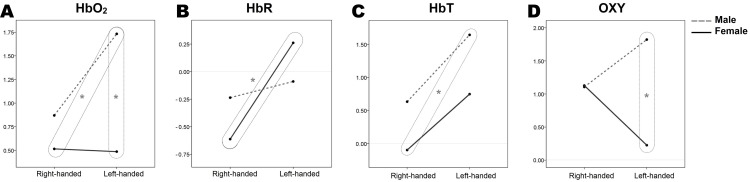
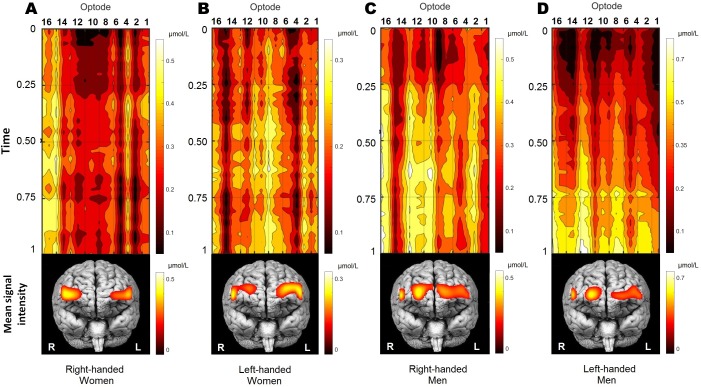
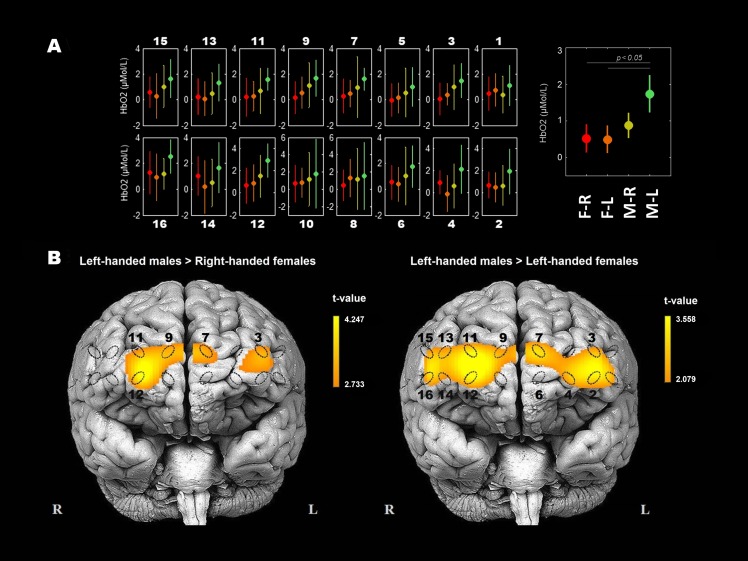
This study investigated the potential role of sex and handedness on the performance of a computerised Wisconsin Card Sorting Test (WCST) in healthy participants by applying functional near-infrared spectroscopy (fNIRS). We demonstrated significant ( < 0.05) sex-related differences of hemodynamic response in the prefrontal cortex of 70 healthy participants (female, = 35 and male, = 35; right-handed, = 40 and left-handed, = 30). In contrast, behavioural results of the WCST do not show sex bias, which is consistent with previous literature. Because of this, we compared ours and sparse previous fNIRS studies on the WCST. We propose that, according to recent studies of neurovascular coupling, this contradiction between neuroimaging and behavioural results may be explained by normal variability in neurovascular dynamics.
本研究通过应用功能近红外光谱技术(fNIRS),调查了性别和利手对健康参与者进行计算机化威斯康星卡片分类测验(WCST)表现的潜在作用。我们在70名健康参与者(女性35名,男性35名;右利手40名,左利手30名)的前额叶皮质中证明了血流动力学反应存在显著的(<0.05)性别相关差异。相比之下,WCST的行为结果未显示出性别偏差,这与先前的文献一致。因此,我们比较了我们的研究以及之前关于WCST的少量fNIRS研究。我们提出,根据最近对神经血管耦合的研究,神经成像和行为结果之间的这种矛盾可能由神经血管动力学的正常变异性来解释。