Biomedical Engineering, Kings' College London, London, UK.
Department of Physiology and Division of Cardiovascular Medicine, University of Kentucky, Lexington, USA.
J Mol Cell Cardiol. 2019 Feb;127:11-19. doi: 10.1016/j.yjmcc.2018.11.015. Epub 2018 Nov 29.
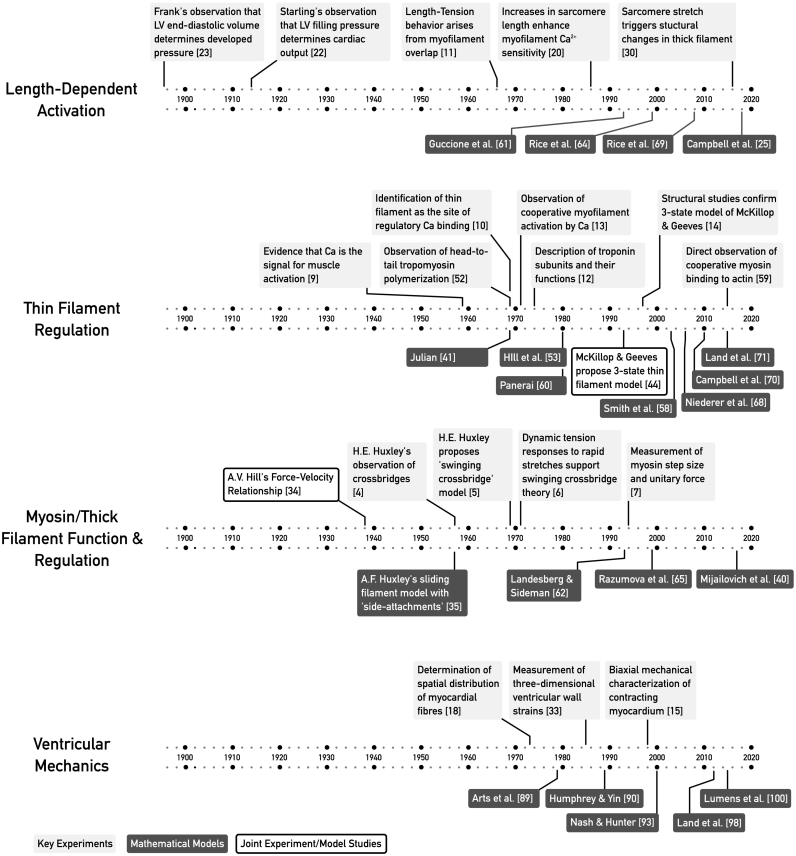
Cardiac mechanics plays a crucial role in atrial and ventricular function, in the regulation of growth and remodelling, in the progression of disease, and the response to treatment. The spatial scale of the critical mechanisms ranges from nm (molecules) to cm (hearts) with the fastest events occurring in milliseconds (molecular events) and the slowest requiring months (growth and remodelling). Due to its complexity and importance, cardiac mechanics has been studied extensively both experimentally and through mathematical models and simulation. Models of cardiac mechanics evolved from seminal studies in skeletal muscle, and developed into cardiac specific, species specific, human specific and finally patient specific calculations. These models provide a formal framework to link multiple experimental assays recorded over nearly 100 years into a single unified representation of cardiac function. This review first provides a summary of the proteins, physiology and anatomy involved in the generation of cardiac pump function. We then describe the evolution of models of cardiac mechanics starting with the early theoretical frameworks describing the link between sarcomeres and muscle contraction, transitioning through myosin-level models to calcium-driven systems, and ending with whole heart patient-specific models.
心脏力学在心房和心室功能、生长和重塑的调节、疾病的进展以及对治疗的反应中起着至关重要的作用。关键机制的空间尺度范围从纳米(分子)到厘米(心脏),最快的事件发生在毫秒(分子事件),最慢的需要数月(生长和重塑)。由于其复杂性和重要性,心脏力学已经通过实验和数学模型和模拟进行了广泛的研究。心脏力学模型从骨骼肌肉的开创性研究中发展而来,并发展成为心脏特异性、物种特异性、人类特异性,最后是患者特异性计算。这些模型提供了一个正式的框架,将近 100 年来记录的多个实验测定结果链接到心脏功能的单一统一表示中。这篇综述首先概述了产生心脏泵功能的蛋白质、生理学和解剖学。然后,我们描述了心脏力学模型的演变,从描述肌节和肌肉收缩之间联系的早期理论框架开始,过渡到肌球蛋白水平模型,再到钙驱动系统,最后是整个心脏患者特异性模型。