Centre for Research in Ageing and Cognitive Health (REACH), University of Exeter, St Luke's Campus, Exeter, UK.
Centre for Research Excellence in Promoting Cognitive Health and Preventing Cognitive Decline, University of New South Wales and Neuroscience Research Australia, Barker Street, Randwick NSW, Australia.
J Alzheimers Dis. 2019;70(s1):S303-S318. doi: 10.3233/JAD-180608.
Understanding the policy context and how policy is implemented at the local and clinical level is an important precursor to developing preventive strategies focusing on dementia risk reduction in primary healthcare settings.
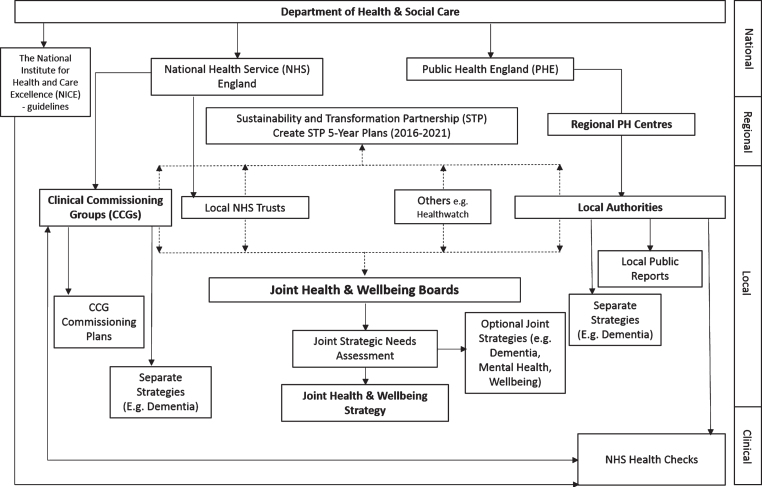
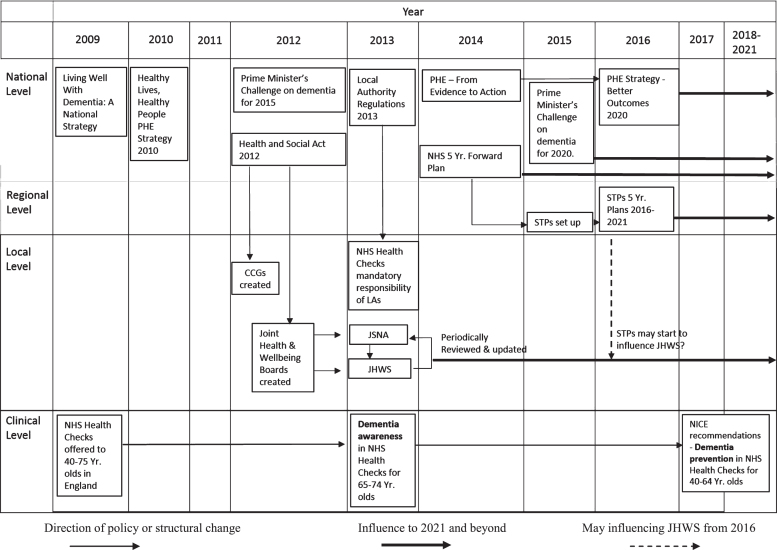
Using England as a case study, we review policies and strategies relevant to dementia prevention from the national to local level and how these are translated into primary healthcare services.
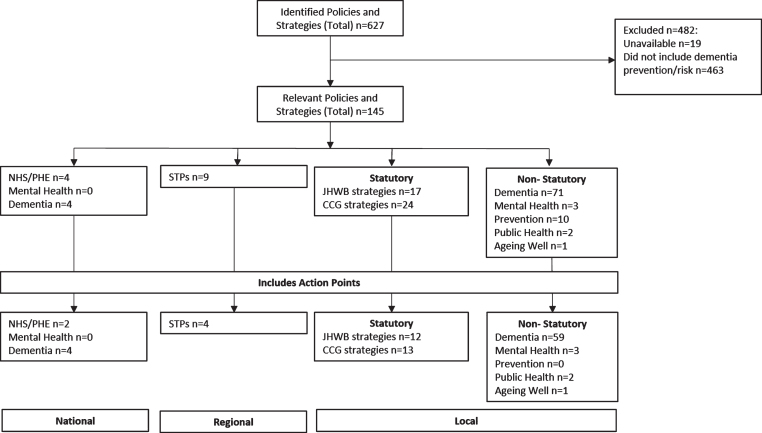
We conducted a scoping review covering: 1) identification of national, regional, and local policies and strategies that include dementia prevention; 2) identification of national guidelines for implementing dementia prevention at the clinical level; and 3) evaluation of the implementation of these at the clinical level.
Dementia prevention is addressed in national policy, and this filters through to regional and local levels. Focus on dementia prevention is limited and variable. Reference to modifiable risk factors is associated with other non-communicable diseases, placing less emphasis on factors more dementia specific. Evidence of implementation of dementia prevention policies at the clinical level is limited and inconsistent. Available evidence suggests messages about dementia prevention may best be delivered through primary healthcare services such as the National Health Service (NHS) Health Check.
The limitations identified in this review could be addressed through development of a national policy focused specifically on dementia prevention. This could provide a platform for increasing knowledge and understanding among the general population and healthcare professionals. It would be important for such a policy to cover the full range of modifiable risk factors relevant to dementia.
了解政策背景以及政策在地方和临床层面的实施情况,是在基层医疗保健环境中制定专注于降低痴呆风险的预防策略的重要前提。
以英国为例,我们回顾了从国家到地方层面与痴呆预防相关的政策和策略,以及这些政策如何转化为基层医疗保健服务。
我们进行了一次范围界定综述,涵盖:1)确定包含痴呆预防的国家、地区和地方政策和策略;2)确定在临床层面实施痴呆预防的国家指南;3)评估这些指南在临床层面的实施情况。
国家政策中涉及痴呆预防,这一政策也渗透到了地区和地方层面。对痴呆预防的关注有限且多变。对可改变风险因素的提及与其他非传染性疾病相关联,而对更具痴呆特异性的因素则关注较少。在临床层面实施痴呆预防政策的证据有限且不一致。现有证据表明,通过基层医疗保健服务(如国民保健制度(NHS)健康检查)传递痴呆预防信息可能效果最佳。
本综述中发现的局限性可以通过制定一项专门针对痴呆预防的国家政策来解决。这可以为普通民众和医疗保健专业人员提供增加知识和理解的平台。这样的政策涵盖与痴呆相关的所有可改变的风险因素非常重要。