Emergency and Intensive Care Center, The Third Xiangya Hospital of Central South University, 138 Tongzipo Road, Changsha, 410013, Hunan Province, PR, China.
Respir Res. 2018 Dec 5;19(1):243. doi: 10.1186/s12931-018-0937-2.
Acute lung injury (ALI) is a life-threatening lung disease where alveolar macrophages (AMs) play a central role both in the early phase to initiate inflammatory responses and in the late phase to promote tissue repair. In this study, we examined whether BML-111, a lipoxin A4 receptor agonist, could alter the phenotypes of AM and thus present prophylactic benefits for ALI.
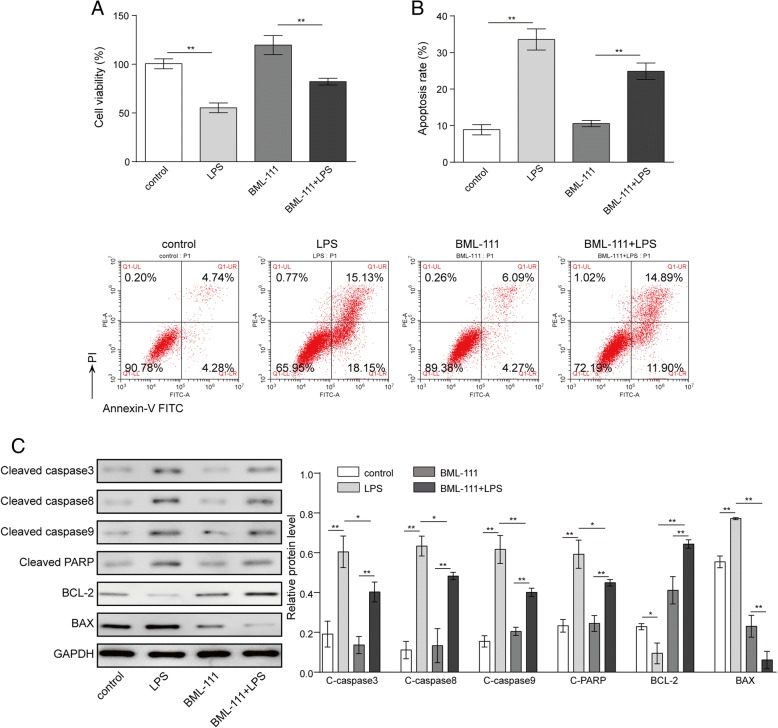
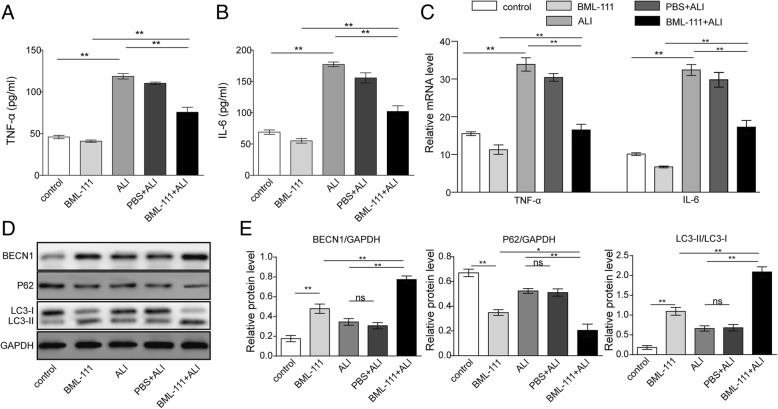
In vitro, isolated AMs were treated with lipopolysaccharide (LPS) to induce ALI. In response to BML-111 pre-treatment, apoptosis and autophagy of AMs were examined by flow cytometry, and by measuring biomarkers for each process. The potential involvement of MAPK1 and mTOR signaling pathway was analyzed. In vivo, an LPS-induced septic ALI model was established in rats and the preventative significance of BML-111 was assessed. On the cellular and molecular levels, the pro-inflammatory cytokines TNF-α and IL-6 from bronchoalveolar lavage were measured by ELISA, and the autophagy in AMs examined using Western blot.
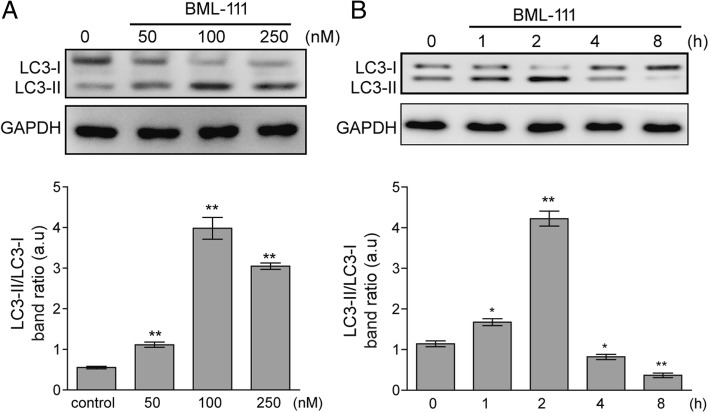
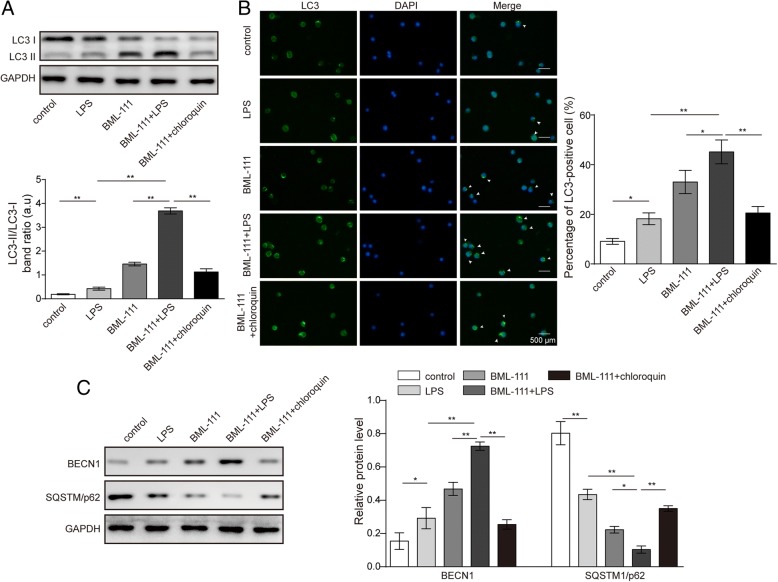
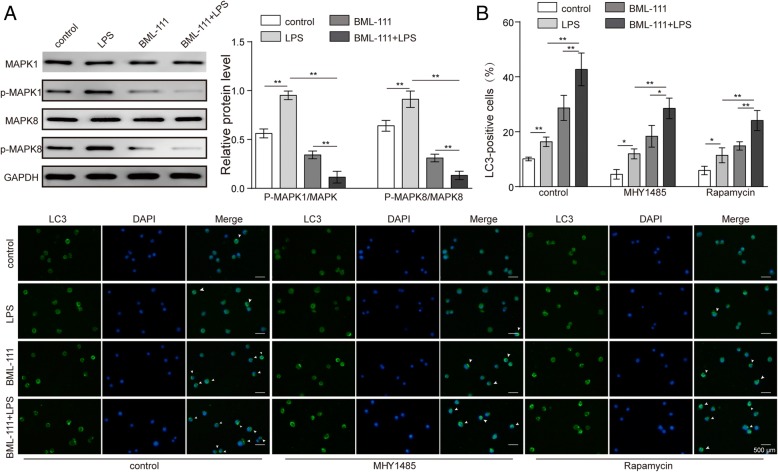
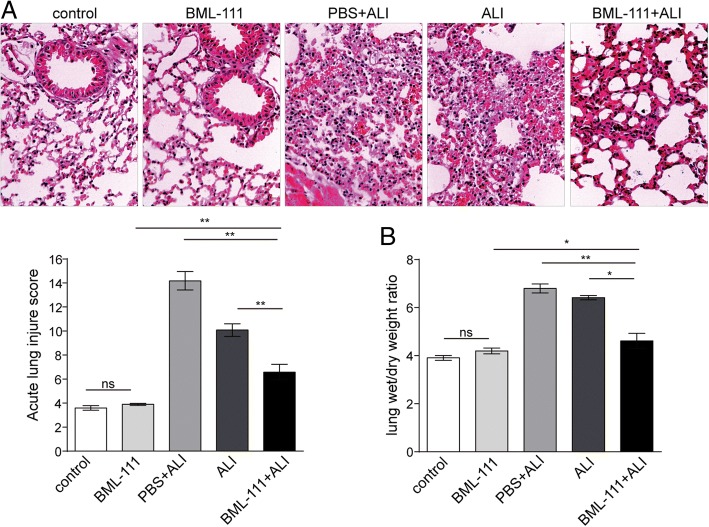
BML-111 inhibited apoptosis and induced autophagy of AMs in response to ALI inducer, LPS. The enhancement of autophagy was mediated through the suppression of MAPK1 and MAPK8 signaling, but independent of mTOR signaling. In vivo, BML-111 pre-treatment significantly alleviated LPS-induced ALI, which was associated with the reduction of apoptosis, the dampened production of pro-inflammatory cytokines in the lung tissue, as well as the increase of autophagy of AMs.
This study reveals the prophylactic significance of BML-111 in ALI and the underlying mechanism: by targeting the MAPK signaling but not mTOR pathway, BML-111 stimulates autophagy in AMs, attenuates the LPS-induced cell apoptosis, and promotes the resolution of ALI.
急性肺损伤(ALI)是一种危及生命的肺部疾病,肺泡巨噬细胞(AMs)在启动炎症反应的早期阶段和促进组织修复的晚期阶段都发挥着核心作用。在这项研究中,我们研究了脂氧素 A4 受体激动剂 BML-111 是否可以改变 AM 的表型,从而为 ALI 提供预防益处。
在体外,用脂多糖(LPS)处理分离的 AM 以诱导 ALI。在用 BML-111 预处理后,通过流式细胞术检查 AM 的细胞凋亡和自噬,并测量每个过程的生物标志物。分析 MAPK1 和 mTOR 信号通路的潜在参与。在体内,在大鼠中建立 LPS 诱导的脓毒症性 ALI 模型,并评估 BML-111 的预防作用。在细胞和分子水平上,通过 ELISA 测量支气管肺泡灌洗液中的促炎细胞因子 TNF-α和 IL-6,并使用 Western blot 检查 AM 中的自噬。
BML-111 抑制了 LPS 诱导的 AM 凋亡并诱导了其自噬。自噬的增强是通过抑制 MAPK1 和 MAPK8 信号传导介导的,但与 mTOR 信号传导无关。在体内,BML-111 预处理可显著减轻 LPS 诱导的 ALI,这与凋亡减少、肺组织中促炎细胞因子的产生减少以及 AM 自噬增加有关。
这项研究揭示了 BML-111 在 ALI 中的预防意义及其潜在机制:通过靶向 MAPK 信号通路而不是 mTOR 途径,BML-111 刺激 AM 中的自噬,减轻 LPS 诱导的细胞凋亡,并促进 ALI 的解决。