Chen Xin, Dong Dezuo, Pan Changcun, Xu Cheng, Sun Yu, Geng Yibo, Kong Lu, Xiao Xiong, Zhao Zitong, Zhou Wei, Huang Lijie, Song Yongmei, Zhang Liwei
Department of Neurosurgery, Beijing Tiantan Hospital, Capital Medical University, Tiantanxili 6, Dongcheng District, Beijing, 100050, China.
Department of Radiation Oncology, Key Laboratory of Carcinogenesis and Translational Research (Ministry of Education/Beijing), Peking University Cancer Hospital and Institute, Beijing, 100142, China.
J Cancer. 2018 Oct 31;9(23):4463-4476. doi: 10.7150/jca.26417. eCollection 2018.
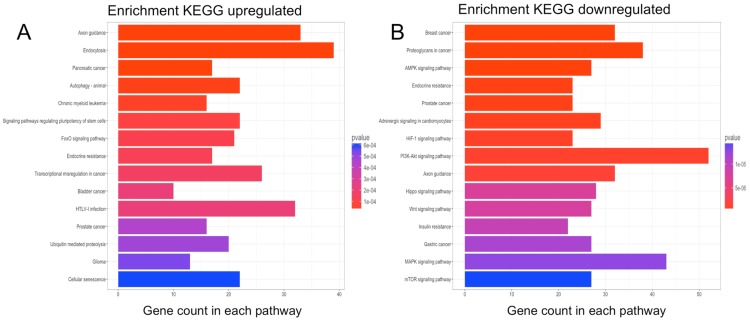
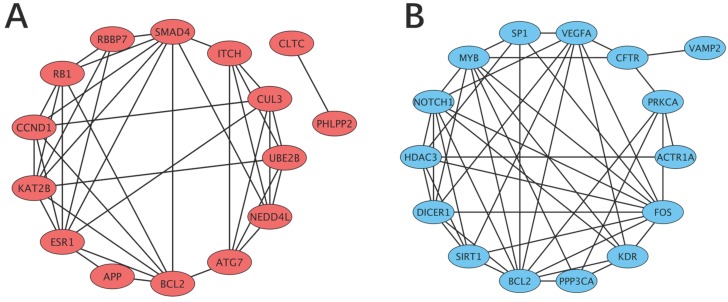
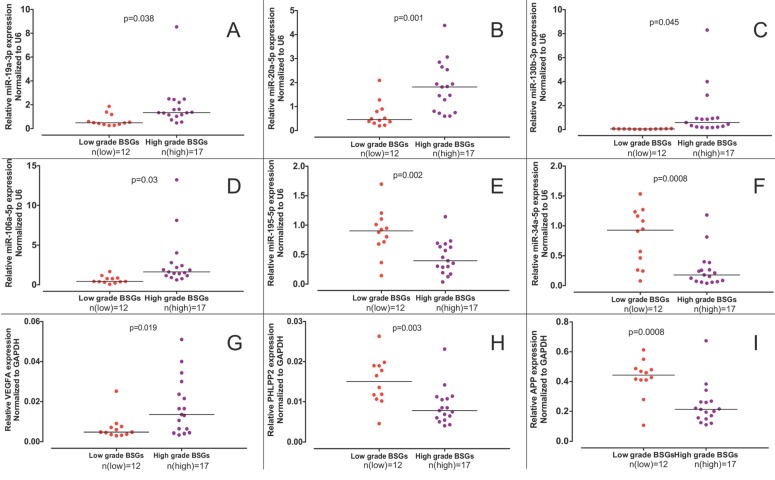
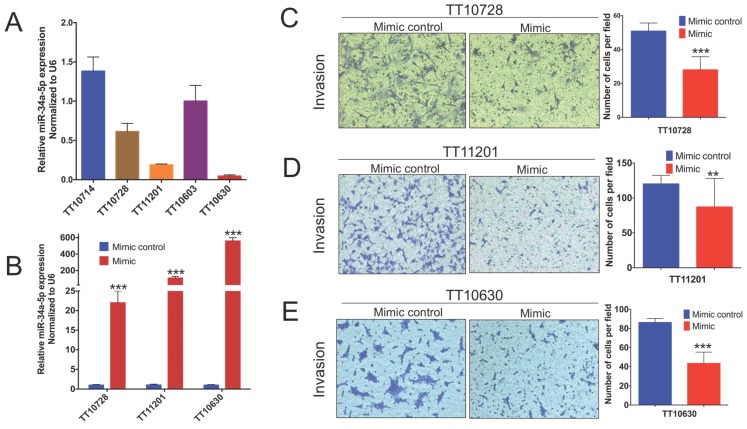
Gliomas arising in the brainstem are rare tumours that are difficult to surgically resect, and the microRNAs (miRNAs) and signalling pathways associated with brainstem gliomas (BSGs) are largely unknown. To identify grade-associated miRNAs in BSGs, a microarray analysis of 10 low-grade and 15 high-grade BSGs was performed in this study. Differentially expressed miRNAs (DE-miRNAs) were identified, and the functional DE-miRNAs were selected. The potential target genes and enriched pathways were analysed, and a target gene-associated protein-protein interaction (PPI) network was generated. Grade-associated functional DE-miRNAs were confirmed by real-time quantitative PCR. First, 28 functional DE-miRNAs, including 13 upregulated miRNAs and 15 downregulated miRNAs, were identified. Second, 2546 target genes that were involved in BSG-related pathways, such as signalling pathways regulating the pluripotency of stem cells, the AMPK signalling pathway, the HIF-1 signalling pathway, the PI3K-Akt signalling pathway, the Wnt signalling pathway and the Hippo signalling pathway, were screened. Third, PHLPP2 and VEGFA were identified as hub genes in the PPI network. Last, we found that hsa-miR-34a-5p inhibits BSG cell invasion . In summary, using integrated bioinformatics analysis, we have identified the potential target genes and pathways of grade-associated functional DE-miRNAs in BSGs, which could improve the accuracy of prognostic evaluation. Furthermore, these hub genes and pathways could be therapeutic targets for the treatment of BSGs.
脑干胶质瘤是难以手术切除的罕见肿瘤,与脑干胶质瘤(BSG)相关的微小RNA(miRNA)和信号通路在很大程度上尚不清楚。为了鉴定BSG中与分级相关的miRNA,本研究对10例低级别和15例高级别BSG进行了微阵列分析。鉴定了差异表达的miRNA(DE-miRNA),并选择了具有功能的DE-miRNA。分析了潜在的靶基因和富集的通路,并生成了与靶基因相关的蛋白质-蛋白质相互作用(PPI)网络。通过实时定量PCR对与分级相关的具有功能的DE-miRNA进行了验证。首先,鉴定了28个具有功能的DE-miRNA,包括13个上调的miRNA和15个下调的miRNA。其次,筛选出2546个参与BSG相关通路的靶基因,如调节干细胞多能性的信号通路、AMPK信号通路、HIF-1信号通路、PI3K-Akt信号通路、Wnt信号通路和Hippo信号通路。第三,PHLPP2和VEGFA被鉴定为PPI网络中的枢纽基因。最后,我们发现hsa-miR-34a-5p抑制BSG细胞侵袭。总之,通过综合生物信息学分析,我们鉴定了BSG中与分级相关的具有功能的DE-miRNA的潜在靶基因和通路,这可以提高预后评估的准确性。此外,这些枢纽基因和通路可能成为治疗BSG的治疗靶点。