Center for Sleep Science and Medicine, Stanford University, Stanford, 94304, CA, USA.
Department of Electrical Engineering, Technical University of Denmark, Kongens Lyngby, 2800, Denmark.
Nat Commun. 2018 Dec 6;9(1):5229. doi: 10.1038/s41467-018-07229-3.
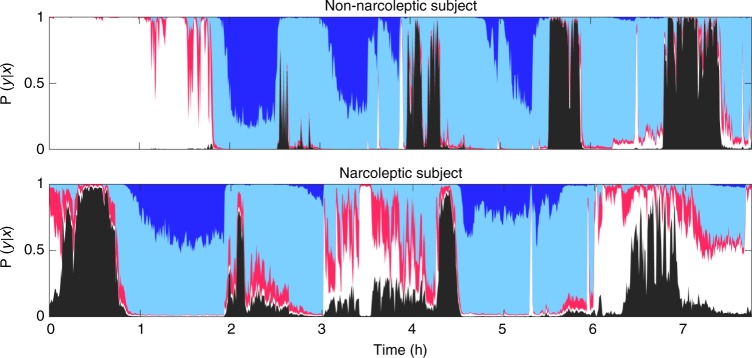
Analysis of sleep for the diagnosis of sleep disorders such as Type-1 Narcolepsy (T1N) currently requires visual inspection of polysomnography records by trained scoring technicians. Here, we used neural networks in approximately 3,000 normal and abnormal sleep recordings to automate sleep stage scoring, producing a hypnodensity graph-a probability distribution conveying more information than classical hypnograms. Accuracy of sleep stage scoring was validated in 70 subjects assessed by six scorers. The best model performed better than any individual scorer (87% versus consensus). It also reliably scores sleep down to 5 s instead of 30 s scoring epochs. A T1N marker based on unusual sleep stage overlaps achieved a specificity of 96% and a sensitivity of 91%, validated in independent datasets. Addition of HLA-DQB1*06:02 typing increased specificity to 99%. Our method can reduce time spent in sleep clinics and automates T1N diagnosis. It also opens the possibility of diagnosing T1N using home sleep studies.
目前,分析睡眠以诊断睡眠障碍,如 1 型发作性睡病(T1N),需要经过训练的评分技术人员对多导睡眠图记录进行视觉检查。在这里,我们使用神经网络对大约 3000 份正常和异常睡眠记录进行自动睡眠分期评分,生成了一个催眠密度图——一种比经典催眠图传达更多信息的概率分布。在 70 名受试者中,通过 6 名评分员对睡眠分期评分的准确性进行了验证。表现最好的模型优于任何单个评分员(87%比共识)。它还可以可靠地对睡眠进行评分,评分间隔为 5 秒而不是 30 秒。一种基于异常睡眠阶段重叠的 T1N 标志物的特异性为 96%,敏感性为 91%,在独立数据集上得到验证。添加 HLA-DQB1*06:02 分型可将特异性提高到 99%。我们的方法可以减少睡眠诊所的时间,并实现 T1N 的自动化诊断。它还为使用家庭睡眠研究诊断 T1N 开辟了可能性。