Norling B, Westermark G T, Westermark P
Department of Medical, University of Uppsala, Sweden.
Clin Exp Immunol. 1988 Aug;73(2):333-7.
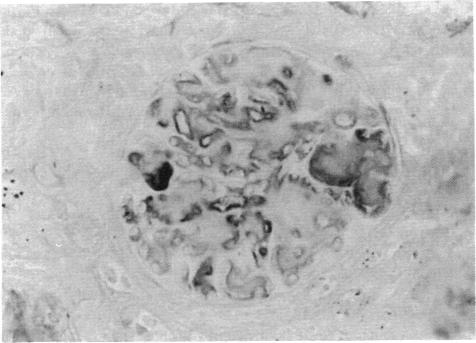
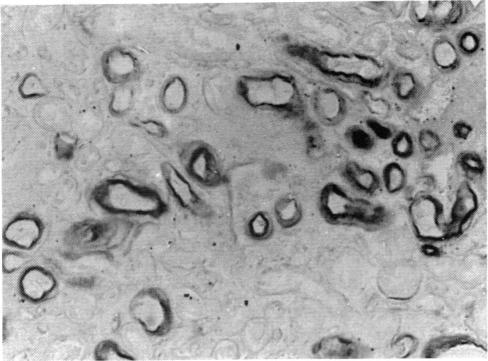
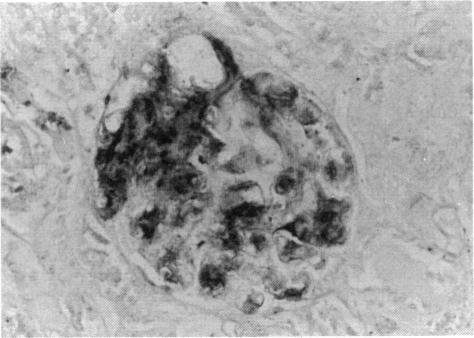
The distribution of proteoglycans in kidneys from patients with secondary (AA) systemic amyloidosis was investigated. Antisera reacting with the protein cores of chondroitin sulphate proteoglycan (CSPG), dermatan sulphate proteoglycan (DSPG) and heparan sulphate proteoglycan (HSPG) were used in conjunction with the peroxidase-antiperoxidase (PAP) method. HSPG was the only proteoglycan found to be specifically localized to the amyloid deposits. The staining was most intense on the endothelial side of the deposits in both the glomeruli and in the vessel walls. No staining was observed after absorption of the HSPG antiserum with a fraction of the amyloid preparations, corresponding in size to that reported for glomerular HSPG. The possible role of HSPG and endothelial cells in the pathogenesis of the amyloid deposits is discussed.
对继发性(AA型)系统性淀粉样变性患者肾脏中蛋白聚糖的分布进行了研究。使用了与硫酸软骨素蛋白聚糖(CSPG)、硫酸皮肤素蛋白聚糖(DSPG)和硫酸乙酰肝素蛋白聚糖(HSPG)的蛋白核心发生反应的抗血清,并结合过氧化物酶-抗过氧化物酶(PAP)方法。发现HSPG是唯一特异性定位于淀粉样沉积物的蛋白聚糖。在肾小球和血管壁沉积物的内皮侧染色最为强烈。用一部分淀粉样制剂吸收HSPG抗血清后未观察到染色,该淀粉样制剂的大小与报道的肾小球HSPG的大小相对应。讨论了HSPG和内皮细胞在淀粉样沉积物发病机制中的可能作用。