Chen Zhihui, Cui Ji, Dai Weigang, Yang Hong, He Yulong, Song Xinming
Department of Gastrointestinal Surgery Centre, The First Affiliated Hospital, Sun Yat-sen University, Guangzhou 510080, China,
Department of Operating Room, The First Affiliated Hospital, Sun Yat-sen University, Guangzhou 510080, China.
Cancer Manag Res. 2018 Nov 14;10:5667-5676. doi: 10.2147/CMAR.S177430. eCollection 2018.
No studies have been published on the relationship between marital status and outcomes in small intestinal cancers. The present study was conducted to explore the influence of marital status on small intestinal adenocarcinoma survival based on the Surveillance, Epidemiology, and End Results (SEER) database.
Data from eligible patients diagnosed with small intestinal adenocarcinoma between 2004 and 2015 were extracted from the SEER database. Patients were categorized into married group (including common law) and unmarried group (including single [never married], widowed, divorced, separated, and unmarried or domestic partner). The primary endpoints were 5-year overall survival (OS) and 5-year cancer-specific survival (CSS). A survival curve was generated by the Kaplan-Meier method, and the survival rate differences were estimated by a log-rank test. A multivariate Cox proportional hazard model was used to evaluate the independent risk factors for survival.
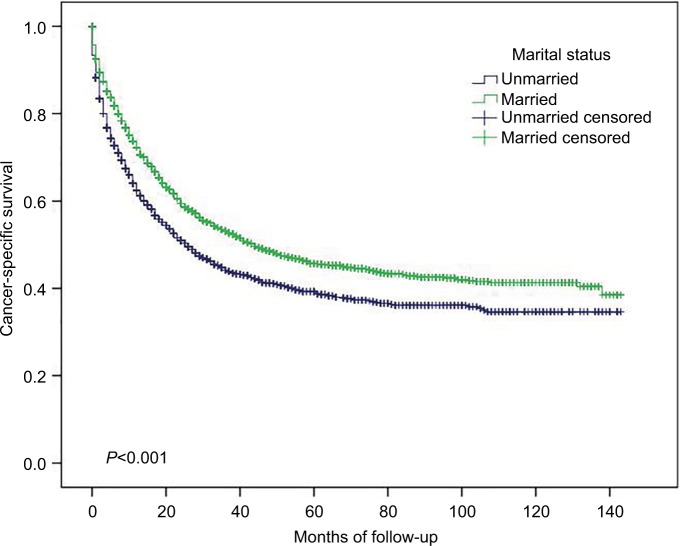
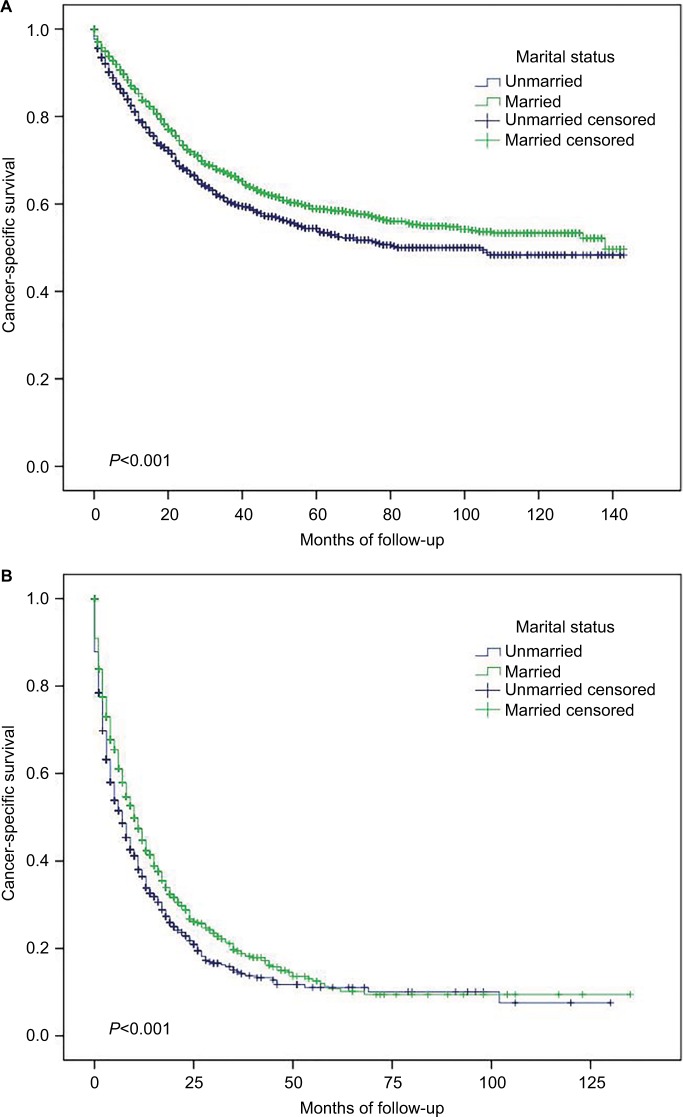
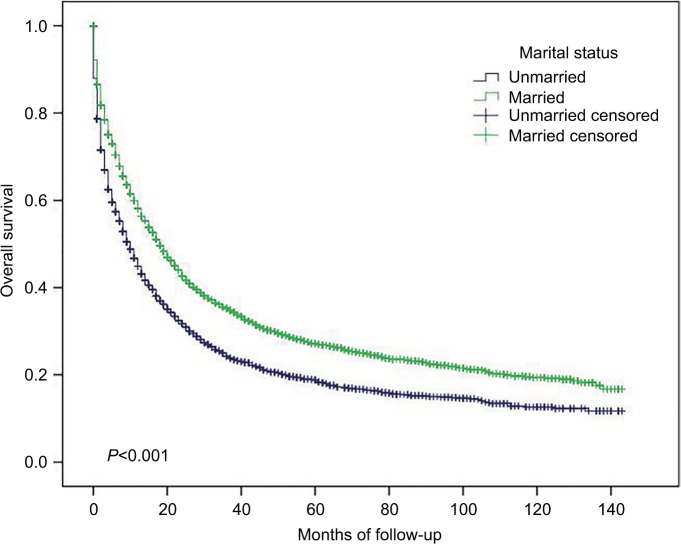
A total of 6,747 small intestinal adenocarcinoma patients were enrolled, including 3,862 married and 2,885 unmarried patients. The 5-year OS and 5-year CSS were significantly greater in married patients than in unmarried patients (27.1 vs 18.8% for OS and 45.7 vs 39.3% for CSS, both <0.001). After adjusting for age, insurance status, tumor primary site, TNM stage, tumor grade, tumor histology, and surgery, the multivariate Cox proportional hazards model showed that marriage is an independent protective factor for OS (HR =0.789, 95% CI: 0.745-0.836, <0.001) and CSS (HR =0.794, 95% CI: 0.736-0.857, <0.001).
Married small intestinal adenocarcinoma patients have better OS and CSS than unmarried patients. Psychological and economic supports from the spouses of married patients may contribute to improvements in survival.
目前尚无关于小肠癌患者婚姻状况与预后关系的研究发表。本研究基于监测、流行病学和最终结果(SEER)数据库,探讨婚姻状况对小肠腺癌患者生存的影响。
从SEER数据库中提取2004年至2015年间确诊为小肠腺癌的符合条件患者的数据。患者分为已婚组(包括事实婚姻)和未婚组(包括单身[从未结婚]、丧偶、离婚、分居以及未婚或同居伴侣)。主要终点为5年总生存率(OS)和5年癌症特异性生存率(CSS)。采用Kaplan-Meier法生成生存曲线,通过对数秩检验估计生存率差异。使用多变量Cox比例风险模型评估生存的独立危险因素。
共纳入6747例小肠腺癌患者,其中已婚患者3862例,未婚患者2885例。已婚患者的5年OS和5年CSS显著高于未婚患者(OS分别为27.1%和18.8%,CSS分别为45.7%和39.3%,均P<0.001)。在调整年龄、保险状况、肿瘤原发部位、TNM分期、肿瘤分级、肿瘤组织学类型和手术等因素后,多变量Cox比例风险模型显示,婚姻是OS(HR=0.789,95%CI:0.745-0.836,P<0.001)和CSS(HR=0.794,95%CI:0.736-0.857,P<0.001)的独立保护因素。
已婚小肠腺癌患者的OS和CSS优于未婚患者。已婚患者配偶给予的心理和经济支持可能有助于提高生存率。