Division of Infectious Diseases, Department of Internal Medicine, Korea University College of Medicine, Seoul, Korea.
Department of Hospital Infection Control, Korea University Ansan Hospital, Ansan, Korea.
J Korean Med Sci. 2018 Nov 19;33(50):e321. doi: 10.3346/jkms.2018.33.e321. eCollection 2018 Dec 10.
Pertussis is highly contagious respiratory disease. Healthcare workers (HCWs) can be an important mediator of the disease. A seroprevalence of pertussis was investigated in HCWs to determine the immune status against pertussis and to detect the unidentified pertussis.
This study was conducted for HCWs at a hospital located in Korea in 2011. After obtaining written informed consent for HCWs voluntarily participating in the study, 10 mL of blood was collected from each subject. Demographic and medical data were collected using questionnaire. Data on the underlying disease and vaccination history were reviewed again through medical records. The presence of anti-pertussis toxin (anti-PT) immunoglobulin G (IgG), and immunoglobulin A (IgA) was detected by quantitative analysis using a commercially available ELISA kit (EUROIMMUN, Lübeck, Germany).
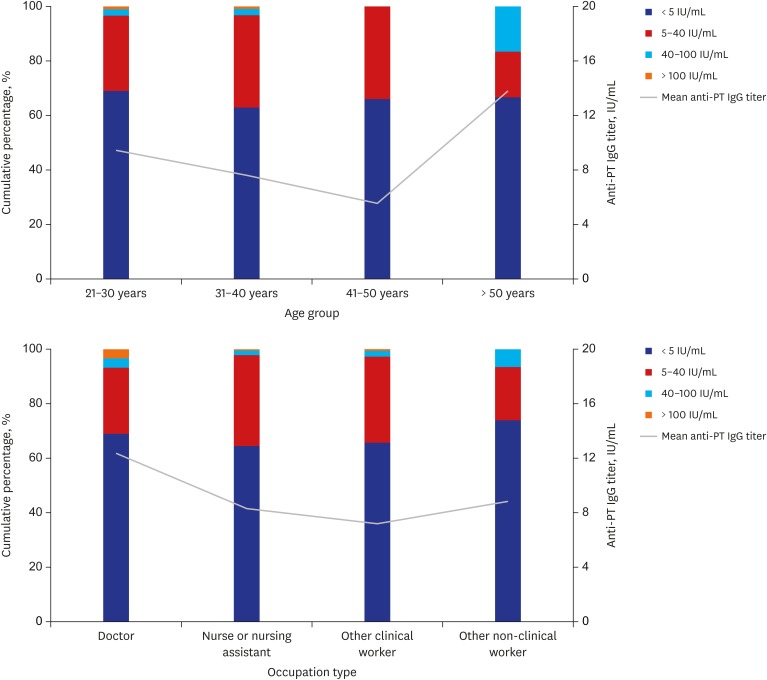
A total of 412 HCW participated in the study. Among them, 14 were excluded due to the inadequate sample amount or medical history not secured. Of the 398 HCWs analyzed, 16.6% (66/398) were men and the mean age was 33.82 ± 9.10 years (range, 21-67). The mean anti-PT IgG titer was 8.32 ± 20.40 IU/mL (range, 0.4-287.5 IU/mL). The overall seroprevalence (rate of anti-PT IgG antibody [Ab] titer > 5 IU/mL) was 33.7%. Three (0.8%) HCWs had the Ab level > 100 IU/mL indicated acute infection. There was no statistically significant difference in the seroprevalence and mean titer of anti-PT IgG Ab according to age group, type of occupation, patient-facing position, or working in the pediatric department.
The seroprevalence of pertussis of the HCWs of a university hospital in Korea was low, and there were some unrecognized acute infections. Therefore, booster immunization of pertussis to HCWs should be actively considered.
百日咳是一种高度传染性的呼吸道疾病。医疗保健工作者(HCWs)可能是该疾病的重要传播媒介。本研究旨在调查 HCWs 中的百日咳血清流行率,以确定针对百日咳的免疫状态并发现未被识别的百日咳感染。
本研究于 2011 年在韩国的一家医院进行,对自愿参与研究的 HCWs 采集 10ml 血样。通过问卷收集人口统计学和医疗数据,并通过病历再次审查潜在疾病和疫苗接种史。使用商业上可获得的 ELISA 试剂盒(EUROIMMUN,吕贝克,德国)通过定量分析检测抗百日咳毒素(anti-PT)免疫球蛋白 G(IgG)和免疫球蛋白 A(IgA)的存在。
共有 412 名 HCW 参与了研究。其中,由于样本量不足或未获取到医疗史,14 名被排除在外。在分析的 398 名 HCWs 中,16.6%(66/398)为男性,平均年龄为 33.82±9.10 岁(范围,21-67)。平均抗-PT IgG 滴度为 8.32±20.40IU/mL(范围,0.4-287.5IU/mL)。总体血清流行率(抗-PT IgG 抗体[Ab]滴度>5IU/mL 的比率)为 33.7%。有 3 名(0.8%)HCWs 的 Ab 水平>100IU/mL,提示急性感染。按年龄组、职业类型、面向患者的职位或在儿科工作划分,抗-PT IgG Ab 的血清流行率和平均滴度无统计学差异。
韩国一所大学医院 HCWs 的百日咳血清流行率较低,存在一些未被识别的急性感染。因此,应积极考虑为 HCWs 进行百日咳加强免疫接种。