Laboratorio Nazionale CIB (LNCIB), AREA Science Park, Trieste, Italy.
Dipartimento di Scienze della Vita, Università degli Studi di Trieste, Trieste, Italy.
Cell Death Differ. 2019 Jan;26(2):199-212. doi: 10.1038/s41418-018-0246-9. Epub 2018 Dec 11.
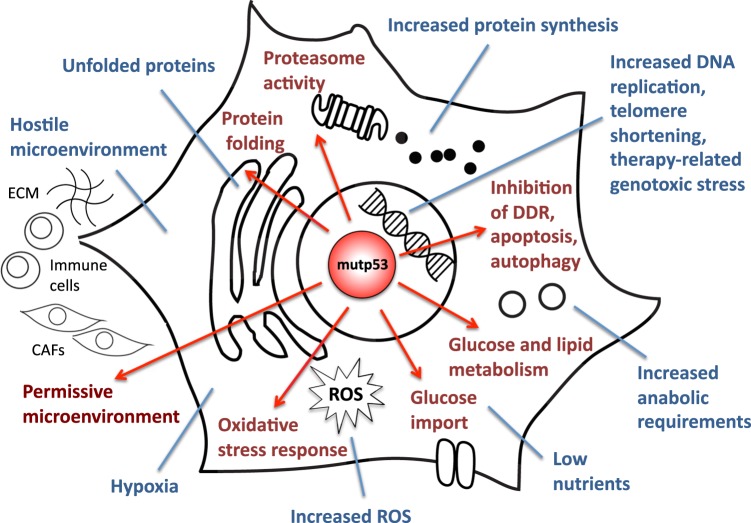
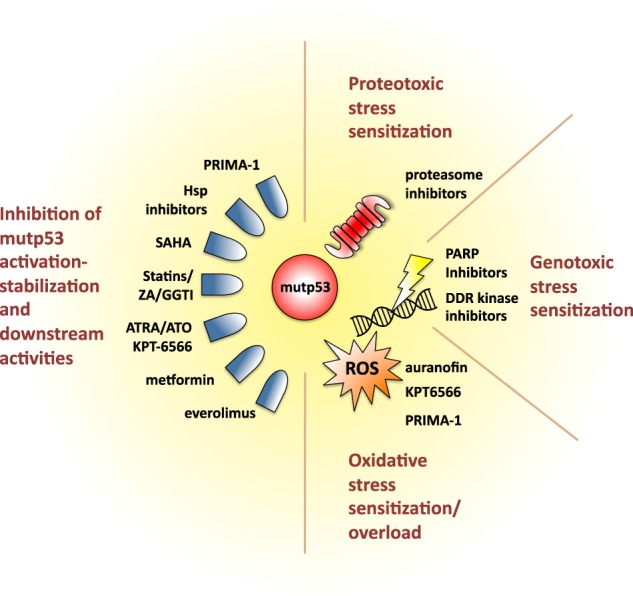
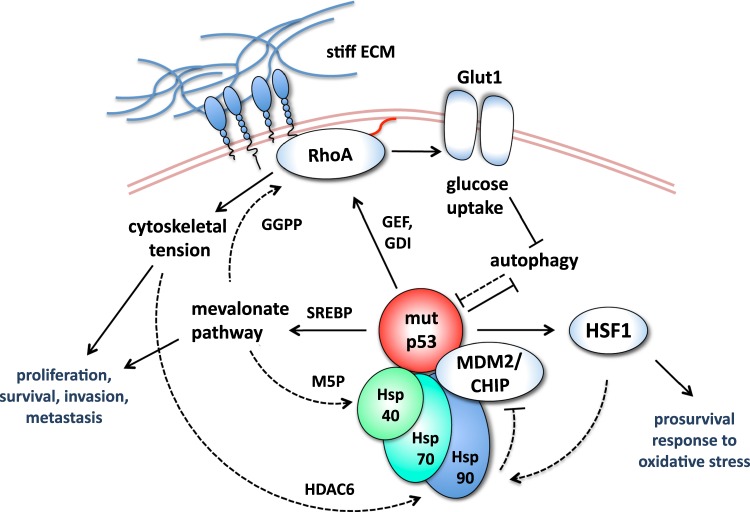
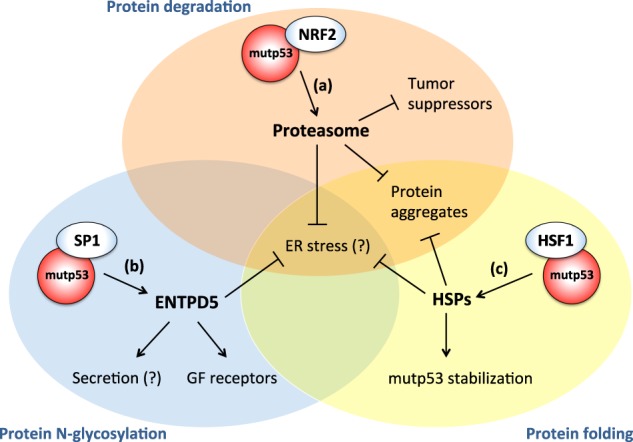
Forty years of research have established that the p53 tumor suppressor provides a major barrier to neoplastic transformation and tumor progression by its unique ability to act as an extremely sensitive collector of stress inputs, and to coordinate a complex framework of diverse effector pathways and processes that protect cellular homeostasis and genome stability. Missense mutations in the TP53 gene are extremely widespread in human cancers and give rise to mutant p53 proteins that lose tumor suppressive activities, and some of which exert trans-dominant repression over the wild-type counterpart. Cancer cells acquire selective advantages by retaining mutant forms of the protein, which radically subvert the nature of the p53 pathway by promoting invasion, metastasis and chemoresistance. In this review, we consider available evidence suggesting that mutant p53 proteins can favor cancer cell survival and tumor progression by acting as homeostatic factors that sense and protect cancer cells from transformation-related stress stimuli, including DNA lesions, oxidative and proteotoxic stress, metabolic inbalance, interaction with the tumor microenvironment, and the immune system. These activities of mutant p53 may explain cancer cell addiction to this particular oncogene, and their study may disclose tumor vulnerabilities and synthetic lethalities that could be exploited for hitting tumors bearing missense TP53 mutations.
四十年的研究已经确立,p53 肿瘤抑制因子通过其作为压力输入的极其敏感的收集器的独特能力,以及协调保护细胞内稳态和基因组稳定性的多种效应途径和过程的复杂框架,为肿瘤的发生和肿瘤的进展提供了主要的障碍。TP53 基因中的错义突变在人类癌症中极其普遍,并产生失去肿瘤抑制活性的突变 p53 蛋白,其中一些对野生型蛋白具有转录显性抑制作用。癌细胞通过保留突变形式的蛋白获得选择性优势,通过促进侵袭、转移和化疗耐药性,从根本上颠覆了 p53 通路的性质。在这篇综述中,我们考虑了现有的证据,这些证据表明,突变型 p53 蛋白可以通过充当感应和保护癌细胞免受与转化相关的应激刺激的稳态因子,包括 DNA 损伤、氧化和蛋白毒性应激、代谢失衡、与肿瘤微环境的相互作用以及免疫系统,从而有利于癌细胞的存活和肿瘤的进展。这些突变型 p53 的活性可以解释癌细胞对这种特定致癌基因的依赖性,它们的研究可能会揭示肿瘤的脆弱性和合成致死性,这些脆弱性和合成致死性可以被利用来攻击携带错义 TP53 突变的肿瘤。