Magalhães-Barbosa Maria Clara de, Prata-Barbosa Arnaldo, Raymundo Carlos Eduardo, Cunha Antonio José Ledo Alves da, Lopes Claudia de Souza
Instituto D'Or de Pesquisa e Ensino, Rio de Janeiro, RJ, Brasil.
Universidade Federal do Rio de Janeiro, Rio de Janeiro, RJ, Brasil.
Rev Paul Pediatr. 2018 Oct-Dec;36(4):398-406. doi: 10.1590/1984-0462/;2018;36;4;00017.
To assess the validity and reliability of a triage system for pediatric emergency care (CLARIPED) developed in Brazil.
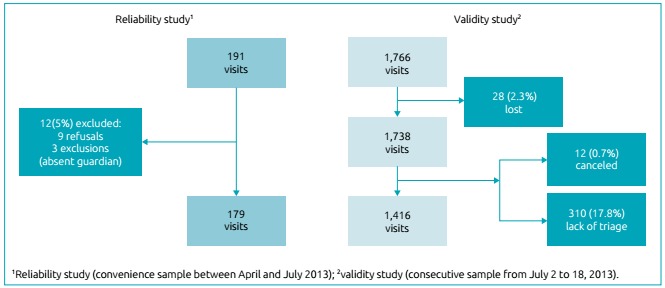
Validity phase: prospective observational study with children aged 0 to 15 years who consecutively visited the pediatric emergency department (ED) of a tertiary hospital from July 2 to 18, 2013. We evaluated the association of urgency levels with clinical outcomes (resource utilization, ED admission rate, hospitalization rate, and ED length of stay); and compared the CLARIPED performance to a reference standard. Inter-rater reliability phase: a convenience sample of patients who visited the pediatric ED between April and July 2013 was consecutively and independently double triaged by two nurses, and the quadratic weighted kappa was estimated.
In the validity phase, the distribution of urgency levels in 1,416 visits was the following: 0.0% red (emergency); 5.9% orange (high urgency); 40.5% yellow (urgency); 50.6% green (low urgency); and 3.0% blue (no urgency). The percentage of patients who used two or more resources decreased from the orange level to the yellow, green, and blue levels (81%, 49%, 22%, and 2%, respectively, p<0.0001), as did the ED admission rate, ED length of stay, and hospitalization rate. The sensitivity to identify patients with high urgency level was 0.89 (confidence interval of 95% [95%CI] 0.78-0.95), and the undertriage rate was 7.4%. The inter-rater reliability in 191patients classified by two nurses was substantial (kw2=0.75; 95%CI 0.74-0.79).
The CLARIPED system showed good validity and substantial reliability for triage in a pediatric emergency department.
评估巴西开发的儿科急诊护理分诊系统(CLARIPED)的有效性和可靠性。
有效性阶段:对2013年7月2日至18日连续就诊于一家三级医院儿科急诊科的0至15岁儿童进行前瞻性观察研究。我们评估了紧急程度与临床结局(资源利用、急诊科入院率、住院率和急诊科住院时间)之间的关联;并将CLARIPED的表现与参考标准进行比较。评分者间信度阶段:对2013年4月至7月间就诊于儿科急诊科的患者进行便利抽样,由两名护士对其进行连续且独立的双重分诊,并估计二次加权kappa值。
在有效性阶段,1416次就诊的紧急程度分布如下:0.0%为红色(紧急);5.9%为橙色(高度紧急);40.5%为黄色(紧急);50.6%为绿色(低紧急);3.0%为蓝色(无紧急)。使用两种或更多资源的患者百分比从橙色级别降至黄色、绿色和蓝色级别(分别为81%、49%、22%和2%,p<0.0001),急诊科入院率、急诊科住院时间和住院率也呈下降趋势。识别高度紧急患者的敏感度为0.89(95%置信区间[95%CI]为0.78 - 0.95),分诊不足率为7.4%。两名护士对191名患者进行分类的评分者间信度较高(kw2 = 0.75;95%CI为0.74 - 0.79)。
CLARIPED系统在儿科急诊科分诊中显示出良好的有效性和较高的可靠性。