Petré Henrik, Wernstål Fredrik, Mattsson C Mikael
Åstrand Laboratory of Work Physiology, The Swedish School of Sport and Health Sciences, Stockholm, Sweden.
Department of Physiology and Pharmacology, Karolinska Institutet, SE-171 77, Stockholm, Sweden.
Sports Med Open. 2018 Dec 13;4(1):55. doi: 10.1186/s40798-018-0169-5.
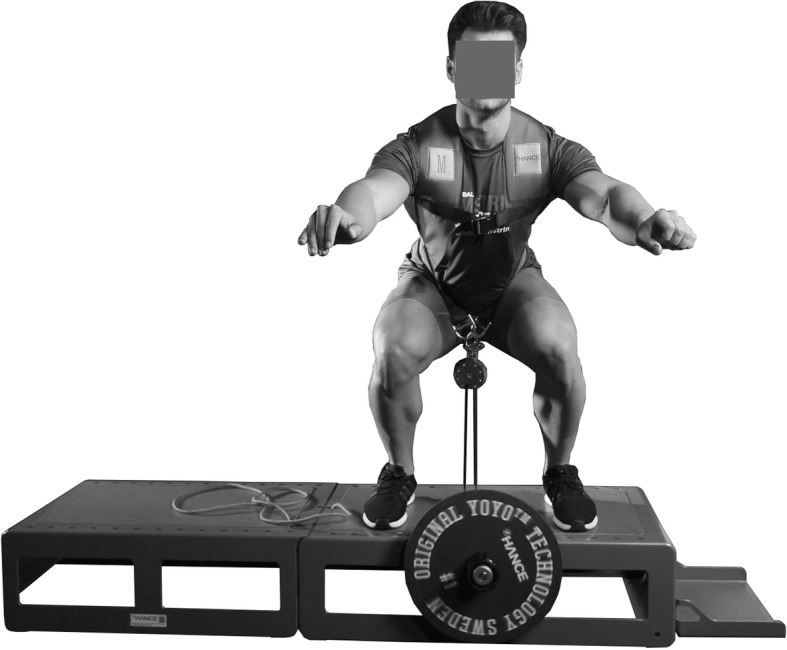
Strength and power development are abilities important for athletic performance in many sports. Generally, resistance training based on gravity is used to improve these qualities. Flywheel training instead utilizes kinetic energy transferred to a flywheel. This allows for eccentric overload and variable resistance throughout the movement. The aim of this review was to identify the effects of flywheel training on multiple strength-related variables affecting athletic performance. The meta-analysis investigates the effects on (1) muscle growth (cross-sectional area (CSA) and volume/mass), (2) maximum dynamic strength, (3) development of power, (4) development of horizontal movement, and (5) development of vertical movement.
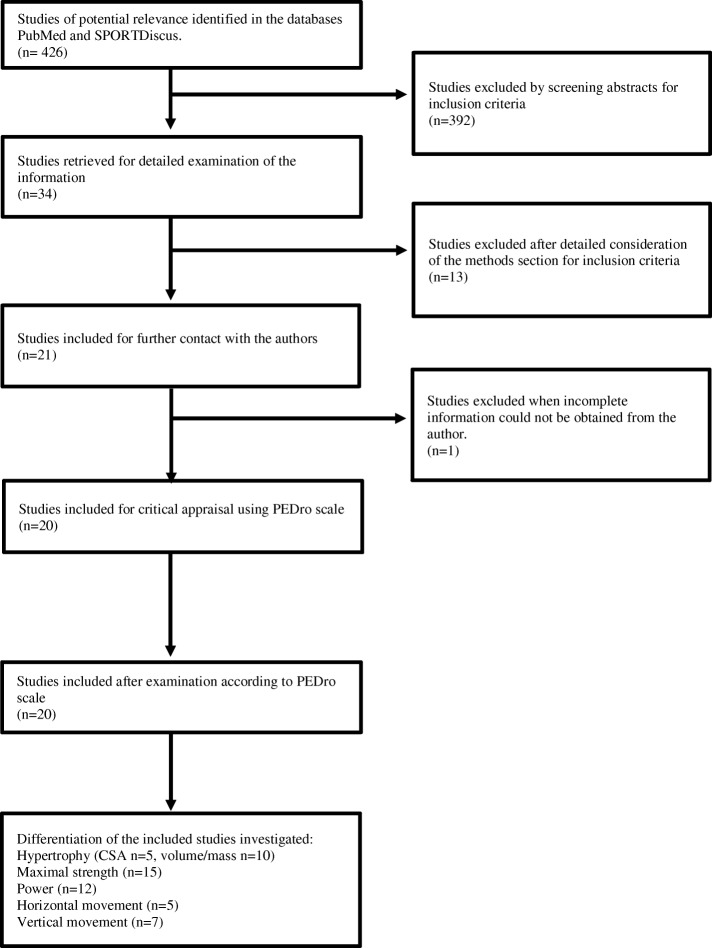
The meta-analysis includes 20 experimental studies that met the inclusion criteria. The quality of included studies was ranked according to the PEDro scale. Possible bias was identified in Funnel plot analyses. To enable the compilation of all results analyses, the random effect model was carried out using the software Review Manager Version 5.3 and presented with Forest plots.
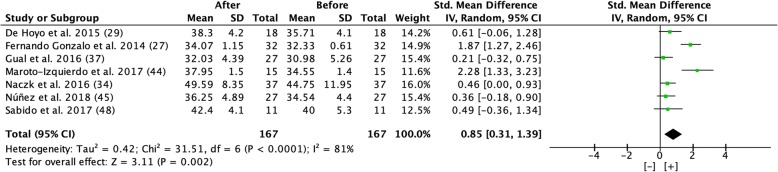
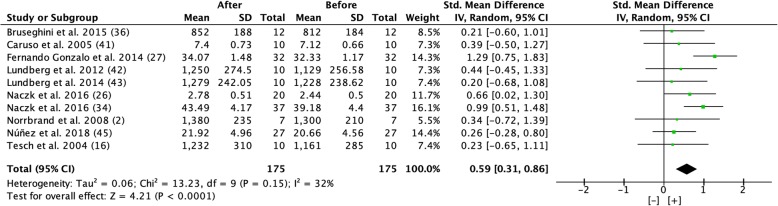
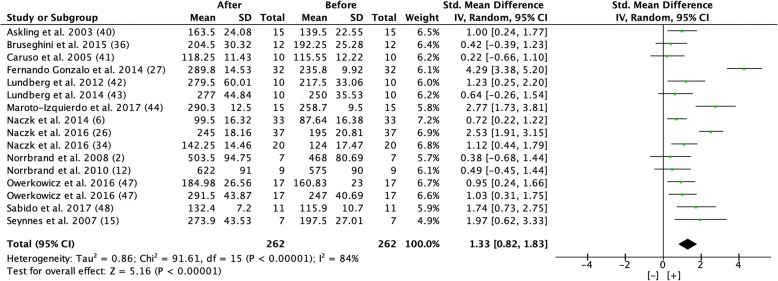
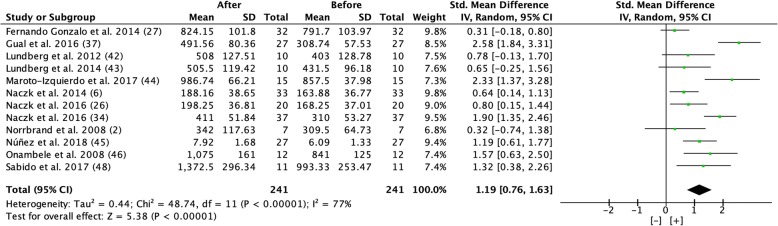
Flywheel training for a period of 4-24 weeks shows statistically significant increases in all strength aspects. Effect sizes were for hypertrophy, CSA 0.59; volume/mass 0.59; maximum strength 1.33; power 1.19; horizontal 1.01 and vertical movement 0.85. The evidence is particularly strong for beneficial effects from flywheel training in the development of maximal strength and power in trained younger individuals, and utilization of this training modality in shorter more intensive blocks.
Flywheel training is an effective method for improving several aspects of strength and power with importance for sports performance.
力量和爆发力的发展是许多运动项目中对运动表现至关重要的能力。一般来说,基于重力的阻力训练用于提高这些素质。而飞轮训练则利用传递到飞轮的动能。这允许在整个运动过程中实现离心过载和可变阻力。本综述的目的是确定飞轮训练对影响运动表现的多个与力量相关变量的影响。荟萃分析调查了对以下方面的影响:(1)肌肉生长(横截面积(CSA)和体积/质量),(2)最大动态力量,(3)爆发力发展,(4)水平运动发展,以及(5)垂直运动发展。
荟萃分析包括20项符合纳入标准的实验研究。纳入研究的质量根据PEDro量表进行排名。在漏斗图分析中识别可能的偏倚。为了能够汇总所有结果分析,使用Review Manager 5.3版软件进行随机效应模型分析,并以森林图呈现。
为期4 - 24周的飞轮训练在所有力量方面均显示出统计学上的显著增加。效应大小分别为:肥大,CSA为0.59;体积/质量为0.59;最大力量为1.33;爆发力为1.19;水平运动为1.01,垂直运动为0.85。对于飞轮训练对训练有素的年轻个体最大力量和爆发力发展的有益影响,以及在更短、更密集的训练阶段使用这种训练方式的证据尤为充分。
飞轮训练是一种有效的方法,可改善力量和爆发力的多个方面,对运动表现具有重要意义。