Department of Oncological and Laparoscopic Surgery, The First Affiliated Hospital of Harbin Medical University, Harbin, China 150001.
Environ Microbiol. 2019 Feb;21(2):772-783. doi: 10.1111/1462-2920.14498. Epub 2018 Dec 19.
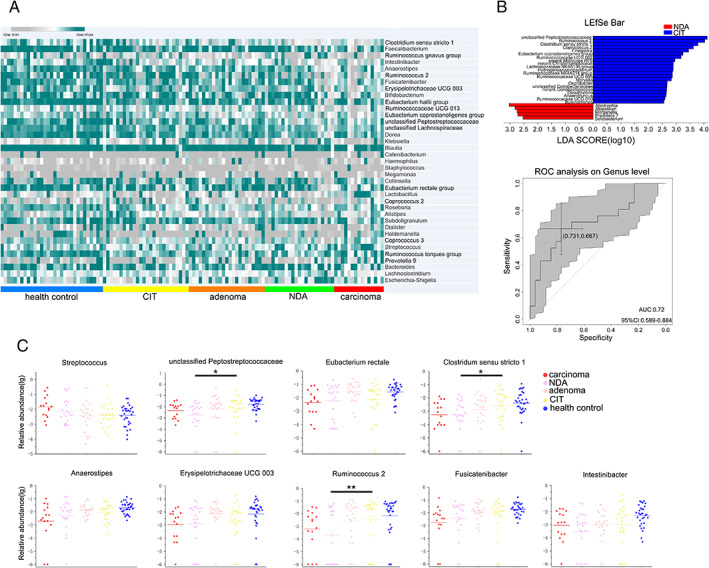
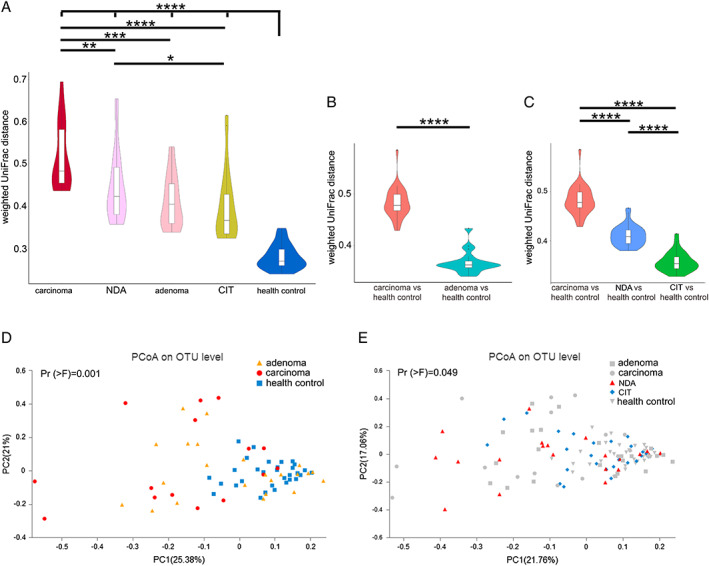
Colorectal cancer (CRC) is a common disease worldwide that is strongly associated with the gut microbiota. However, little is known regarding the gut microbiota after surgical treatment. 16S rRNA gene sequencing was used to evaluate differences in gut microbiota among colorectal adenoma patients, CRC patients, CRC postoperative patients and healthy controls by comparing gut microbiota diversity, overall composition and taxonomic signature abundance. The gut microbiota of CRC patients, adenoma patients and healthy controls developed in accordance with the adenoma-carcinoma sequence, with impressive shifts in the gut microbiota before or during the development of CRC. The gut microbiota of postoperative patients and CRC patients differed significantly. Subdividing CRC postoperative patients according to the presence or absence of newly developed adenoma which based on the colonoscopy findings revealed that the gut microbiota of newly developed adenoma patients differed significantly from that of clean intestine patients and was more similar to the gut microbiota of carcinoma patients than to the gut microbiota of healthy controls. The alterations of the gut microbiota between the two groups of postoperative patients corresponded to CRC prognosis. More importantly, we used the different gut microbiota as biomarkers to distinguish postoperative patients with or without newly developed adenoma, achieving an AUC value of 0.72. These insights on the changes in the gut microbiota of CRC patients after surgical treatment may allow the use of the microbiota as non-invasive biomarkers for the diagnosis of newly developed adenomas and to help prevent cancer recurrence in postoperative patients.
结直肠癌(CRC)是一种在全球范围内较为常见的疾病,与肠道微生物群有密切关系。然而,对于手术后肠道微生物群的变化,我们知之甚少。本研究通过比较结直肠腺瘤患者、CRC 患者、CRC 术后患者和健康对照组的肠道微生物多样性、总体组成和分类特征丰度,使用 16S rRNA 基因测序评估了肠道微生物群的差异。CRC 患者、腺瘤患者和健康对照组的肠道微生物群遵循腺瘤-癌序列发展,在 CRC 发生或发展之前或期间,肠道微生物群发生了显著变化。术后患者和 CRC 患者的肠道微生物群存在显著差异。根据结肠镜检查结果将 CRC 术后患者分为新发生腺瘤组和无新发生腺瘤组,结果表明新发生腺瘤患者的肠道微生物群与清洁肠患者显著不同,与癌患者的肠道微生物群更相似,而与健康对照组的肠道微生物群不同。两组术后患者肠道微生物群的变化与 CRC 预后相关。更重要的是,我们使用不同的肠道微生物群作为生物标志物来区分有无新发生腺瘤的术后患者,获得了 0.72 的 AUC 值。这些关于 CRC 患者手术后肠道微生物群变化的见解可能使我们能够将微生物群用作新发生腺瘤的非侵入性生物标志物,并有助于预防术后患者癌症复发。