Darmani Homa, Tawalbeh Khitam H, Al-Hiyasat Ahmad S, Al-Akhras Mohammad-Ali
Department of Applied Biology, Faculty of Faculty of Science and Arts, Jordan University of Science and Technology , Irbid , Jordan.
Department of Biology, College of Medicine, King Saud bin Abdulaziz University for Health Sciences , Riyadh , Saudi Arabia.
Pol J Microbiol. 2018;67(4):455-462. doi: 10.21307/pjm-2018-053.
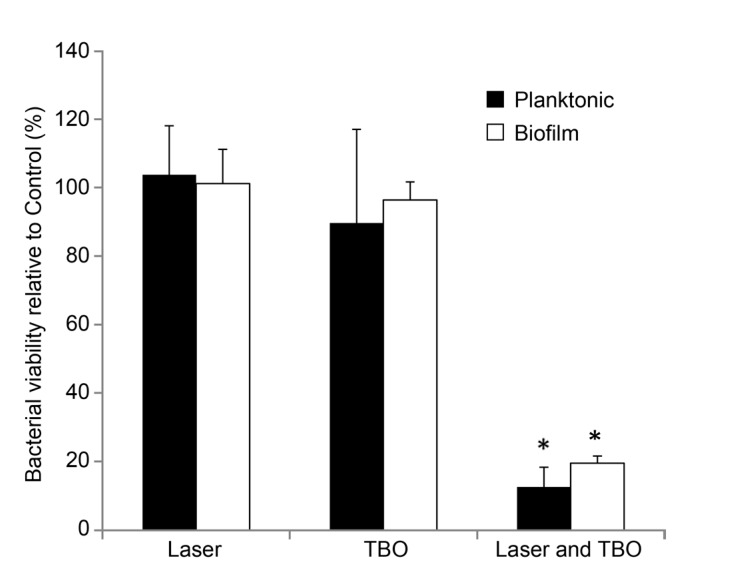
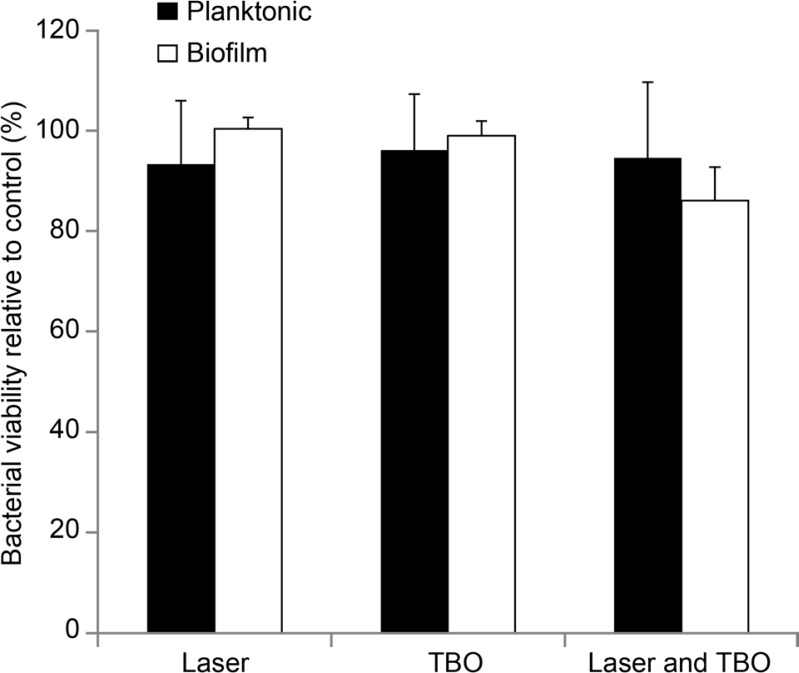
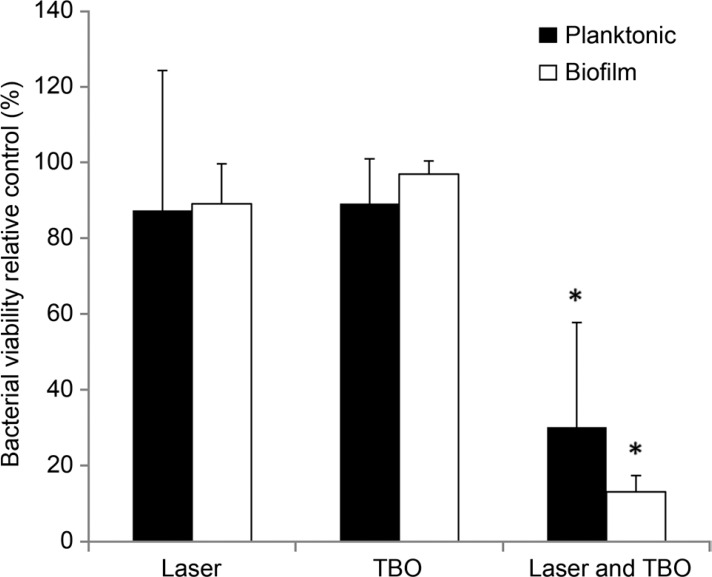
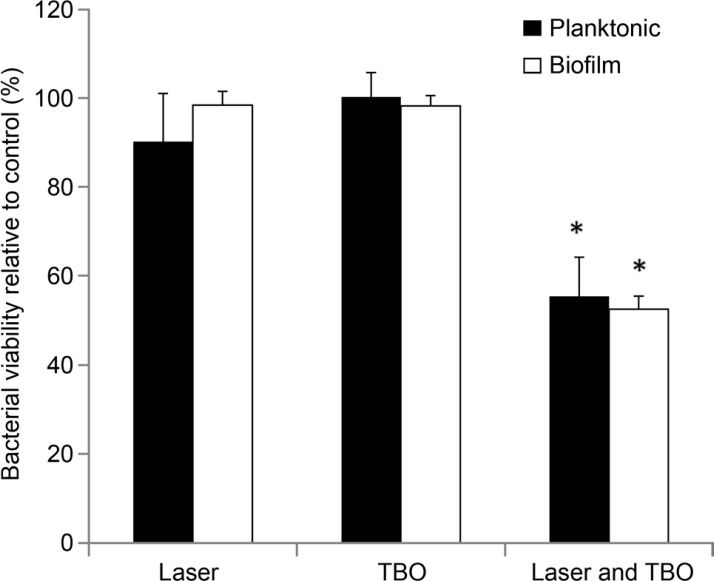
This study compared the outcome of photosensitization on the viability of four different cariogens in planktonic form as well as biofilms in human dentine. Photodynamic therapy was carried out with a gallium aluminium arsenide laser (670 nm wavelength) using Toluidine blue O (TBO) as the photosensitizer. Cariogenic bacteria ( Streptococcus mutans , Lactobacillus casei , Streptococcus salivarius and Actinomyces viscosus ) were exposed to TBO and then to the laser for 1 minute in planktonic suspension. Then, tooth slices previously incubated for 24 hours with broth cultures of broth culture of the four cariogenic organisms were exposed to antimicrobial photosensitization. The control samples consisted of planktonic and sessile cells that were exposed to TBO alone, laser alone and the bacterial cells that were not treated with TBO or laser. The results showed significant reductions in the viability of S. mutans , L. casei and A. viscosus in both planktonic form (to 13%, 30%, and 55%, respectively) and sessile form hosted in dentinal tubules (to 19%, 13% and 52%, respectively), relative to the controls. S. salivarius was the least affected in planktonic (94% viability) and sessile form (86% viability). In conclusion, sensitivity to photosensitization is species-dependent and sessile biofilm cells are affected to the same extent as their planktonic counterparts. This study compared the outcome of photosensitization on the viability of four different cariogens in planktonic form as well as biofilms in human dentine. Photodynamic therapy was carried out with a gallium aluminium arsenide laser (670 nm wavelength) using Toluidine blue O (TBO) as the photosensitizer. Cariogenic bacteria (, , and ) were exposed to TBO and then to the laser for 1 minute in planktonic suspension. Then, tooth slices previously incubated for 24 hours with broth cultures of broth culture of the four cariogenic organisms were exposed to antimicrobial photosensitization. The control samples consisted of planktonic and sessile cells that were exposed to TBO alone, laser alone and the bacterial cells that were not treated with TBO or laser. The results showed significant reductions in the viability of , and in both planktonic form (to 13%, 30%, and 55%, respectively) and sessile form hosted in dentinal tubules (to 19%, 13% and 52%, respectively), relative to the controls. was the least affected in planktonic (94% viability) and sessile form (86% viability). In conclusion, sensitivity to photosensitization is species-dependent and sessile biofilm cells are affected to the same extent as their planktonic counterparts.
本研究比较了光致敏作用对四种不同浮游形式致龋菌以及人牙本质中生物膜活力的影响。使用甲苯胺蓝O(TBO)作为光敏剂,用砷化镓铝激光(波长670nm)进行光动力治疗。将致龋菌(变形链球菌、干酪乳杆菌、唾液链球菌和粘性放线菌)置于TBO中,然后在浮游悬浮液中用激光照射1分钟。接着,将先前用四种致龋菌的肉汤培养物孵育24小时的牙片进行抗菌光致敏处理。对照样品包括仅暴露于TBO的浮游和固着细胞、仅暴露于激光的细胞以及未用TBO或激光处理的细菌细胞。结果显示,相对于对照,变形链球菌、干酪乳杆菌和粘性放线菌的浮游形式(分别降至13%、30%和55%)以及牙本质小管中固着形式(分别降至19%、13%和52%)的活力均显著降低。唾液链球菌在浮游形式(活力为94%)和固着形式(活力为86%)中受影响最小。总之,对光致敏的敏感性因菌种而异,固着生物膜细胞与其浮游对应细胞受到的影响程度相同。本研究比较了光致敏作用对四种不同浮游形式致龋菌以及人牙本质中生物膜活力的影响。使用甲苯胺蓝O(TBO)作为光敏剂,用砷化镓铝激光(波长670nm)进行光动力治疗。将致龋菌(, , 和 )置于TBO中,然后在浮游悬浮液中用激光照射1分钟。接着,将先前用四种致龋菌的肉汤培养物孵育24小时的牙片进行抗菌光致敏处理。对照样品包括仅暴露于TBO的浮游和固着细胞、仅暴露于激光的细胞以及未用TBO或激光处理的细菌细胞。结果显示,相对于对照,, 和 的浮游形式(分别降至13%、30%和55%)以及牙本质小管中固着形式(分别降至19%、13%和52%)的活力均显著降低。 在浮游形式(活力为94%)和固着形式(活力为86%)中受影响最小。总之,对光致敏的敏感性因菌种而异,固着生物膜细胞与其浮游对应细胞受到的影响程度相同。