Institute for Collaboration on Health, Intervention, and Policy.
School of Medicine.
Health Psychol. 2019 Feb;38(2):143-150. doi: 10.1037/hea0000689. Epub 2018 Dec 13.
Self-regulation interventions encouraging daily weighing prevent weight gain in young adults; however, concerns have been raised that such interventions may have undesirable effects on eating pathology, depression, and health-related quality of life (HRQL). The present study examined whether self-regulation interventions and self-weighing frequency were associated with these indices in normal weight individuals and those with overweight or obesity.
Young adults ( = 599), 18-35 years with a body mass index (BMI) 21.0-30.9 kg/m² were randomized to control, self-regulation with small changes (SC) or self-regulation with large changes (LC). Interventions taught frequent self-weighing to guide behavioral changes. SC prescribed daily small decreases in intake and increases in physical activity. LC prescribed a 5- to 10-lb weight loss to buffer against anticipated gains. Psychological indices were assessed at baseline and periodically over 2 years of follow-up.
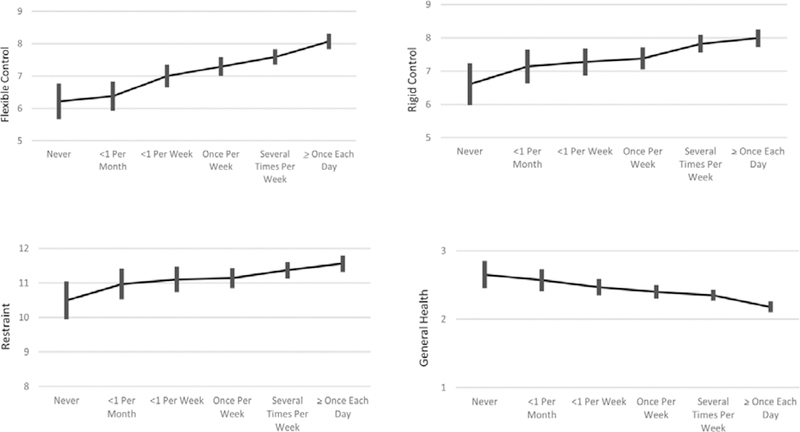
There was no evidence that the interventions increased depressive symptoms or compensatory behaviors or decreased HRQL relative to control. LC increased flexible and rigid control and SC decreased disinhibition. Results did not differ by weight status with the exception of rigid control; here, differences between LC and the other conditions were smaller among those with BMI ≥ 25. Greater self-weighing frequency over time was associated with increases in flexible and rigid control, dietary restraint, and improvements in HRQL.
The self-regulation interventions and increases in self-weighing had no untoward effects. Encouraging weight gain prevention in young adults through frequent weighing and self-regulation appears to be safe for normal weight young adults and those with overweight. (PsycINFO Database Record (c) 2019 APA, all rights reserved).
鼓励每日称重的自我调节干预措施可预防年轻人体重增加;然而,人们担心这种干预措施可能对饮食病理学、抑郁和健康相关生活质量(HRQL)产生不良影响。本研究调查了自我调节干预措施和自我称重频率是否与正常体重者和超重或肥胖者的这些指标相关。
将 18-35 岁、体重指数(BMI)为 21.0-30.9 kg/m²的年轻成年人(n=599)随机分为对照组、小幅度自我调节(SC)组或大幅度自我调节(LC)组。干预措施教导频繁自我称重以指导行为改变。SC 规定每天少量减少摄入量和增加身体活动。LC 规定减轻 5-10 磅体重以缓冲预期的增加。在基线和 2 年的随访期间定期评估心理指标。
与对照组相比,干预措施并没有增加抑郁症状或补偿行为,也没有降低 HRQL。LC 增加了灵活和僵化的控制,SC 减少了抑制。结果不因体重状况而异,但刚性控制除外;在此,LC 与其他条件之间的差异在 BMI≥25 的人群中较小。随着时间的推移,自我称重频率的增加与灵活和僵化控制、饮食抑制和 HRQL 的改善有关。
自我调节干预措施和自我称重频率的增加没有不良影响。通过频繁称重和自我调节鼓励年轻人预防体重增加似乎对正常体重的年轻人和超重者是安全的。