Bourla Alexis, Ferreri Florian, Ogorzelec Laetitia, Peretti Charles-Siegfried, Guinchard Christian, Mouchabac Stephane
Department of Adult Psychiatry and Medical Psychology, Sorbonne Université, Saint-Antoine Hospital, Assistance Publique Hôpitaux de Paris, Paris, France.
Sociology and Anthropology Laboratory, University of Burgundy Franche-Comté, Besançon, France.
JMIR Ment Health. 2018 Dec 14;5(4):e10240. doi: 10.2196/10240.
Recent discoveries in the fields of machine learning (ML), Ecological Momentary Assessment (EMA), computerized adaptive testing (CAT), digital phenotype, imaging, and biomarkers have brought about a new paradigm shift in medicine.
The aim of this study was to explore psychiatrists' perspectives on this paradigm through the prism of new clinical decision support systems (CDSSs). Our primary objective was to assess the acceptability of these new technologies. Our secondary objective was to characterize the factors affecting their acceptability.
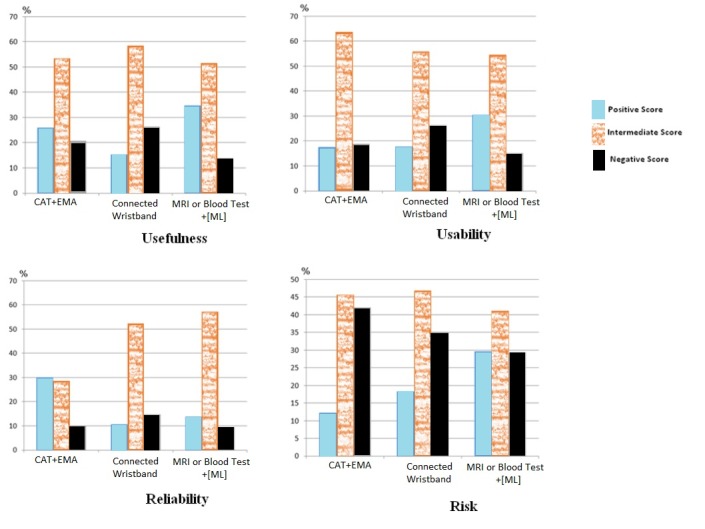
A sample of psychiatrists was recruited through a mailing list. Respondents completed a Web-based survey. A quantitative study with an original form of assessment involving the screenplay method was implemented involving 3 scenarios, each featuring 1 of the 3 support systems, namely, EMA and CAT, biosensors comprising a connected wristband-based digital phenotype, and an ML-based blood test or magnetic resonance imaging (MRI). We investigated 4 acceptability domains based on International Organization for Standardization and Nielsen models (usefulness, usability, reliability, and risk).
We recorded 515 observations. Regarding our primary objective, overall acceptability was moderate. MRI coupled with ML was considered to be the most useful system, and the connected wristband was considered the least. All the systems were described as risky (410/515, 79.6%). Regarding our secondary objective, acceptability was strongly influenced by socioepidemiological variables (professional culture), such as gender, age, and theoretical approach.
This is the first study to assess psychiatrists' views on new CDSSs. Data revealed moderate acceptability, but our analysis shows that this is more the result of the lack of knowledge about these new technologies rather than a strong rejection. Furthermore, we found strong correspondences between acceptability profiles and professional culture profiles. Many medical, forensics, and ethical issues were raised, including therapeutic relationship, data security, data storage, and privacy risk. It is essential for psychiatrists to receive training and become involved in the development of new technologies.
机器学习(ML)、生态瞬时评估(EMA)、计算机自适应测试(CAT)、数字表型、成像和生物标志物领域的最新发现给医学带来了新的范式转变。
本研究旨在通过新的临床决策支持系统(CDSS)来探究精神科医生对这一范式的看法。我们的主要目标是评估这些新技术的可接受性。次要目标是确定影响其可接受性的因素。
通过邮件列表招募了一组精神科医生作为样本。受访者完成了一项基于网络的调查。实施了一项定量研究,采用一种涉及剧本法的原始评估形式,包含3个场景,每个场景以3种支持系统中的1种为特色,即EMA和CAT、由基于腕带的连接式数字表型组成的生物传感器,以及基于ML的血液检测或磁共振成像(MRI)。我们根据国际标准化组织和尼尔森模型研究了4个可接受性领域(有用性、可用性、可靠性和风险)。
我们记录了515份观察结果。关于我们的主要目标,总体可接受性为中等。MRI与ML相结合被认为是最有用的系统,而连接式腕带被认为是最没用的。所有系统都被描述为有风险(410/515,79.6%)。关于我们的次要目标,可接受性受到社会流行病学变量(专业文化)的强烈影响,如性别、年龄和理论方法。
这是第一项评估精神科医生对新CDSS看法的研究。数据显示可接受性为中等,但我们的分析表明,这更多是由于对这些新技术缺乏了解,而非强烈抵制的结果。此外,我们发现可接受性概况与专业文化概况之间存在很强的对应关系。还提出了许多医学、法医和伦理问题,包括治疗关系、数据安全、数据存储和隐私风险。精神科医生接受培训并参与新技术的开发至关重要。