Cunningham-Myrie Colette Andrea, Mabile Emily, Govia Ishtar, Younger Novie O, Tulloch-Reid Marshall Kerr, McFarlane Shelly, Francis Damian, Gordon-Strachan Georgiana, Wilks Rainford, Greene Lisa-Gaye, Lyew-Ayee Parris, Theall Katherine P
Department of Community Health and Psychiatry, University of the West Indies, Mona, Jamaica.
Louisiana Department of Health, Office of Public Health, Bureau of Family Health, Baton Rouge, Louisiana, USA.
BMJ Open. 2018 Dec 14;8(12):e021952. doi: 10.1136/bmjopen-2018-021952.
To examine whether neighbourhood characteristics are associated with cumulative biological risk (CBR) and sex differences in CBR in a nationally representative sample in Jamaica, a small island developing country with increasing prevalence of non-communicable diseases (NCDs).
Cross-sectional study SETTING: A population-based cross-sectional survey, the Jamaica Health and Lifestyle Survey 2008 (JHLS II) recruited persons at their homes over a 4 month period from all 14 parishes and 113 neighbourhoods defined as enumeration districts (EDs).
2544 persons aged 15-74 years old from the 2008 Jamaica Health and Lifestyle Survey (JHLS II), who completed interviewer-administered questionnaires and had biomarkers assessed, and whose home addresses could be reliably geocoded.
A summary measure CBR was created using seven markers-systolic and diastolic blood pressure readings, waist circumference, body mass index, total cholesterol, fasting blood glucose levels and self-reported asthma. Weighted multilevel models examined clustering, using the intraclass correlation coefficient (ICC), of CBR across neighbourhoods and the impact of neighbourhood characteristics (recreational space availability and neighbourhood disorder) on CBR.
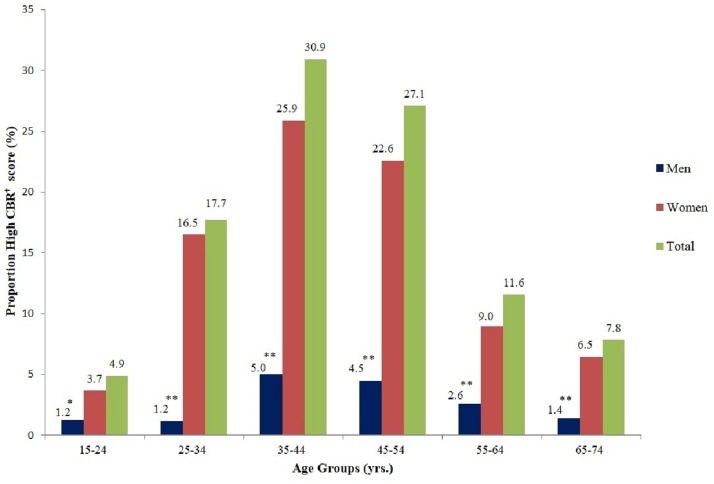
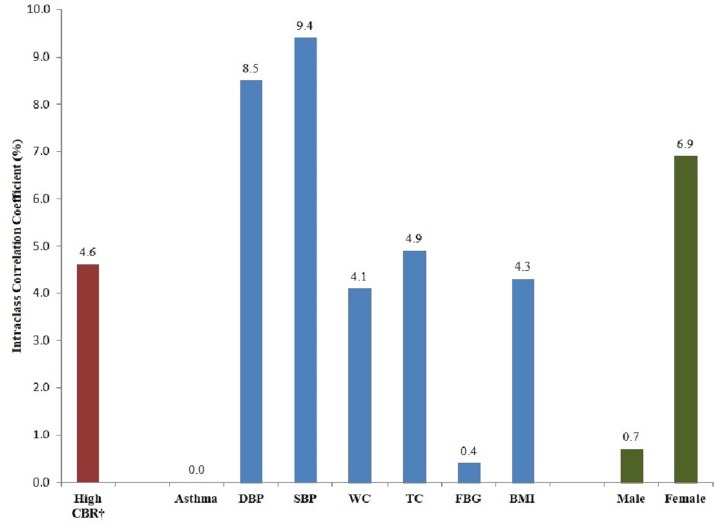
Women had significantly higher mean CBR scores than men across all age groups. There was significant clustering of CBR by ED, and among women versus men (ICC: F=6.9%, M=0.7%). Women living in more disordered neighbourhoods were 26% more likely to have high CBR as those in less disordered ones (aOR=1.26, 95% CI=1.08 to 1.47; p<0.05). Individuals living in EDs with greater recreational space availability were 25% less likely to have a high CBR (aOR=0.75, 95% CI=0.64 to 0.90; p<0.05).
Policy-makers in Jamaica should pay greater attention to neighbourhood factors such as recreational space availability and neighbourhood disorder that may contribute to CBR in any effort to curtail the epidemic of NCDs.
在牙买加这个非传染性疾病(NCDs)患病率不断上升的小岛屿发展中国家,以全国代表性样本研究邻里特征是否与累积生物风险(CBR)相关以及CBR中的性别差异。
横断面研究
基于人群的横断面调查,2008年牙买加健康与生活方式调查(JHLS II)在4个月内从所有14个教区和113个被定义为枚举区(EDs)的邻里中,在居民家中招募人员。
来自2008年牙买加健康与生活方式调查(JHLS II)的2544名15 - 74岁的人,他们完成了由访谈员管理的问卷并进行了生物标志物评估,且家庭住址能够可靠地进行地理编码。
使用七个指标创建了一个CBR汇总指标,包括收缩压和舒张压读数、腰围、体重指数、总胆固醇、空腹血糖水平和自我报告的哮喘。加权多级模型使用组内相关系数(ICC)检验了CBR在邻里间的聚类情况以及邻里特征(娱乐空间可用性和邻里混乱程度)对CBR的影响。
在所有年龄组中,女性的平均CBR得分显著高于男性。按ED划分以及在女性与男性之间,CBR存在显著聚类(ICC:女性 = 6.9%,男性 = 0.7%)。生活在更混乱邻里的女性患高CBR的可能性比生活在较不混乱邻里的女性高26%(调整后比值比[aOR]=1.26,95%置信区间[CI]=1.08至1.47;p<0.05)。生活在娱乐空间可用性更高的ED中的个体患高CBR的可能性低25%(aOR = 0.75,95% CI = 0.64至0.90;p<0.05)。
牙买加的政策制定者在任何遏制非传染性疾病流行的努力中,都应更加关注娱乐空间可用性和邻里混乱程度等可能导致CBR的邻里因素。