Department of Human Nutrition, University of Warmia and Mazury in Olsztyn, Sloneczna 45F, 10-718 Olsztyn, Poland.
Department of Human Nutrition, Faculty of Human Nutrition and Consumer Sciences, Warsaw University of Life Science-SGGW, Nowoursynowska 159 C, 02-776 Warsaw, Poland.
Nutrients. 2019 Feb 3;11(2):331. doi: 10.3390/nu11020331.
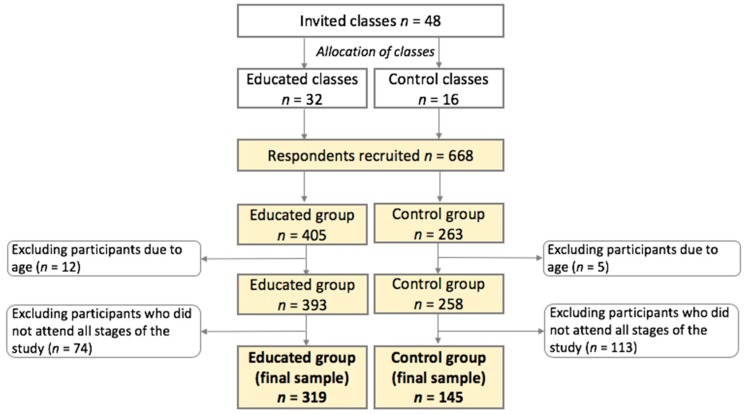
The sustainability of education focused on improving the dietary and lifestyle behaviours of teenagers has not been extensively studied. The aim of this study was to determine the sustainability of diet-related and lifestyle-related school-based education on sedentary and active lifestyle, diet quality and body composition of Polish pre-teenagers in a medium-term follow-up study. An education-based intervention study was carried out on 464 students aged 11⁻12 years (educated/control group: 319/145). Anthropometric measurements were taken and body mass index (BMI) and waist-to-height ratios (WHtR) were calculated, both at the baseline and after nine months. Dietary data from a short-form food frequency questionnaire (SF-FFQ4PolishChildren) were collected. Two measures of lifestyle (screen time, physical activity) and two diet quality scores (pro-healthy, pHDI, and non-healthy, nHDI) were established. After nine months, in the educated group (vs. control) a significantly higher increase was found in nutrition knowledge score (mean difference of the change: 1.8 points) with a significantly higher decrease in physical activity (mean difference of the change: -0.20 points), nHDI (-2.3% points), the z-WHtR (-0.18 SD), and the z-waist circumference (-0.13 SD). Logistic regression modelling with an adjustment for confounders revealed that after nine months in the educated group (referent: control), the chance of adherence to a nutrition knowledge score of at least the median was over 2 times higher, and that of the nHDI category of at least the median was significantly lower (by 35%). In conclusion, diet-related and lifestyle-related school-based education from an almost one-year perspective can reduce central adiposity in pre-teenagers, despite a decrease in physical activity and the tendency to increase screen time. Central adiposity reduction can be attributed to the improvement of nutrition knowledge in pre-teenagers subjected to the provided education and to stopping the increase in unhealthy dietary habits.
以改善青少年饮食和生活方式行为为重点的教育的可持续性尚未得到广泛研究。本研究的目的是在一项中期随访研究中确定波兰青春期前儿童基于学校的与饮食和生活方式相关的教育对久坐不动和活跃生活方式、饮食质量和身体成分的可持续性。在一项基于教育的干预研究中,对 464 名 11⁻12 岁的学生(教育/对照组:319/145)进行了研究。在基线和九个月后测量了人体测量学指标,并计算了体重指数(BMI)和腰高比(WHtR)。从短期食物频率问卷(SF-FFQ4PolishChildren)收集了饮食数据。建立了两种生活方式(屏幕时间、体力活动)和两种饮食质量评分(健康促进、pHDI 和非健康、nHDI)。九个月后,与对照组相比,受教育组(vs. 对照组)的营养知识评分显著升高(变化的平均差异:1.8 分),体力活动显著降低(变化的平均差异:-0.20 分),nHDI(-2.3% 分),z-WHtR(-0.18 SD)和 z-腰围(-0.13 SD)。在调整混杂因素后进行逻辑回归建模,结果表明,在九个月后,与对照组相比,受教育组(参照组)至少达到中位数的营养知识评分的几率增加了两倍以上,至少达到中位数的 nHDI 类别的几率显著降低(降低了 35%)。总之,从近一年的角度来看,基于学校的与饮食和生活方式相关的教育可以减少青春期前儿童的中心性肥胖,尽管体力活动减少和增加屏幕时间的趋势。中心性肥胖的减少归因于接受教育的青春期前儿童营养知识的提高和阻止不健康饮食习惯的增加。