Han Sang-Sook, Han Jeong-Won, Kim Yun-Hyung
College of Nursing Science, Kyung Hee University, Seoul, Republic of Korea.
College of Nursing, Kosin University, Busan, Republic of Korea.
Saf Health Work. 2018 Dec;9(4):441-446. doi: 10.1016/j.shaw.2017.12.001. Epub 2017 Dec 9.
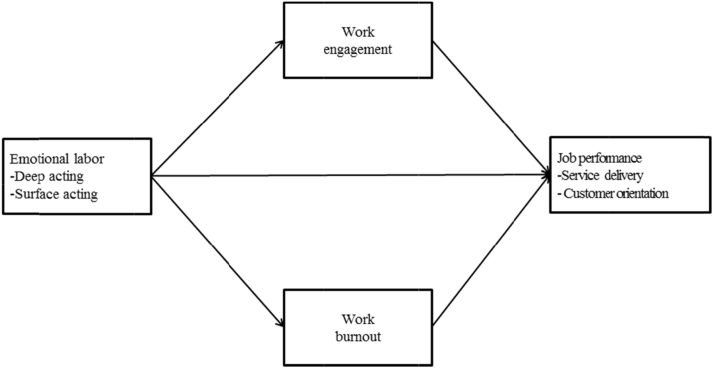
The emotional labor performed by organization members affects psychological well-being at the individual level, which consequently affects results at the organizational level. Moreover, despite evidence that the customer orientation and service level of nurses greatly affect hospital management, studies that comprehensively analyze emotional labor, work burnout, and work engagement related to customer orientation and service level are lacking. This study investigated relationships and paths by designing a model of the effect of emotional labor performed by nurses on the level of service delivery and customer orientation.
This survey-based study was based on a path analysis designed to verify a hypothesized model involving emotional labor performed by nurses, level of service delivery, customer orientation, work engagement, and burnout. Questionnaires were distributed to 378 nurses in general hospitals with more than 500 beds located in Seoul, Republic of Korea, between March 25 and April 8, 2013.
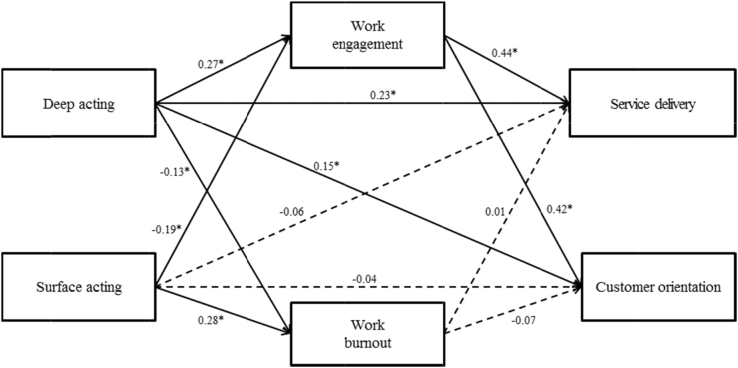
The results showed that deep acting and work engagement had direct and indirect effects on increasing the level of service delivery and customer orientation of nurses. However, surface acting had an indirect effect on reducing the level of service delivery and customer orientation.
It would be more effective to develop interventions to enhance deep acting and work engagement than to attempt to reduce surface acting and work burnout in clinical nursing settings.
组织成员所进行的情绪劳动会影响个体层面的心理健康,进而影响组织层面的结果。此外,尽管有证据表明护士的客户导向和服务水平对医院管理有很大影响,但缺乏全面分析与客户导向和服务水平相关的情绪劳动、工作倦怠和工作投入的研究。本研究通过设计一个护士情绪劳动对服务提供水平和客户导向影响的模型,来探究其中的关系和路径。
这项基于调查的研究基于路径分析,旨在验证一个假设模型,该模型涉及护士的情绪劳动、服务提供水平、客户导向、工作投入和倦怠。2013年3月25日至4月8日期间,对韩国首尔500张床位以上综合医院的378名护士进行了问卷调查。
结果表明,深度表演和工作投入对提高护士的服务提供水平和客户导向有直接和间接影响。然而,表面表演对降低服务提供水平和客户导向有间接影响。
在临床护理环境中,开发增强深度表演和工作投入的干预措施比试图减少表面表演和工作倦怠更有效。