Brahmi Fatiha, Nury Thomas, Debbabi Meryam, Hadj-Ahmed Samia, Zarrouk Amira, Prost Michel, Madani Khodir, Boulekbache-Makhlouf Lila, Lizard Gérard
Laboratoire de Biomathématique, Biochimie, Biophysique et Scientométrie, Faculté des Sciences de la Nature et de la Vie, Université de Bejaia, Bejaia 06000, Algerie.
Laboratoire Bio-peroxIL 'Biochimie du Peroxysome, Inflammation et Métabolisme Lipidique' EA 7270/Inserm, Faculté des Sciences Gabriel, Université de Bourgogne Franche-Comté, 6 Bd Gabriel, 21000 Dijon, France.
Antioxidants (Basel). 2018 Dec 6;7(12):184. doi: 10.3390/antiox7120184.
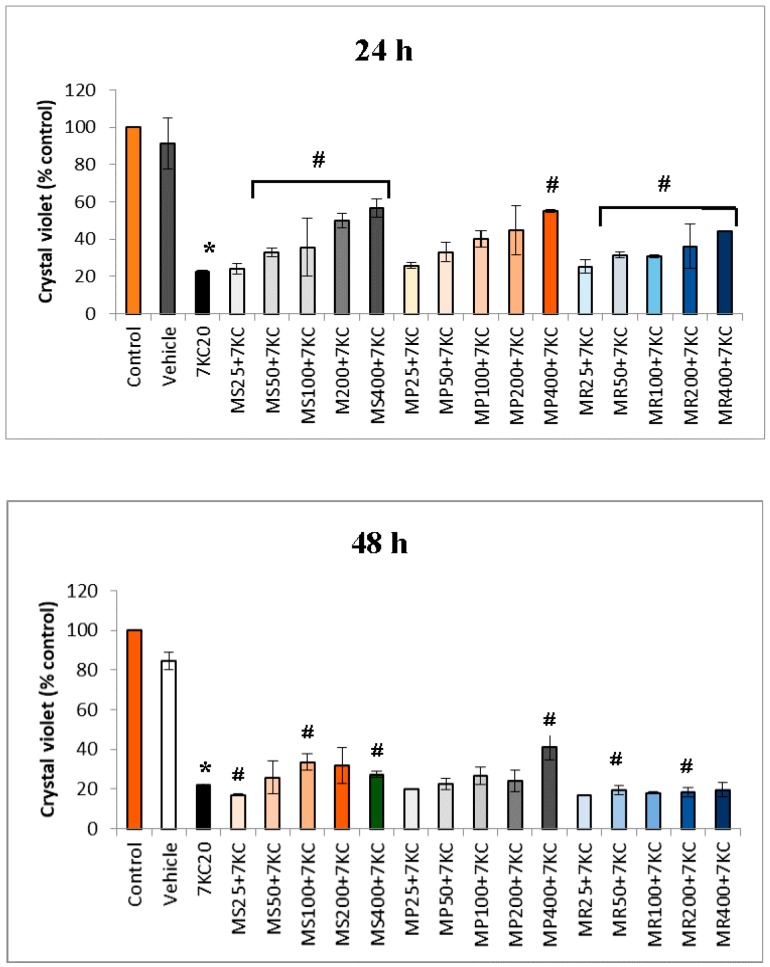
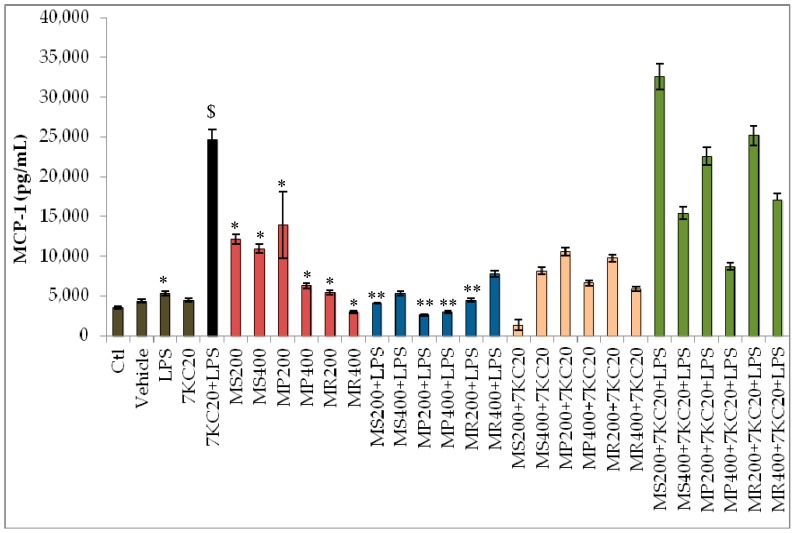
The present study consisted in evaluating the antioxidant, anti-inflammatory and cytoprotective properties of ethanolic extracts from three mint species ( L. (MS), L. (MP) and (L.) Huds (MR)) with biochemical methods on murine RAW 264.7 macrophages (a transformed macrophage cell line isolated from ascites of BALB/c mice infected by the Abelson leukemia virus). The total phenolic, flavonoid and carotenoid contents were determined with spectrophotometric methods. The antioxidant activities were quantified with the Kit Radicaux Libres (KRL), the ferric reducing antioxidant power (FRAP) and the 2,2-diphenyl-1-picrylhydrazyl (DPPH) assays. The MS extract showed the highest total phenolic content, and the highest antioxidant capacity, while the MR extract showed the lowest total phenolic content and the lowest antioxidant capacity. The cytoprotective and anti-inflammatory activities of the extracts were quantified on murine RAW 264.7 macrophages treated with 7-ketocholesterol (7KC; 20 µg/mL: 50 µM) associated or not for 24 h and 48 h with ethanolic mint extracts used at different concentrations (25, 50, 100, 200 and 400 µg/mL). Under treatment with 7KC, an important inhibition of cell growth was revealed with the crystal violet test. This side effect was strongly attenuated in a dose dependent manner with the different ethanolic mint extracts, mainly at 48 h. The most important cytoprotective effect was observed with the MS extract. In addition, the effects of ethanolic mint extracts on cytokine secretion (Interleukin (IL)-6, IL-10, Monocyte Chemoattractant Protein (MCP)-1, Interferon (IFN)-ϒ, Tumor necrosis factor (TNF)-α) were determined at 24 h on lipopolysaccharide (LPS, 0.2 µg/mL)-, 7KC (20 µg/mL)- and (7KC + LPS)-treated RAW 264.7 cells. Complex effects of mint extracts were observed on cytokine secretion. However, comparatively to LPS-treated cells, all the extracts strongly reduce IL-6 secretion and two of them (MP and MR) also decrease MCP-1 and TNF-α secretion. However, no anti-inflammatory effects were observed on 7KC- and (7KC + LPS)-treated cells. Altogether, these data bring new evidences on the potential benefits (especially antioxidant and cytoprotective properties) of Algerian mint on human health.
本研究旨在通过生化方法评估三种薄荷属植物(唇萼薄荷(MS)、留兰香薄荷(MP)和辣薄荷(MR))乙醇提取物对小鼠RAW 264.7巨噬细胞(一种从感染阿贝尔逊白血病病毒的BALB/c小鼠腹水中分离出的转化巨噬细胞系)的抗氧化、抗炎和细胞保护特性。采用分光光度法测定总酚、黄酮和类胡萝卜素含量。用自由基试剂盒(KRL)、铁还原抗氧化能力(FRAP)和2,2-二苯基-1-苦基肼(DPPH)法对抗氧化活性进行定量。MS提取物的总酚含量最高,抗氧化能力也最强,而MR提取物的总酚含量最低,抗氧化能力也最弱。在不同浓度(25、50、100、200和400 μg/mL)的薄荷乙醇提取物分别与7-酮胆固醇(7KC;20 μg/mL:50 μM)联合或不联合处理24小时和48小时的小鼠RAW 264.7巨噬细胞上,对提取物的细胞保护和抗炎活性进行定量。在用7KC处理后,结晶紫试验显示细胞生长受到显著抑制。不同的薄荷乙醇提取物以剂量依赖的方式强烈减轻了这种副作用,主要在48小时时。MS提取物观察到最重要的细胞保护作用。此外,在24小时时测定了薄荷乙醇提取物对脂多糖(LPS,0.2 μg/mL)、7KC(20 μg/mL)和(7KC + LPS)处理的RAW 264.7细胞中细胞因子分泌(白细胞介素(IL)-6、IL-10、单核细胞趋化蛋白(MCP)-1、干扰素(IFN)-γ、肿瘤坏死因子(TNF)-α)的影响。观察到薄荷提取物对细胞因子分泌有复杂的影响。然而,与LPS处理的细胞相比,所有提取物都强烈降低IL-6分泌,其中两种提取物(MP和MR)还降低MCP-1和TNF-α分泌。然而,在7KC和(7KC + LPS)处理的细胞上未观察到抗炎作用。总之,这些数据为阿尔及利亚薄荷对人类健康的潜在益处(尤其是抗氧化和细胞保护特性)提供了新的证据。