Centre d'Immunologie de Marseille-Luminy, Turing Center for Living Systems, CNRS, INSERM, Aix Marseille Univ, Marseille, France.
Centre d'Immunophénomique, Aix Marseille Univ, CNRS, INSERM, Marseille, France.
Front Immunol. 2018 Dec 4;9:2805. doi: 10.3389/fimmu.2018.02805. eCollection 2018.
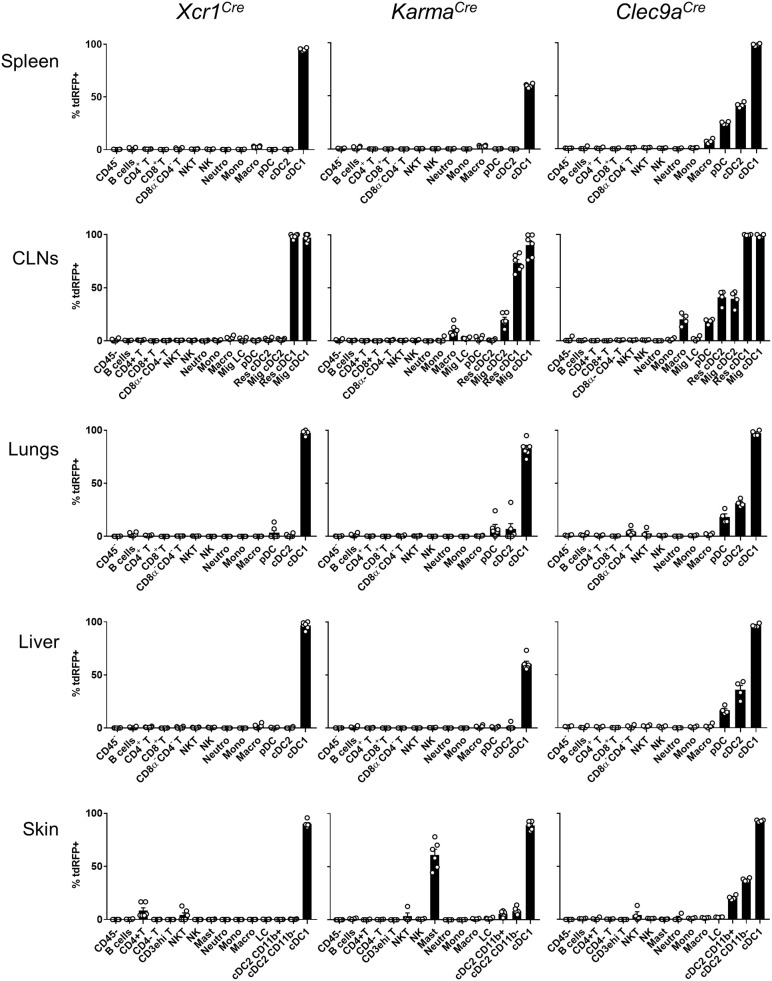
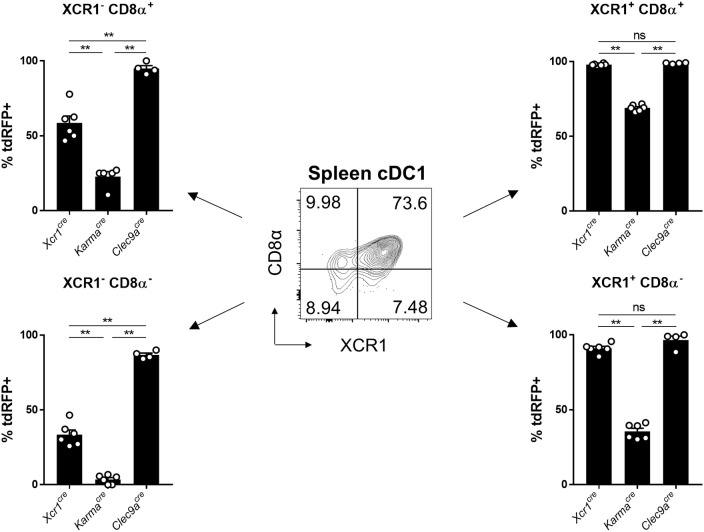
Type 1 conventional DCs (cDC1) excel in the cross-priming of CD8 T cells, which is crucial for orchestrating efficient immune responses against viruses or tumors. However, our understanding of their physiological functions and molecular regulation has been limited by the lack of proper mutant mouse models allowing their conditional genetic targeting. Because the and ( genes belong to the core transcriptomic fingerprint of mouse cDC1, we used them to engineer two novel Cre-driver lines, the and mice, by knocking in an IRES-Cre expression cassette into their 3'-UTR. We used genetic tracing to characterize the specificity and efficiency of these new models in several lymphoid and non-lymphoid tissues, and compared them to the mouse model, which targets the immediate precursors of cDCs. Amongst the three Cre-driver mouse models examined, the model was the most efficient and specific for the fate mapping of all cDC1, regardless of the tissues examined. The model was rather specific for cDC1 when compared with the mouse, but less efficient than the model. Unexpectedly, the model targeted a small fraction of CD4 T cells, and the model a significant proportion of mast cells in the skin. Importantly, the targeting specificity of these two mouse models was not changed upon inflammation. A high frequency of germline recombination was observed solely in the mouse model when both the and the alleles were brought by the same gamete irrespective of its gender. , and being differentially expressed within the cDC1 population, the three CRE-driver lines examined showed distinct recombination patterns in cDC1 phenotypic subsets. This advances our understanding of cDC1 subset heterogeneity and the differentiation trajectory of these cells. Therefore, to the best of our knowledge, upon informed use, the and mouse models represent the best tools currently reported to specifically and faithfully target cDC1 , both at steady state and upon inflammation. Future use of these mutant mouse models will undoubtedly boost our understanding of the biology of cDC1.
1 型传统树突状细胞 (cDC1) 在 CD8 T 细胞的交叉呈递中表现出色,这对于协调针对病毒或肿瘤的有效免疫反应至关重要。然而,由于缺乏适当的条件性基因靶向突变体小鼠模型,我们对其生理功能和分子调控的理解一直受到限制。由于 和 (基因属于小鼠 cDC1 的核心转录组特征,我们使用它们构建了两个新的 Cre 驱动系,即 和 小鼠,通过将 IRES-Cre 表达盒敲入其 3'-UTR 中。我们使用遗传追踪来描述这些新模型在几种淋巴和非淋巴组织中的特异性和效率,并将其与靶向 cDC 前体的 小鼠模型进行比较。在检查的三个 Cre 驱动小鼠模型中, 模型在所有 cDC1 的命运映射中效率最高且特异性最强,无论检查的组织如何。与 小鼠相比, 模型对于 cDC1 相当特异,但效率低于 模型。出乎意料的是, 模型靶向了一小部分 CD4 T 细胞, 模型靶向了皮肤中的大量肥大细胞。重要的是,这些两种小鼠模型的靶向特异性在炎症时没有改变。当同一配子携带 和 等位基因时,仅在 小鼠模型中观察到高频的种系重组,而无论其性别如何。由于 和 在 cDC1 群体中差异表达,因此检查的三个 CRE 驱动系在 cDC1 表型亚群中显示出不同的重组模式。这提高了我们对 cDC1 亚群异质性和这些细胞分化轨迹的理解。因此,据我们所知,在知情使用的情况下, 和 小鼠模型代表了目前报道的专门且忠实地靶向 cDC1 的最佳工具,无论是在稳态还是炎症时。这些突变体小鼠模型的未来使用无疑将增进我们对 cDC1 生物学的理解。