Nutrition Research Group, Research Institute of Biomedical and Health Sciences, University of Las Palmas de Gran Canaria, 35016 Las Palmas de Gran Canaria, Spain.
Consorcio CIBER, M.P. Fisiopatología de la Obesidad y Nutrición (CIBERObn), Instituto de Salud Carlos III (ISCIII), 28029 Madrid, Spain.
Nutrients. 2018 Dec 18;10(12):2000. doi: 10.3390/nu10122000.
The aim of this analysis was to ascertain the type of relationship between fish and seafood consumption, omega-3 polyunsaturated fatty acids (ω-3 PUFA) intake, and depression prevalence.
Cross-sectional analyses of the PREDIMED-Plus trial. Fish and seafood consumption and ω-3 PUFA intake were assessed through a validated food-frequency questionnaire. Self-reported life-time medical diagnosis of depression or use of antidepressants was considered as outcome. Depressive symptoms were collected by the Beck Depression Inventory-II. Logistic regression models were used to estimate the association between seafood products and ω-3 PUFA consumption and depression. Multiple linear regression models were fitted to assess the association between fish and long-chain (LC) ω-3 PUFA intake and depressive symptoms.
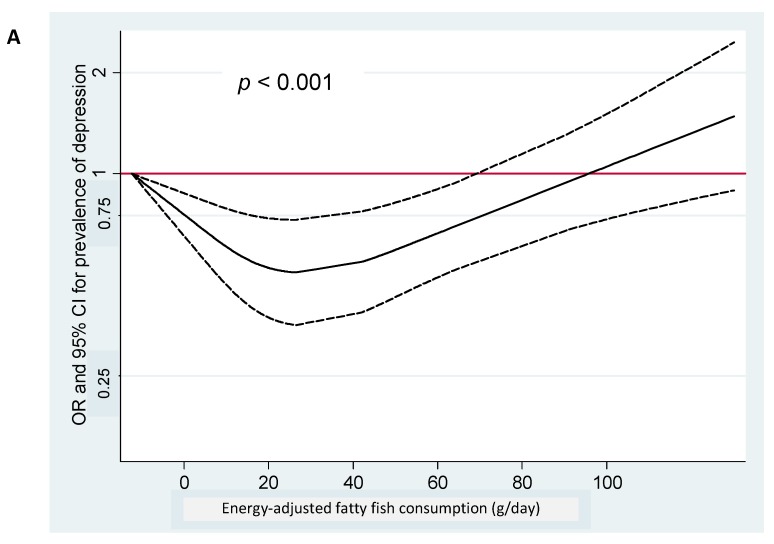
Out of 6587 participants, there were 1367 cases of depression. Total seafood consumption was not associated with depression. The odds ratios (ORs) (95% confidence intervals (CIs)) for the 2nd, 3rd, and 4th quintiles of consumption of fatty fish were 0.77 (0.63⁻0.94), 0.71 (0.58⁻0.87), and 0.78 (0.64⁻0.96), respectively, and for trend = 0.759. Moderate intake of total LC ω-3 PUFA (approximately 0.5⁻1 g/day) was significantly associated with a lower prevalence of depression.
In our study, moderate fish and LC ω-3 PUFA intake, but not high intake, was associated with lower odds of depression suggesting a U-shaped relationship.
本分析旨在确定鱼类和海鲜消费、ω-3 多不饱和脂肪酸(ω-3 PUFA)摄入与抑郁症患病率之间的关系类型。
对 PREDIMED-Plus 试验进行横断面分析。通过验证的食物频率问卷评估鱼类和海鲜的消费和 ω-3 PUFA 的摄入。将终生医学诊断的抑郁症或使用抗抑郁药作为结果。通过贝克抑郁量表 II 收集抑郁症状。使用逻辑回归模型估计海鲜产品和 ω-3 PUFA 消费与抑郁症之间的关联。拟合多元线性回归模型评估鱼类和长链(LC)ω-3 PUFA 摄入与抑郁症状之间的关联。
在 6587 名参与者中,有 1367 例抑郁症。总海鲜消费量与抑郁症无关。食用肥鱼的第 2、3 和第 4 五分位数的比值比(OR)(95%置信区间(CI))分别为 0.77(0.63⁻0.94)、0.71(0.58⁻0.87)和 0.78(0.64⁻0.96),趋势检验 = 0.759。总 LC ω-3 PUFA 的适度摄入(约 0.5⁻1 g/天)与抑郁症的患病率降低显著相关。
在我们的研究中,适度的鱼类和 LC ω-3 PUFA 摄入,而不是高摄入,与较低的抑郁几率相关,提示存在 U 型关系。