Parkinson Gabrielle T, Hanley Jonathan G
Centre for Synaptic Plasticity and School of Biochemistry, University of Bristol, Bristol, United Kingdom.
Front Mol Neurosci. 2018 Dec 5;11:440. doi: 10.3389/fnmol.2018.00440. eCollection 2018.
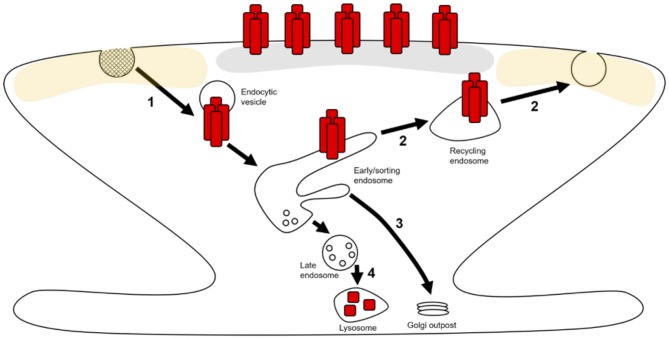
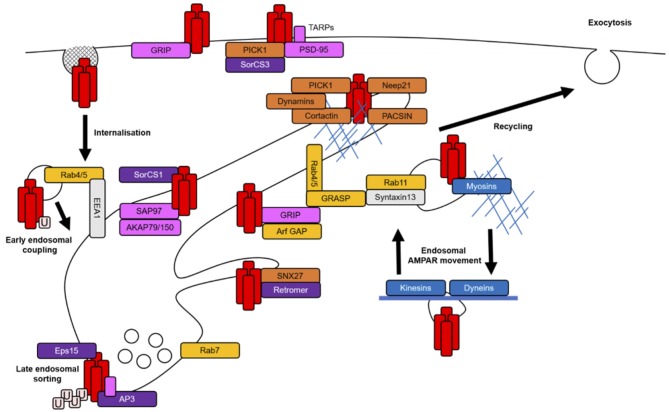
The regulation of synaptic AMPA receptors (AMPARs) is critical for excitatory synaptic transmission, synaptic plasticity and the consequent formation of neural circuits during brain development and their modification during learning and memory processes. The number of synaptic AMPARs is regulated through endocytosis, exocytosis and endosomal sorting that results in recycling back to the plasma membrane or degradation in the lysosome. Hence, endo-lysosomal sorting is vitally important in maintaining AMPAR expression at the synapse, and the dynamic regulation of these trafficking events is a key component of synaptic plasticity. A reduction in synaptic strength such as in long-term depression (LTD) involves AMPAR sorting to lysosomes to reduce synaptic AMPAR number, whereas long-term potentiation (LTP) involves an increase in AMPAR recycling to increase the number of AMPARs at synapses. Here, we review our current understanding of the endosomal trafficking routes taken by AMPARs, and the mechanisms involved in AMPAR endosomal sorting, focussing on the numerous AMPAR associated proteins that have been implicated in this complex process. We also discuss how these events are dysregulated in brain disorders.
突触α-氨基-3-羟基-5-甲基-4-异恶唑丙酸受体(AMPARs)的调节对于兴奋性突触传递、突触可塑性以及大脑发育过程中神经回路的形成及其在学习和记忆过程中的修饰至关重要。突触AMPARs的数量通过内吞作用、胞吐作用和内体分选来调节,内体分选导致其循环回到质膜或在溶酶体中降解。因此,内体-溶酶体分选对于维持突触处的AMPAR表达至关重要,而这些转运事件的动态调节是突触可塑性的关键组成部分。突触强度的降低,如在长时程抑制(LTD)中,涉及AMPAR分选至溶酶体以减少突触AMPAR数量,而长时程增强(LTP)则涉及AMPAR循环增加以增加突触处AMPAR的数量。在此,我们综述了目前对AMPARs所采用的内体转运途径以及AMPAR内体分选所涉及机制的理解,重点关注了众多与这一复杂过程相关的AMPAR结合蛋白。我们还讨论了这些事件在脑部疾病中是如何失调的。