Department Biology II, Ludwig-Maximilians-Universität München, Munich, Germany.
Bernstein Center for Computational Neuroscience Munich, Munich, Germany.
Sci Rep. 2018 Dec 20;8(1):18001. doi: 10.1038/s41598-018-36234-1.
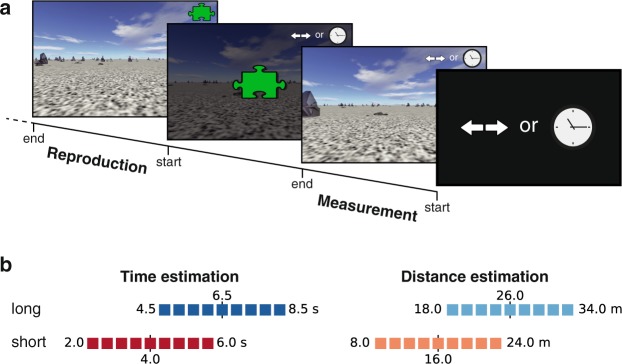
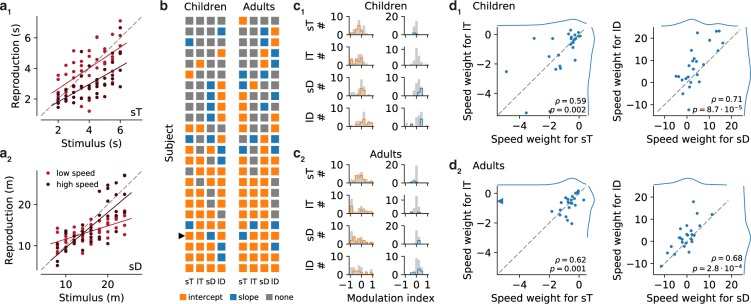
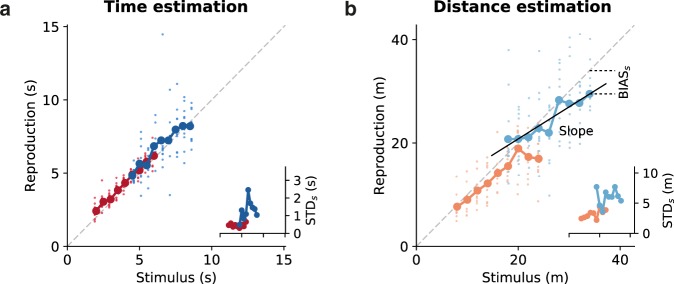
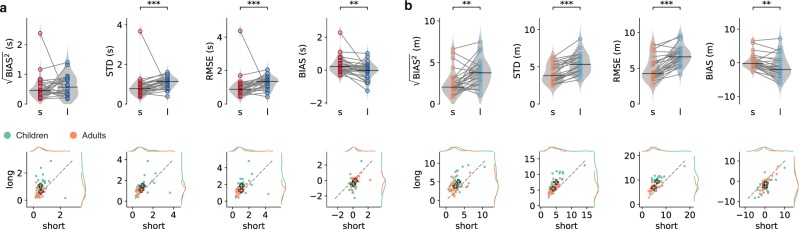
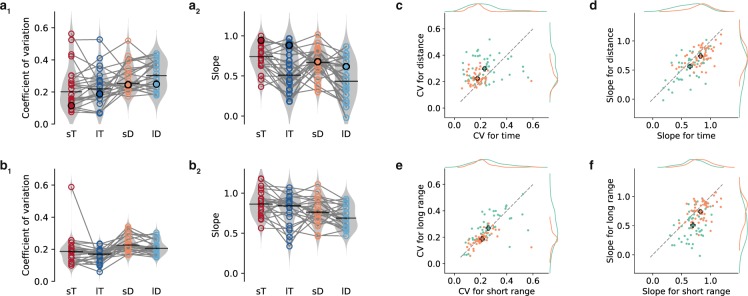
Navigation crucially depends on the capability to estimate time elapsed and distance covered during movement. From adults it is known that magnitude estimation is subject to characteristic biases. Most intriguing is the regression effect (central tendency), whose strength depends on the stimulus distribution (i.e. stimulus range), a second characteristic of magnitude estimation known as range effect. We examined regression and range effects for time and distance estimation in eleven-year-olds and young adults, using an egocentric virtual navigation task. Regression effects were stronger for distance compared to time and depended on stimulus range. These effects were more pronounced in children compared to adults due to a more heterogeneous performance among the children. Few children showed veridical estimations similar to adults; most children, however, performed less accurate displaying stronger regression effects. Our findings suggest that children use magnitude processing strategies similar to adults, but it seems that these are not yet fully developed in all eleven-year-olds and are further refined throughout adolescence.
导航的关键取决于在运动过程中估计经过的时间和距离的能力。成年人的研究表明,大小估计受到特征性偏差的影响。最有趣的是回归效应(集中趋势),其强度取决于刺激分布(即刺激范围),这是大小估计的第二个特征,称为范围效应。我们使用自我中心的虚拟导航任务,研究了 11 岁儿童和年轻人对时间和距离的估计的回归和范围效应。与时间相比,距离的回归效应更强,并且取决于刺激范围。由于儿童之间的表现差异较大,因此与成年人相比,儿童的这些效应更为明显。少数儿童表现出与成年人相似的真实估计,但是大多数儿童的表现不够准确,表现出更强的回归效应。我们的研究结果表明,儿童使用与成年人相似的大小处理策略,但似乎并非所有 11 岁儿童都已完全发展出这些策略,而且这些策略在整个青春期仍在不断完善。