Yadollahpour Ali, Nourozi Jamshid, Mirbagheri Seyed Ahmad, Simancas-Acevedo Eric, Trejo-Macotela Francisco R
Department of Medical Physics, School of Medicine, Ahvaz Jundishapur University of Medical Sciences, Ahvaz, Iran.
Department of Environmental and Energy, Science and Research Branch, Islamic Azad University, Tehran, Iran.
Front Physiol. 2018 Dec 6;9:1753. doi: 10.3389/fphys.2018.01753. eCollection 2018.
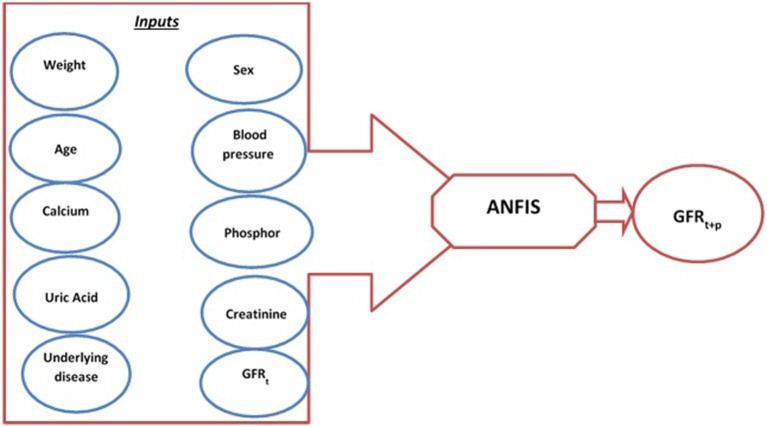
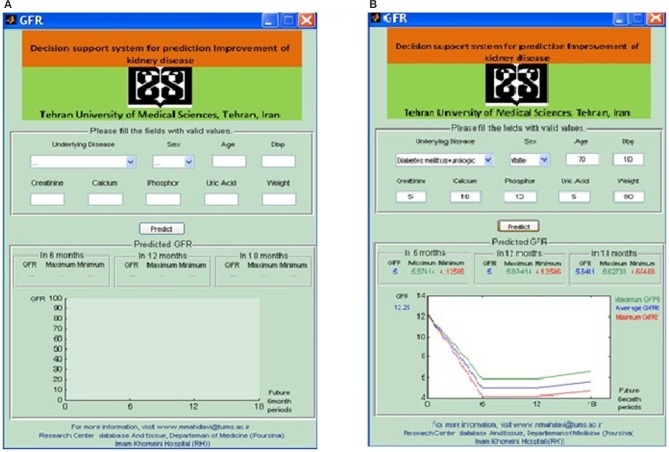
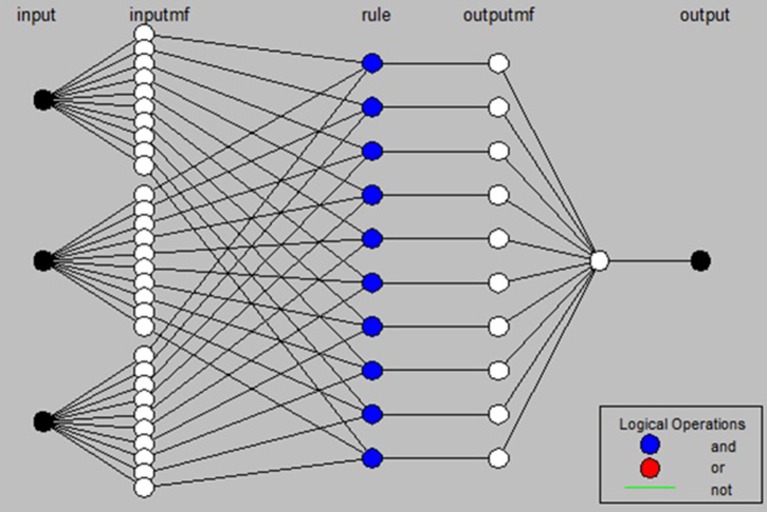
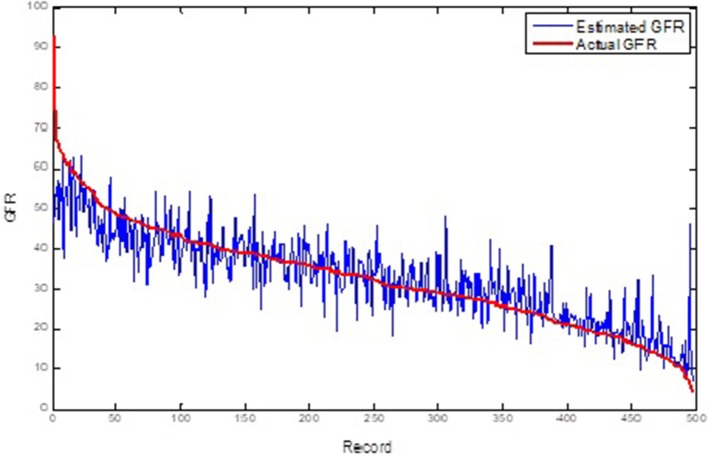
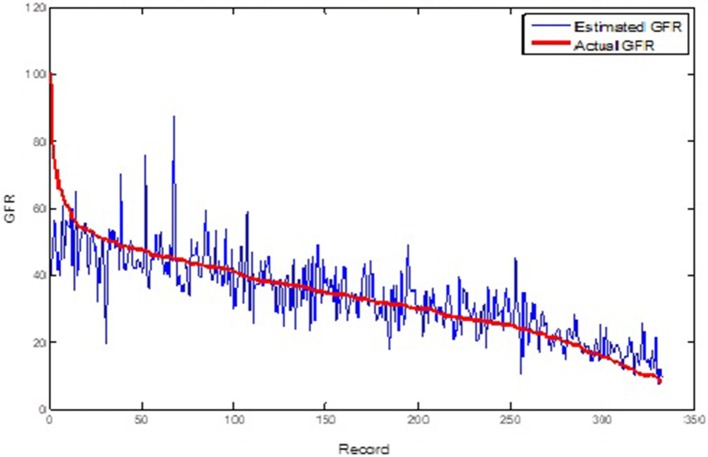
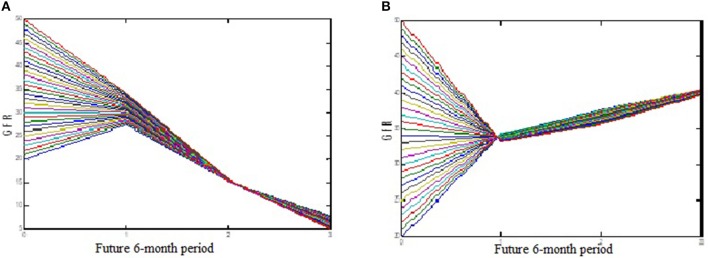
Chronic kidney disease (CKD) has a covert nature in its early stages that could postpone its diagnosis. Early diagnosis can reduce or prevent the progression of renal damage. The present study introduces an expert medical decision support system (MDSS) based on adaptive neuro-fuzzy inference system (ANFIS) to predict the timeframe of renal failure. The core system of the MDSS is a Takagi-Sugeno type ANFIS model that predicts the glomerular filtration rate (GFR) values as the biological marker of the renal failure. The model uses 10-year clinical records of newly diagnosed CKD patients and considers the threshold value of 15 cc/kg/min/1.73 m of GFR as the marker of renal failure. Following the evaluation of 10 variables, the ANFIS model uses the weight, diastolic blood pressure, and diabetes mellitus as underlying disease, and current GFR as the inputs of the predicting model to predict the GFR values at future intervals. Then, a user-friendly graphical user interface of the model was built in MATLAB, in which the user can enter the physiological parameters obtained from patient recordings to determine the renal failure time as the output. Assessing the performance of the MDSS against the real data of male and female CKD patients showed that this decision support model could accurately estimate GFR variations in all sequential periods of 6, 12, and 18 months, with a normalized mean absolute error lower than 5%. Despite the high uncertainties of the human body and the dynamic nature of CKD progression, our model can accurately predict the GFR variations at long future periods. The MDSS GUI could be useful in medical centers and used by experts to predict renal failure progression and, through taking effective actions, CKD can be prevented or effectively delayed.
慢性肾脏病(CKD)在早期具有隐匿性,这可能会延迟其诊断。早期诊断可以减少或预防肾损伤的进展。本研究引入了一种基于自适应神经模糊推理系统(ANFIS)的专家医学决策支持系统(MDSS),以预测肾衰竭的时间范围。MDSS的核心系统是一个Takagi-Sugeno型ANFIS模型,该模型将肾小球滤过率(GFR)值预测为肾衰竭的生物学标志物。该模型使用新诊断的CKD患者的10年临床记录,并将GFR的15 cc/kg/min/1.73 m阈值视为肾衰竭的标志物。在对10个变量进行评估后,ANFIS模型将体重、舒张压和糖尿病作为基础疾病,并将当前GFR作为预测模型的输入,以预测未来各时间段的GFR值。然后,在MATLAB中构建了该模型的用户友好图形用户界面,用户可以在其中输入从患者记录中获得的生理参数,以确定肾衰竭时间作为输出。针对男性和女性CKD患者的真实数据评估MDSS的性能表明,该决策支持模型能够准确估计6个月、12个月和18个月所有连续时间段内的GFR变化,归一化平均绝对误差低于5%。尽管人体存在高度不确定性且CKD进展具有动态性,但我们的模型能够准确预测未来较长时间段内的GFR变化。MDSS图形用户界面在医疗中心可能会很有用,专家可以使用它来预测肾衰竭的进展,并通过采取有效行动来预防或有效延缓CKD。