Lopez Keila N, O'Connor Michael, King Jason, Alexander James, Challman Melissa, Lovick Donna K, Goodly Nicole, Smith Amelia, Fawcett Elliott, Mulligan Courtney, Thompson Debbe, Fordis Michael
Division of Pediatric Cardiology, Department of Pediatrics, Baylor College of Medicine/Texas Children's Hospital, Houston, TX, United States.
Center for Collaborative and Interactive Technologies, Baylor College of Medicine, Houston, TX, United States.
JMIR Form Res. 2018 Jul-Dec;2(2). doi: 10.2196/formative.9963. Epub 2018 Jan 29.
Congenital heart diseases (CHDs) are the most common type of birth defects. Improvements in CHD care have led to approximately 1.4 million survivors reaching adulthood. Successful transition and transfer from pediatric to adult care is crucial. Unfortunately, less than 30% of adolescents with CHD successfully transition to adult care; this number is lower for minority and lower socioeconomic status populations. Few CHD programs exist to facilitate successful transition.
The goal of our study was to describe the formative research used to develop a prototype mobile app to facilitate transition to adult care for adolescents with CHD.
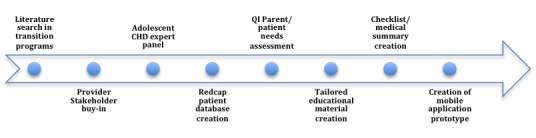
A literature search about best practices in transition medicine for CHD was conducted to inform app development. Formative research with a diverse group of CHD adolescents and their parents was conducted to determine gaps and needs for CHD transition to adult care. As part of the interview, surveys assessing transition readiness and CHD knowledge were completed. Two adolescent CHD expert panels were convened to inform educational content and app design.
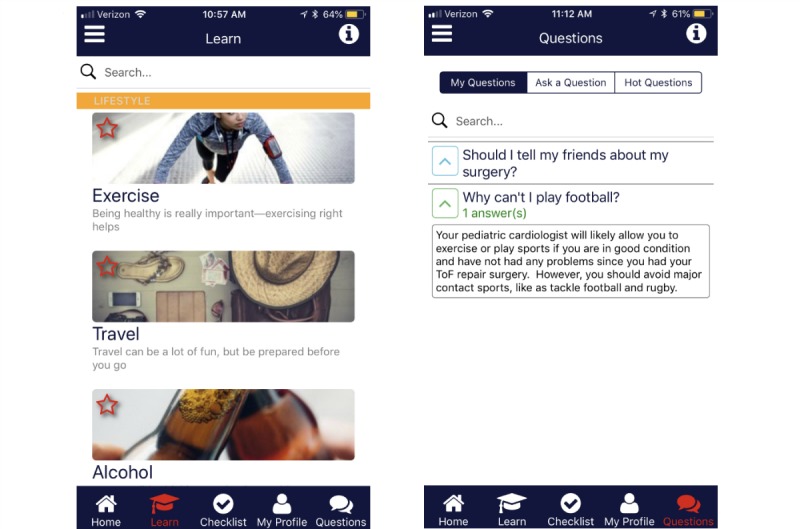
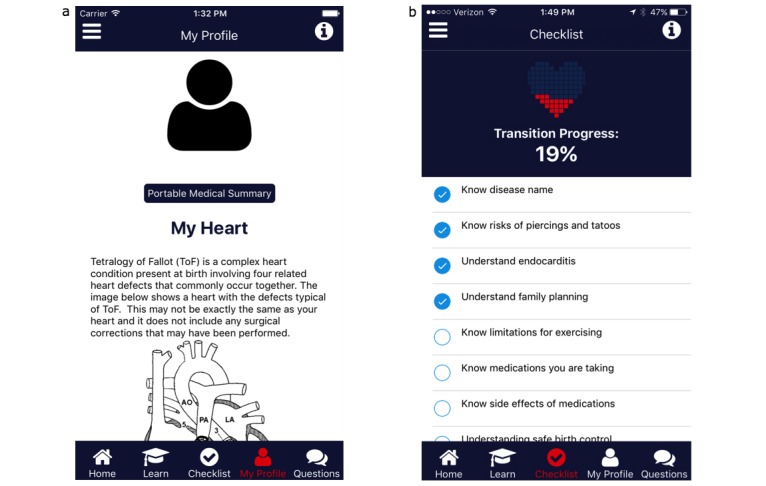
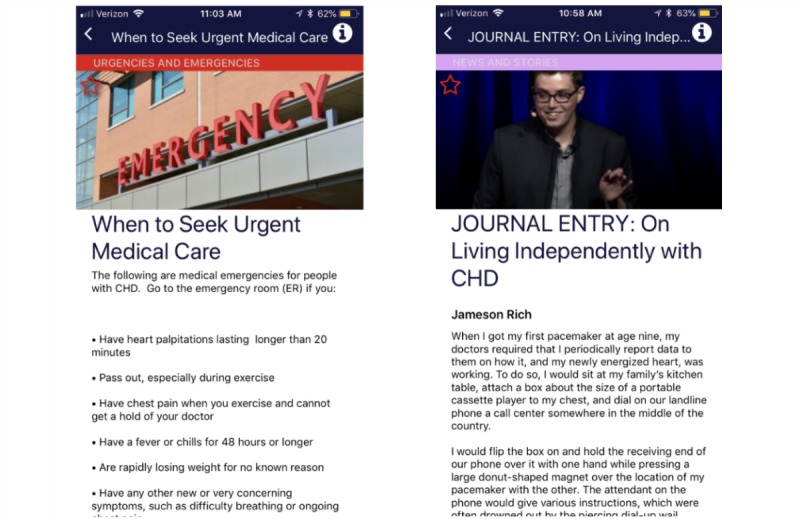
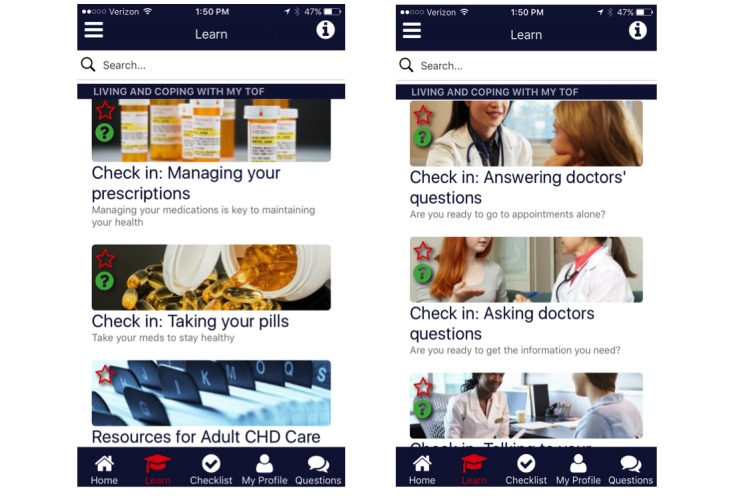
The literature review revealed 113 articles, of which 38 were studies on transition programs and attitudes and 3 identified best practices in transition specific to CHD. A total of 402 adolescents aged 15 to 22 years (median 16 years) participated in semistructured interviews. The group was racially and ethnically diverse (12.6% [51/402] African American and 37.8% [152/402] Latino) and 42.0% (169/402) female; 36.3% (146/402) received public insurance. Most adolescents (313/402, 76.7%) had moderate or severe CHD complexity and reported minimal CHD understanding (79.0% [275/348] of those aged 15 to 17 years and 61.1% [33/54] of those aged 18 to 22 years). Average initial transition readiness score was 50.9/100, meaning that transition readiness training was recommended. When participants with moderate to severe CHD (313/402, 77.9%) were asked about technology use, 94.2% (295/313) reported having access to a mobile phone. Interviews with parents revealed limited interactions with the pediatric cardiologist about transition-related topics: 79.4% (331/417) reported no discussions regarding future family planning, and 55.2% (230/417) reported the adolescent had not been screened for mental health concerns (depression, anxiety). Further, 66.4% (277/417) reported not understanding how health care changes as adolescents become adults. Adolescents in the expert panels (2 groups of 3 adolescents each) expressed interest in a CHD-specific tailored app consisting of quick access to specific educational questions (eg, "Can I exercise?"), a CHD story-blog forum, a mentorship platform, a question and answer space, and a checklist to facilitate transition. They expressed interest in using the app to schedule CHD clinic appointments and receive medication reminders. Based on this data, a prototype mobile app was created to assist in adolescent CHD transition.
Formative research revealed that most adolescents with CHD had access to mobile phones, were not prepared for transition to adult care, and were interested in an app to facilitate transition to adult CHD care. Understanding adolescent and parent needs, interests, and concerns helped in the development of a mobile app with a broader, tailored approach for adolescents with CHD.
先天性心脏病(CHD)是最常见的出生缺陷类型。CHD治疗的改善使约140万患者存活至成年。从儿科护理成功过渡到成人护理至关重要。不幸的是,不到30%的CHD青少年能成功过渡到成人护理;少数族裔和社会经济地位较低人群的这一比例更低。很少有CHD项目能促进成功过渡。
我们研究的目的是描述用于开发一款原型移动应用程序的形成性研究,该应用程序旨在促进CHD青少年向成人护理的过渡。
进行了一项关于CHD过渡医学最佳实践的文献检索,以为应用程序开发提供信息。对不同群体的CHD青少年及其父母进行了形成性研究,以确定CHD向成人护理过渡的差距和需求。作为访谈的一部分,完成了评估过渡准备情况和CHD知识的调查。召集了两个青少年CHD专家小组,以确定教育内容和应用程序设计。
文献综述共检索到113篇文章,其中38篇是关于过渡项目和态度的研究,3篇确定了CHD特定过渡的最佳实践。共有402名15至22岁(中位数16岁)的青少年参与了半结构化访谈。该群体在种族和民族上具有多样性(非裔美国人占12.6%[51/402],拉丁裔占37.8%[152/402]),女性占42.0%(169/402);36.3%(146/402)接受公共保险。大多数青少年(313/402,76.7%)患有中度或重度CHD复杂性,且对CHD的了解很少(15至17岁的青少年中79.0%[275/348],18至22岁的青少年中61.1%[33/54])。平均初始过渡准备得分是50.9/100,这意味着建议进行过渡准备培训。当询问患有中度至重度CHD的参与者(313/402,77.9%)关于技术使用情况时,94.2%(295/313)报告可以使用手机。对父母的访谈显示,他们与儿科心脏病专家就过渡相关话题的互动有限:79.4%(331/417)报告未就未来计划生育进行过讨论,55.2%(230/417)报告青少年未接受过心理健康问题(抑郁、焦虑)筛查。此外,66.4%(277/417)报告不了解青少年成年后医疗保健会如何变化。专家小组中的青少年(两组,每组3名青少年)对一款针对CHD的定制应用程序表示感兴趣,该应用程序包括快速获取特定教育问题(如“我可以锻炼吗?”)、CHD故事博客论坛、指导平台、问答空间以及一份促进过渡的清单。他们表示有兴趣使用该应用程序来安排CHD诊所预约并接收用药提醒。基于这些数据,创建了一款原型移动应用程序以协助青少年CHD过渡。
形成性研究表明,大多数CHD青少年可以使用手机,但未为向成人护理过渡做好准备,并且对一款有助于向成人CHD护理过渡的应用程序感兴趣。了解青少年和父母的需求、兴趣和担忧有助于开发一款针对CHD青少年的更广泛、更具针对性的移动应用程序。