Center for Plant Science Innovation, University of Nebraska-Lincoln, Lincoln, NE, USA.
Department of Agronomy & Horticulture, University of Nebraska-Lincoln, Lincoln, NE, USA.
Plant Biotechnol J. 2019 Jul;17(7):1369-1379. doi: 10.1111/pbi.13061. Epub 2019 Jan 18.
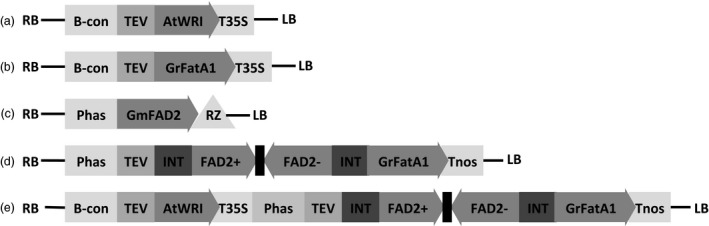
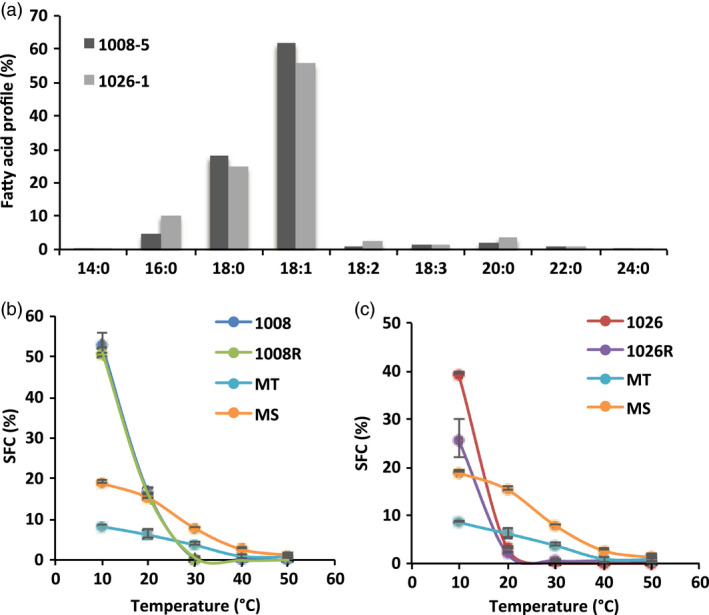
Soybean (Glycine max [L.] Merr.) is a commodity crop highly valued for its protein and oil content. The high percentage of polyunsaturated fatty acids in soybean oil results in low oxidative stability, which is a key parameter for usage in baking, high temperature frying applications, and affects shelf life of packaged products containing soybean oil. Introduction of a seed-specific expression cassette carrying the Arabidopsis transcription factor WRINKLED1 (AtWRI1) into soybean, led to seed oil with levels of palmitate up to approximately 20%. Stacking of the AtWRI1 transgenic allele with a transgenic locus harbouring the mangosteen steroyl-ACP thioesterase (GmFatA) resulted in oil with total saturates up to 30%. The creation of a triple stack in soybean, wherein the AtWRI1 and GmFatA alleles were combined with a FAD2-1 silencing allele led to the synthesis of an oil with 28% saturates and approximately 60% oleate. Constructs were then assembled that carry a dual FAD2-1 silencing element/GmFatA expression cassette, alone or combined with an AtWRI1 cassette. These plasmids are designated pPTN1289 and pPTN1301, respectively. Transgenic events carrying the T-DNA of pPTN1289 displayed an oil with stearate levels between 18% and 25%, and oleate in the upper 60%, with reduced palmitate (<5%). While soybean events harboring transgenic alleles of pPTN1301 had similar levels of stearic and oleate levels as that of the pPTRN1289 events, but with levels of palmitate closer to wild type. The modified fatty acid composition results in an oil with higher oxidative stability, and functionality attributes for end use in baking applications.
大豆(Glycine max [L.] Merr.)是一种高价值的商品作物,因其蛋白质和油含量而备受重视。大豆油中多不饱和脂肪酸的比例很高,导致其氧化稳定性较低,这是在烘焙、高温油炸应用中使用的关键参数,也会影响含有大豆油的包装产品的保质期。将携带拟南芥转录因子 WRINKLED1(AtWRI1)的种子特异性表达盒导入大豆中,导致种子油中的棕榈酸含量达到约 20%。将 AtWRI1 转基因等位基因与含有藤黄果甾酰-ACP 硫酯酶(GmFatA)的转基因位点进行叠加,导致油中的总饱和物含量高达 30%。在大豆中创建三重叠加,将 AtWRI1 和 GmFatA 等位基因与 FAD2-1 沉默等位基因相结合,导致合成的油中 28%为饱和物,约 60%为油酸。然后组装了携带双 FAD2-1 沉默元件/GmFatA 表达盒的构建体,单独或与 AtWRI1 盒组合。这些质粒分别命名为 pPTN1289 和 pPTN1301。携带 pPTN1289 T-DNA 的转基因事件显示出硬脂酸水平在 18%至 25%之间的油,油酸在上部 60%,棕榈酸减少(<5%)。而含有 pPTN1301 转基因等位基因的大豆事件具有与 pPTN1289 事件相似的硬脂酸和油酸水平,但棕榈酸水平更接近野生型。脂肪酸组成的修饰导致油的氧化稳定性更高,具有烘焙应用的功能属性。