Department of Psychology and Neuroscience, University of North Carolina, Chapel Hill, North Carolina, 27599, USA.
Sci Rep. 2018 Dec 21;8(1):18049. doi: 10.1038/s41598-018-36269-4.
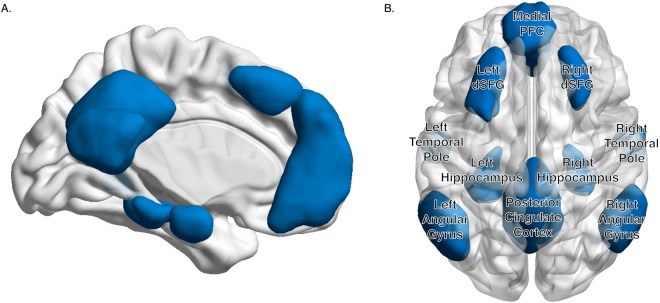
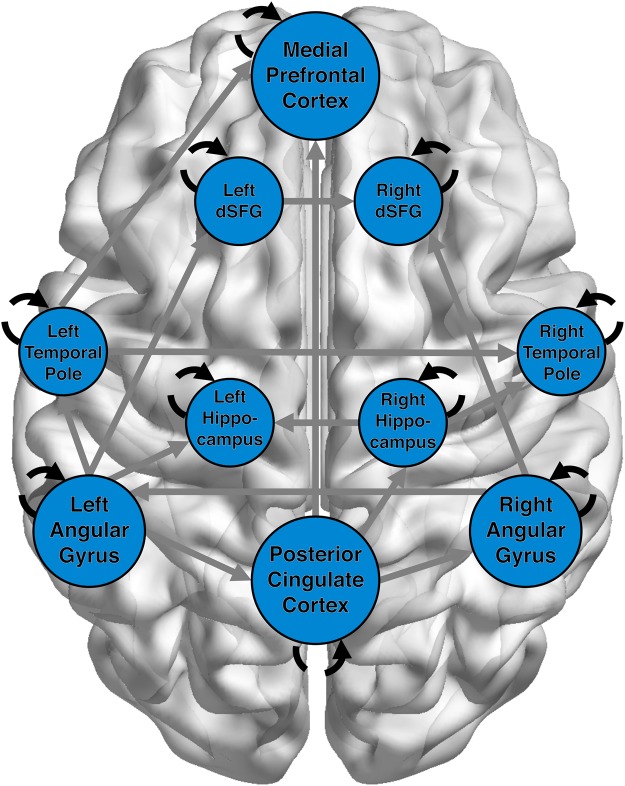
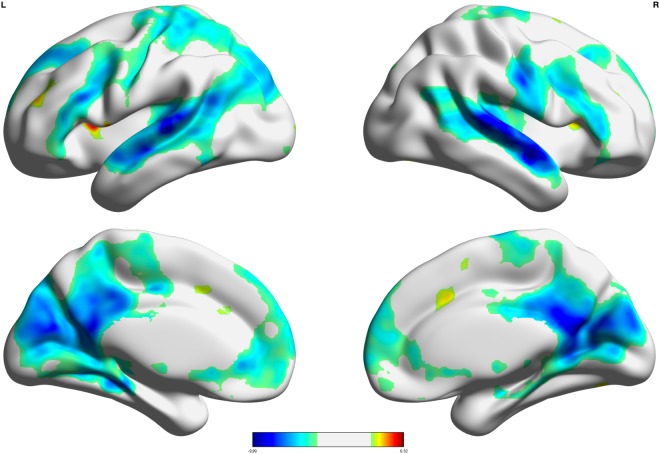
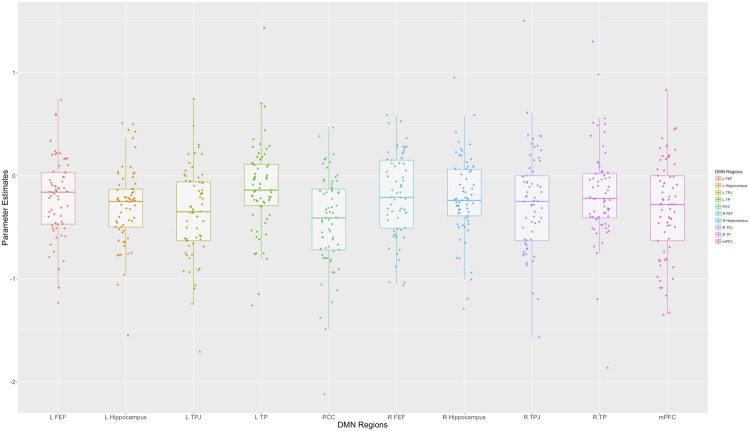
Out of the several intrinsic brain networks discovered through resting-state functional analyses in the past decade, the default mode network (DMN) has been the subject of intense interest and study. In particular, the DMN shows marked suppression during task engagement, and has led to hypothesized roles in internally-directed cognition that need to be down-regulated in order to perform goal-directed behaviors. Previous work has largely focused on univariate deactivation as the mechanism of DMN suppression. However, given the transient nature of DMN down-regulation during task, an important question arises: Does the DMN need to be strongly, or more stably suppressed to promote successful task learning? In order to explore this question, 65 adolescents (M = 13.32; 21 females) completed a risky decision-making task during an fMRI scan. We tested our primary question by examining individual differences in absolute level of deactivation against the stability of activation across time in predicting levels of feedback learning on the task. To measure stability, we utilized a model-based functional connectivity approach that estimates the stability of activation across time within a region. In line with our hypothesis, the stability of activation in default mode regions predicted task engagement over and above the absolute level of DMN deactivation, revealing a new mechanism by which the brain can suppress the influence of brain networks on behavior. These results also highlight the importance of adopting model-based network approaches to understand the functional dynamics of the brain.
在过去十年的静息态功能分析中发现的几个内在脑网络中,默认模式网络 (DMN) 一直是人们关注和研究的热点。特别是,DMN 在任务参与时表现出明显的抑制,这导致了人们假设它在内部导向认知中发挥作用,需要对其进行下调,以便执行目标导向的行为。以前的工作主要集中在单变量去激活作为 DMN 抑制的机制上。然而,鉴于 DMN 在任务期间的下调具有瞬时性,一个重要的问题出现了:为了促进任务学习的成功,DMN 是否需要被强烈或更稳定地抑制?为了探索这个问题,65 名青少年(M = 13.32;21 名女性)在 fMRI 扫描期间完成了一项风险决策任务。我们通过检查在预测任务反馈学习水平时,静息态网络去激活的绝对水平与激活的稳定性之间的个体差异,来检验我们的主要问题。为了测量稳定性,我们利用基于模型的功能连接方法来估计区域内激活的稳定性随时间的变化。与我们的假设一致,默认模式区域的激活稳定性预测了任务参与,超过了 DMN 去激活的绝对水平,揭示了大脑可以抑制脑网络对行为影响的新机制。这些结果还强调了采用基于模型的网络方法来理解大脑功能动力学的重要性。