Clinic of Orthodontics, Lithuanian University of Health Sciences, Luksos-Daumanto st. 6, LT-50106, Kaunas, Lithuania.
BMC Oral Health. 2018 Dec 22;18(1):225. doi: 10.1186/s12903-018-0673-5.
An aesthetic smile has a number of components, and people generally equate a good dental appearance with success in many areas of life. The features that determine smile aesthetics could provide significant insights into post-treatment satisfaction and may predict a patient's objectives when undergoing treatment. The purpose of this study was to evaluate how smile characteristics are perceived by dental students.
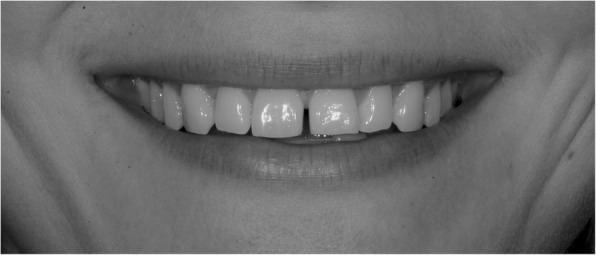
The study was performed in 431 local and international dental students at the Lithuanian University of Health Sciences. The study data were collected using a three-part questionnaire. The first part of the questionnaire included sociodemographic items, i.e., student gender, age, nationality, and years of study; the second consisted of questions about facial aesthetic features; and the third elicited responses to photographs of 17 different smiles retrieved from the Lithuanian University of Health Sciences Clinic of Orthodontics database. The smile aesthetics were evaluated according to their dentolabial, dentogingival, dental, and dental arch characteristics using a 5-point numeric rating scale (1, best; 5, worst). The data were analysed using the Pearson's chi-square and Mann-Whitney U tests.
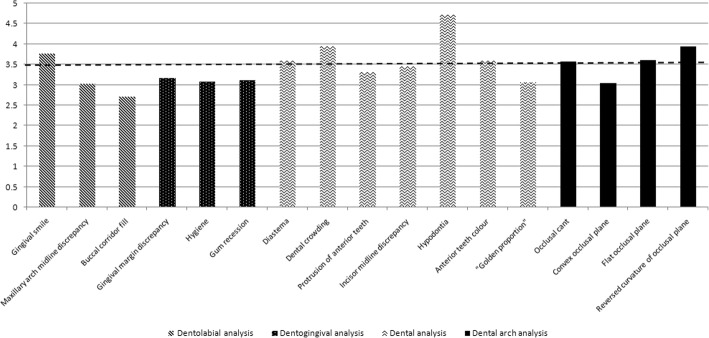
The study included 336 local and 95 international dental students (132 men [30.6%], 299 women [69.4%]). Significantly more women than men focused on a person's teeth when communicating (41.5% vs.32.6%, p < 0.005). Women were more critical than men when evaluating gingival smile, the 'golden proportion', occlusal cant, and dental crowding. The most unfavourable smile characteristics were identified in the dental analysis category, with hypodontia ranked as the worst smile feature (mean numeric rating scale score 4.71).
Among dental students, the most distracting characteristics of a smile when determining its attractiveness were hypodontia, gingival smile, a reversed curvature of the occlusal plane, and dental crowding.
一个有美感的微笑有许多组成部分,人们通常将良好的牙齿外观与生活中许多领域的成功联系起来。决定微笑美学的特征可以为治疗后的满意度提供重要的见解,并可能预测患者接受治疗时的目标。本研究旨在评估牙科学生如何感知微笑特征。
该研究在立陶宛健康科学大学的 431 名当地和国际牙科学生中进行。研究数据通过三部分问卷收集。问卷的第一部分包括社会人口统计学项目,即学生性别、年龄、国籍和学习年限;第二部分包括关于面部美学特征的问题;第三部分则是从立陶宛健康科学大学正畸诊所数据库中获取的 17 种不同微笑的照片。微笑美学通过 5 分制数字评分量表(1 分为最佳,5 分为最差)对牙唇、牙龈、牙齿和牙弓特征进行评估。使用 Pearson 卡方检验和 Mann-Whitney U 检验对数据进行分析。
研究包括 336 名当地和 95 名国际牙科学生(男 132 名[30.6%],女 299 名[69.4%])。与男性(32.6%)相比,女性在交流时更关注一个人的牙齿(41.5%,p<0.005)。在评估龈笑、“黄金比例”、咬合倾斜和牙齿拥挤时,女性比男性更为挑剔。在牙齿分析类别中,最不受欢迎的微笑特征被确定为缺牙,被评为最糟糕的微笑特征(平均数字评分量表评分为 4.71)。
在牙科学生中,在确定微笑吸引力时,最分散注意力的微笑特征是缺牙、龈笑、牙合平面的反向曲率和牙齿拥挤。