Amiri Parisa, Jalali-Farahani Sara, Vahedi-Notash Golnaz, Cheraghi Leila, Azizi Fereidoun
Research Center for Social Determinants of Health, Research Institute for Endocrine Sciences, Shahid Beheshti University of Medical Sciences, Tehran, Iran.
Biostatistics Department, Research Institute for Endocrine Sciences, Shahid Beheshti University of Medical Sciences, Tehran, Iran.
Int J Endocrinol Metab. 2018 Oct 16;16(4 Suppl):e84745. doi: 10.5812/ijem.84745. eCollection 2018 Oct.
Beyond the objective outcomes of metabolic syndrome (MetS), the association between this syndrome and its patient-centered outcomes need to be investigated in Middle-Eastern countries. This report aims to summarize the Tehran lipid and glucose study (TLGS) findings regarding the association between MetS and health-related quality of life (HRQoL) and its influential factors through the past decade.
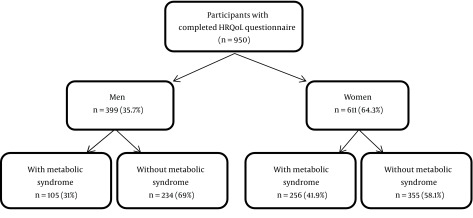
The current review has been conducted on the TLGS published data regarding different aspects of the association between MetS and HRQoL in adult participants through the last decade. To assess HRQoL, the Iranian version of short form health survey (SF-36) was used. To define MetS the most commonly used insulin resistance (IR)-and waist circumference (WC) - based MetS definitions have been applied in the publications reviewed.
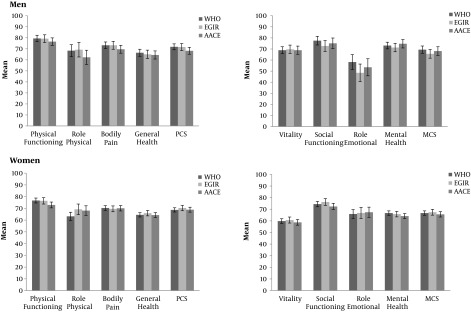
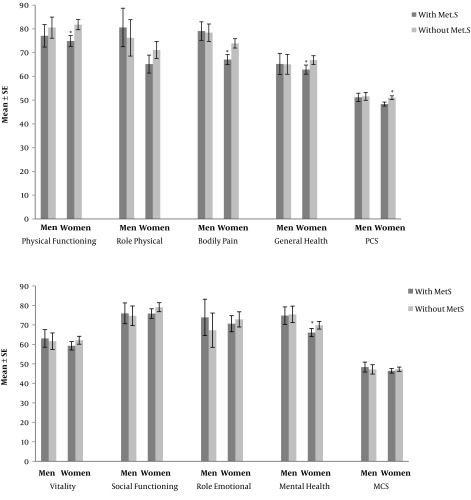
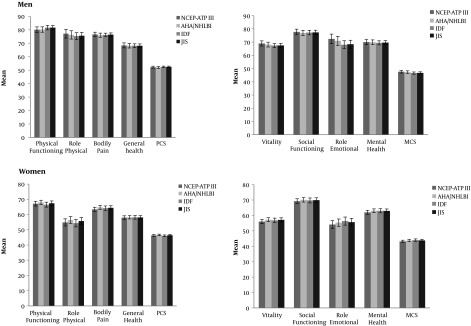
As a whole, MetS was a determinant of poor physical HRQoL only in women (OR: 1.78; 95% CI: 1.21 - 2.61), particularly in those with more component of MetS (P < 0.001). Results further showed that only reproductive aged women with MetS were more likely to report poor PCS compared to those without MetS even after adjusting for age (OR: 1.7, 95% CI: 1.0 - 3.0; P < 0.05). Different structures of MetS and physical HRQoL constructs in men and women as well as age and smoking with significant gender-specific effects on mental HRQoL were factors responsible for the gender specific pattern observed. Considering the duration of MetS, only women with intermittent MetS indicated higher risk for reporting poor PCS (OR: 2.75, 95% CI: 1.19 - 6.37; P < 0.001) compared to those without MetS. The observed sex-specific pattern used to detect poor HRQoL in those with MetS was confirmed by all WC-based definitions except for the American Heart Association/National Heart, Lung, and Blood Institute (AHA/NHLBI) definition. However, none of IR-based definitions could detect poor physical and mental HRQoL in either gender.
In summary, in the TLGS population, the association between MetS and HRQoL followed a sex specific pattern, mainly significant only in women and in the physical aspect.
除了代谢综合征(MetS)的客观结果外,该综合征与其以患者为中心的结果之间的关联需要在中东国家进行调查。本报告旨在总结德黑兰脂质和葡萄糖研究(TLGS)在过去十年中关于MetS与健康相关生活质量(HRQoL)之间的关联及其影响因素的研究结果。
本次综述是基于TLGS过去十年发表的关于成年参与者中MetS与HRQoL关联不同方面的数据进行的。为了评估HRQoL,使用了伊朗版的简短健康调查问卷(SF - 36)。为了定义MetS,在所审查的出版物中应用了最常用的基于胰岛素抵抗(IR)和腰围(WC)的MetS定义。
总体而言,MetS仅是女性身体HRQoL较差的一个决定因素(比值比:1.78;95%置信区间:1.21 - 2.61),尤其是在具有更多MetS组分的女性中(P < 0.001)。结果进一步表明,即使在调整年龄后,与没有MetS的女性相比,只有患有MetS的育龄女性更有可能报告较差的身体成分总结量表(PCS)评分(比值比:1.7,95%置信区间:1.0 - 3.0;P < 0.05)。男性和女性中MetS与身体HRQoL结构的不同,以及年龄和吸烟对心理HRQoL有显著的性别特异性影响,这些都是观察到的性别特异性模式的影响因素。考虑到MetS的持续时间,与没有MetS的女性相比,只有患有间歇性MetS的女性报告较差PCS评分的风险更高(比值比:2.75,95%置信区间:1.19 - 6.37;P < 0.001)。除了美国心脏协会/美国国立心肺血液研究所(AHA/NHLBI)的定义外,所有基于WC的定义都证实了在患有MetS的人群中观察到的用于检测HRQoL较差的性别特异性模式。然而,基于IR的定义均无法检测出任何一种性别的身体和心理HRQoL较差情况。
总之,在TLGS人群中,MetS与HRQoL之间的关联呈现出性别特异性模式,主要仅在女性和身体方面具有显著性。