Huang Jinrong, Shen Yang, Jian Weijun, Xu Haipeng, Li Meiyan, Zhao Jing, Zhou Xingtao, Liao Hongfei
Department of Ophthalmology, The First Affiliated Hospital of Jiangxi Medical College, Shang Rao, Jiangxi Province, China.
Department of Ophthalmology, The Affiliated Eye Hospital of Nanchang University, 463 Bayi Avenue, Nanchang, 330006, Jiangxi Province, China.
BMC Ophthalmol. 2018 Dec 27;18(1):337. doi: 10.1186/s12886-018-0999-4.
Conventional corneal cross-linking is effective for retarding the progression of keratoconus. However the long-term efficacy and safety of accelerated (45 mW/cm2) transepithelial corneal cross-linking (ATE-CXL) on progressive keratoconus (KC) treatment is not fully understood. The purpose of this study is to evaluate the 2-year changes in corneal topographic parameters and densitometry values after ATE-CXL for KC.
Twenty-five progressive eyes of 25 KC patients (KC group) and 25 eyes of 25 myopes without KC (control group) were enrolled. Corneal topography and densitometry values were evaluated pre-operatively and at 6, 12 and 24 months post-operatively in the KC group.
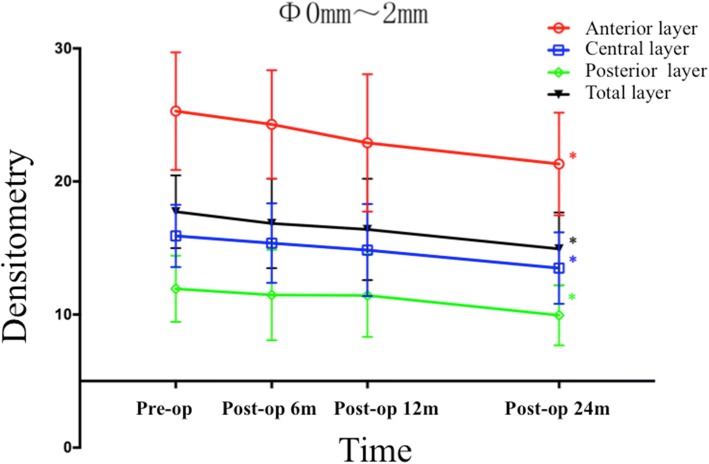
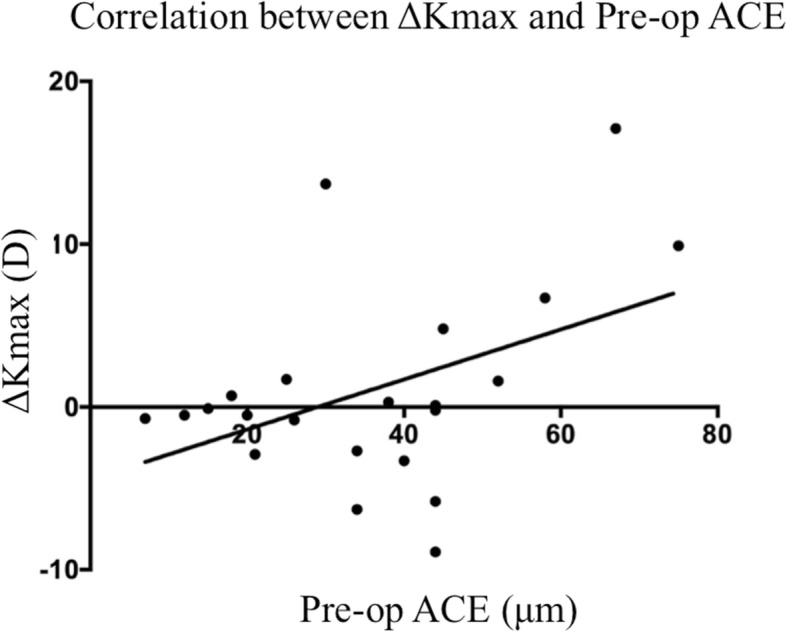
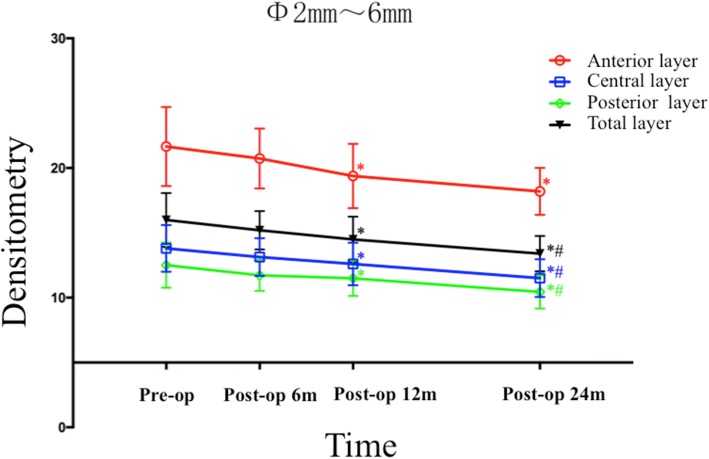
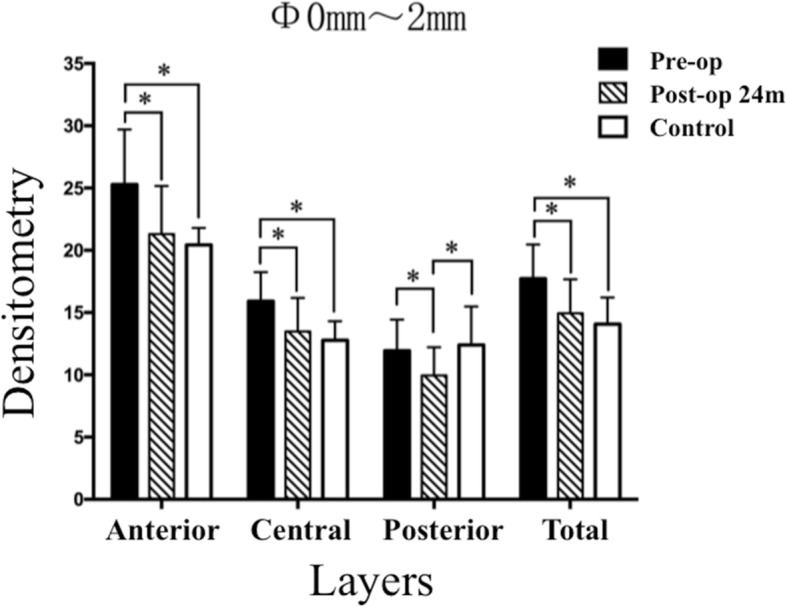
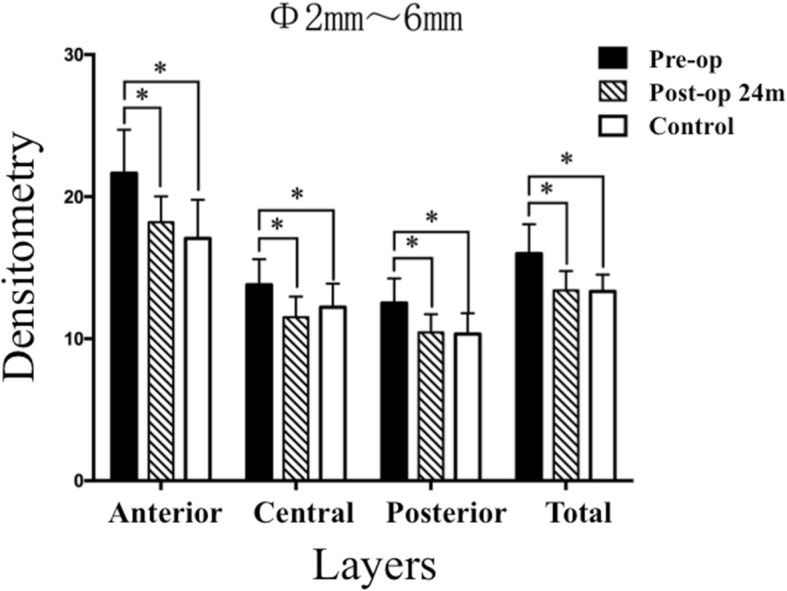
The mean values of flat keratometry (K1), steep keratometry (K2), mean keratometry (Km), corneal astigmatism (CA), maximum keratometry (Kmax), central corneal thickness (CCT), thinnest corneal thickness (TCT), anterior corneal elevation (ACE) and posterior corneal elevation (PCE) all remained unchanged over time (all P values > 0.05). The densitometry values of the anterior, central, posterior and total layers over the annular diameters 0 mm to 2 mm (Φ0-2 mm) and Φ2-6 mm all decreased significantly (all P values < 0.05). At post-operative month 24, except for the densitometry value of the posterior layer (Φ0-2 mm), which was significantly lower than that of the control group (post hoc P = 0.010), all densitometry values obtained from the remaining locations of the KC eyes were equal to those of the control group (All post hoc P values > 0.05). Subgroups with Km ≥ 50.30D or ACE ≥35.3 μm progressed significantly when compared with those with Km < 50.30D (F = 8.167, P = 0.004) or ACE< 35.3 μm (F = 5.207, P = 0.022).
K1, K2, Km, CA, Kmax, CCT, TCT, ACE, and PCE values may remain stable but severer KC patients tend to have poorer long-term outcomes. The densitometry values of the full corneal thickness (total layer over Φ0-2 mm and Φ2-6 mm) may decrease to normal levels at 2 years after ATE-CXL for KC.
传统角膜交联术在延缓圆锥角膜进展方面有效。然而,加速(45 mW/cm2)经上皮角膜交联术(ATE-CXL)治疗进行性圆锥角膜(KC)的长期疗效和安全性尚未完全明确。本研究的目的是评估KC患者接受ATE-CXL术后2年角膜地形图参数和密度测定值的变化。
纳入25例KC患者的25只进行性患眼(KC组)和25例无KC的近视患者的25只眼(对照组)。KC组在术前及术后6、12和24个月评估角膜地形图和密度测定值。
平角膜曲率(K1)、陡角膜曲率(K2)、平均角膜曲率(Km)、角膜散光(CA)、最大角膜曲率(Kmax)、中央角膜厚度(CCT)、最薄角膜厚度(TCT)、前角膜高度(ACE)和后角膜高度(PCE)的平均值随时间均保持不变(所有P值> 0.05)。在环形直径0 mm至2 mm(Φ0-2 mm)和Φ2-6 mm范围内,前、中、后层及全层的密度测定值均显著降低(所有P值< 0.05)。术后24个月时,除后层(Φ0-2 mm)的密度测定值显著低于对照组(事后检验P = 0.010)外,KC组其余部位获得的所有密度测定值均与对照组相等(所有事后检验P值> 0.05)。与Km< 50.30D(F = 8.167,P = 0.004)或ACE< 35.3 μm(F = 5.207,P = 0.022)的亚组相比,Km≥ 50.30D或ACE≥35.3 μm的亚组进展显著。
K1、K2、Km、CA、Kmax、CCT、TCT、ACE和PCE值可能保持稳定,但病情较重的KC患者长期预后往往较差。KC患者接受ATE-CXL术后2年,全角膜厚度(Φ0-2 mm和Φ2-6 mm范围内的全层)的密度测定值可能降至正常水平。