Feldhaus Isabelle, Mathauer Inke
Department of Global Health and Population, Harvard T.H. Chan School of Public Health, 665 Huntington Avenue, Boston, MA, 02115, USA.
Department of Health Systems Governance and Financing, World Health Organisation, Avenue Appia, 1211, Geneva, Switzerland.
BMC Health Serv Res. 2018 Dec 27;18(1):996. doi: 10.1186/s12913-018-3779-1.
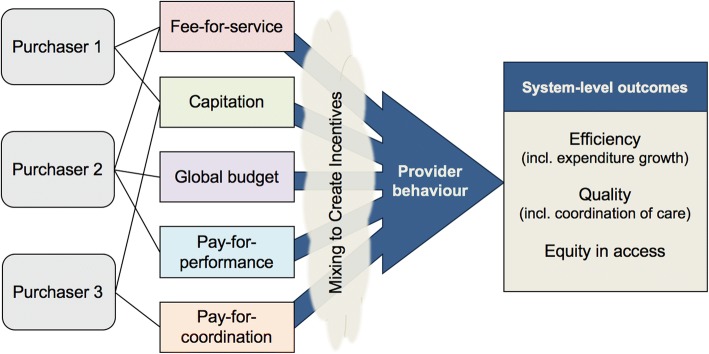
Strategic purchasing of health care services has become a key policy measure on the path to achieving universal health coverage. National provider payment systems for health services are typically characterized by mixes of provider payment methods with each method associated with distinct incentives for provider behaviours. Reaching incentive alignment across methods is critical to enhancing the effectiveness of strategic purchasing.
A structured literature review was conducted to synthesize the evidence on how purposively aligned mixed provider payment systems affect health expenditure growth management, efficiency, and equity in access to services with a particular focus on coordinated and/or integrated care management.
The majority of the 37 reviewed articles focused on high-income countries with 74% from the US. Four categories of payment mixes were examined in this review: blended payment, bundled payment, cost-containment reward models, and aligned cost sharing mechanisms. Blended payment models generally reported moderate to no substantive reductions in expenditure growth, but increases in health system efficiency. Bundled payment schemes consistently report increases in efficiency and corresponding cost savings. Cost-containment rewards generated cost savings that can contribute to effective management of health expenditure growth. Evidence on aligned cost-sharing is scarce.
There is lacking evidence on when and how mixed provider payment systems and cost sharing practices align towards achieving goals. A guiding framework for how to study and evaluate mixed provider payment systems across contexts is warranted. Future research should consider a conceptual framework explicitly acknowledging the complex nature of mixed provider payment systems.
医疗服务的战略采购已成为实现全民健康覆盖道路上的一项关键政策措施。国家医疗服务提供者支付系统的典型特征是多种支付方式的混合,每种方式都与对提供者行为的不同激励措施相关联。实现不同支付方式之间的激励一致性对于提高战略采购的有效性至关重要。
进行了一项结构化文献综述,以综合关于有目的地调整混合提供者支付系统如何影响医疗支出增长管理、效率以及服务可及性公平性的证据,特别关注协调和/或综合护理管理。
37篇被审查文章中的大多数聚焦于高收入国家,其中74%来自美国。本综述考察了四类支付组合:混合支付、捆绑支付、成本控制奖励模式以及调整后的成本分担机制。混合支付模式通常报告支出增长有中度至无实质性下降,但卫生系统效率有所提高。捆绑支付方案一致报告效率提高及相应成本节约。成本控制奖励带来了成本节约,有助于有效管理医疗支出增长。关于调整后的成本分担的证据很少。
缺乏关于混合提供者支付系统和成本分担做法何时以及如何朝着实现目标进行调整的证据。有必要建立一个关于如何在不同背景下研究和评估混合提供者支付系统的指导框架。未来的研究应考虑一个明确承认混合提供者支付系统复杂性的概念框架。