Global Health Division, Menzies School of Health Research and Charles Darwin University, Darwin, NT, Australia; WorldWide Antimalarial Resistance Network, Oxford, UK.
Centre for Epidemiology and Biostatistics, Melbourne School of Population and Global Health, The University of Melbourne, Melbourne, VIC, Australia.
Lancet Infect Dis. 2019 Jan;19(1):91-101. doi: 10.1016/S1473-3099(18)30596-6.
A 14-day course of primaquine is used for radical cure of Plasmodium vivax and Plasmodium ovale malaria only. We quantified the risk of P vivax parasitaemia after treatment of Plasmodium falciparum with commonly used antimalarial drugs to assess the potential benefits of radical cure for all patients with uncomplicated malaria in co-endemic regions.
In this systematic review and meta-analysis, we searched MEDLINE, Embase, Web of Science, and the Cochrane Database of Systematic Reviews for prospective clinical studies in any language, published between Jan 1, 1960, and Jan 5, 2018, assessing drug efficacy in patients with uncomplicated P falciparum malaria in countries co-endemic for P vivax. Studies were included if the presence or absence of P vivax parasitaemia was recorded after treatment. The primary outcome was the risk of P vivax parasitaemia between day 7 and day 42 after initiation of antimalarial treatment for P falciparum, with the pooled risk calculated by random-effects meta-analysis. We compared the risk of P vivax parasitaemia after treatment with different artemisinin-based combination therapies (ACTs). This study is registered with PROSPERO, number CRD42017064838.
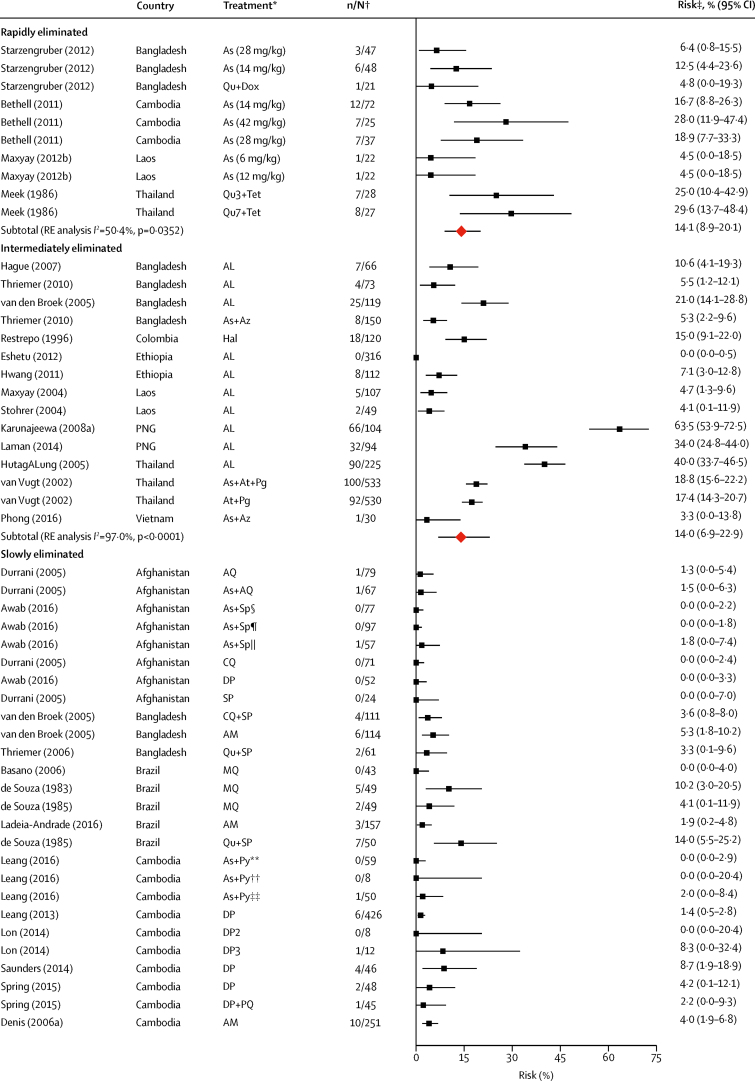
153 of 891 screened studies were included in the analysis, including 31 262 patients from 323 site-specific treatment groups: 130 (85%) studies were from the Asia-Pacific region, 16 (10%) from the Americas, and seven (5%) from Africa. The risk of P vivax parasitaemia by day 42 was 5·6% (95% CI 4·0-7·4; I=92·0%; 117 estimates). The risk of P vivax parasitaemia was 6·5% (95% CI 4·6-8·6) in regions of short relapse periodicity compared with 1·9% (0·4-4·0) in regions of long periodicity, and was greater after treatment with a more rapidly eliminated ACT: 15·3% (5·1-29·3) for artemether-lumefantrine compared with 4·5% (1·2-9·3) for dihydroartemisinin-piperaquine and 5·2% (2·9-7·9) for artesunate-mefloquine. Recurrent parasitaemia was delayed in patients treated with ACTs containing mefloquine or piperaquine compared with artemether-lumefantrine, but by day 63 the risk of vivax parasitaemia was more than 15% for all ACTs assessed.
Our findings show a high risk of vivax parasitaemia after treatment of falciparum malaria, particularly in areas with short relapse periodicity and after rapidly eliminated treatment. In co-endemic regions, universal radical cure for all patients with uncomplicated malaria has the potential to substantially reduce recurrent malaria.
Australian National Health and Medical Research Council, Royal Australasian College of Physicians, Wellcome Trust, and Bill & Melinda Gates Foundation.
青蒿素类药物 14 天疗程仅用于根治间日疟和卵形疟疟疾。我们量化了在使用常用抗疟药物治疗恶性疟后发生间日疟寄生虫血症的风险,以评估在共流行地区所有无并发症疟疾患者中根治治疗的潜在益处。
在这项系统评价和荟萃分析中,我们检索了 MEDLINE、Embase、Web of Science 和 Cochrane 系统评价数据库,以获取 1960 年 1 月 1 日至 2018 年 1 月 5 日期间发表的任何语言的前瞻性临床研究,评估在间日疟流行地区无并发症恶性疟患者中药物疗效。纳入研究需记录治疗后有无间日疟寄生虫血症。主要结局是在开始治疗恶性疟后的第 7 天至第 42 天之间发生间日疟寄生虫血症的风险,采用随机效应荟萃分析计算汇总风险。我们比较了不同的青蒿素类复方疗法(ACTs)治疗后的间日疟寄生虫血症风险。本研究已在 PROSPERO 注册,编号为 CRD42017064838。
在 891 项筛选研究中,有 153 项研究被纳入分析,包括来自 323 个特定地点治疗组的 31062 名患者:130 项(85%)研究来自亚太地区,16 项(10%)来自美洲,7 项(5%)来自非洲。第 42 天间日疟寄生虫血症的风险为 5.6%(95%CI 4.0-7.4;I=92.0%;117 项估计值)。在复发周期较短的地区,间日疟寄生虫血症的风险为 6.5%(95%CI 4.6-8.6),而在复发周期较长的地区为 1.9%(0.4-4.0),ACT 消除速度越快,间日疟寄生虫血症的风险越高:与双氢青蒿素-哌喹相比,蒿甲醚-本芴醇的风险为 15.3%(5.1-29.3),而与蒿甲醚-本芴醇相比,蒿甲醚-本芴醇的风险为 4.5%(1.2-9.3)。与蒿甲醚-本芴醇相比,含有甲氟喹或哌喹的 ACT 治疗后寄生虫血症复发延迟,但到第 63 天,所有评估的 ACT 发生间日疟寄生虫血症的风险均超过 15%。
我们的研究结果表明,在治疗恶性疟后,间日疟寄生虫血症的风险很高,特别是在复发周期较短和消除较快的地区。在共流行地区,对所有无并发症疟疾患者进行普遍根治治疗有可能大大减少复发性疟疾。
澳大利亚国家卫生与医学研究理事会、澳大利亚皇家内科医师学院、惠康信托基金会和比尔及梅琳达·盖茨基金会。