Wang Yichao, Yang Ruixue, Wang Xiaolin, Ci Hongfei, Zhou Lei, Zhu Bo, Wu Shiwu, Wang Danna
Department of Pathology, The First Affiliated Hospital of Bengbu Medical College.
Department of Pathology, Bengbu Medical College, Bengbu, Anhui Province, China.
Medicine (Baltimore). 2018 Dec;97(52):e13817. doi: 10.1097/MD.0000000000013817.
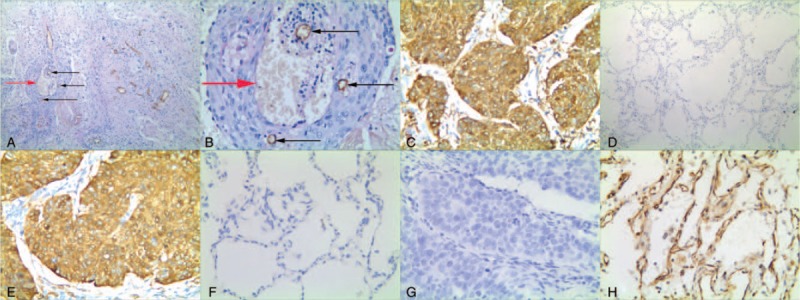
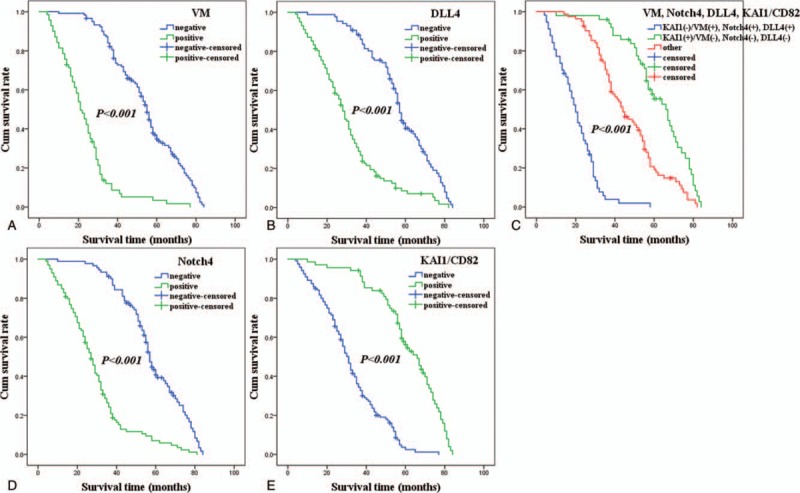
Vasculogenic mimicry (VM) is a new blood supply style in tumors and has long been treated as a useful factor in malignant tumor metastasis and prognosis. Notch4 (a marker of Notch signaling pathway receptors), DLL4 (a marker of Notch signaling pathway ligands) and KAI1/CD82 (a suppressor gene of tumor metastasis) are all effective predictive factors for tumor metastasis. In this study, we analyzed correlations among VM, Notch4, DLL4, and KAI1/CD82 in non-small cell lung cancer (NSCLC), and their respective associations with patients' clinicopathological parameters and survival rate in NSCLC.Positive rates of VM, Notch4, DLL4, and KAI1/CD82 in 189 whole NSCLC specimens were detected by histochemical and immunohistochemical staining. Moreover, patients' clinicopathological information was also collected.Positive rates of VM, Notch4, and DLL4 were significantly higher, and levels of KAI1/CD82 were significantly lower in NSCLC than in normal lung tissues. Positive rates of VM, Notch4, and DLL4 were positively associated with tumor size, lymph node metastasis (LNM), distant metastasis (DM) and tumor-node-metastasis (TNM) stage, and inversely with patients, overall survival (OS) time and positive rate of DLL4 were positively associated with tumor grade. Levels of KAI1/CD82 were negatively associated with tumor size, LNM, DM, and TNM stage. The KAI1/CD82+ subgroup had significantly longer OS time than did the KAI1/CD82- subgroup. In multivariate analysis, high VM, Notch4, DLL4 levels, tumor size, LNM, DM, TNM stage, and low KAI1/CD82 levels were potential to be independent prognostic factors for overall survival time (OST) in NSCLC patients.VM and the expression of Notch4, DLL4, and KAI1/CD82 represent promising markers for tumor metastasis and prognosis, and maybe potential therapeutic targets for NSCLC.
血管生成拟态(VM)是肿瘤中一种新的血液供应方式,长期以来一直被视为恶性肿瘤转移和预后的一个重要因素。Notch4(Notch信号通路受体的标志物)、DLL4(Notch信号通路配体的标志物)和KAI1/CD82(肿瘤转移抑制基因)都是肿瘤转移的有效预测因子。在本研究中,我们分析了非小细胞肺癌(NSCLC)中VM、Notch4、DLL4和KAI1/CD82之间的相关性,以及它们与NSCLC患者临床病理参数和生存率的各自关联。通过组织化学和免疫组织化学染色检测了189例NSCLC全组织标本中VM、Notch4、DLL4和KAI1/CD82的阳性率。此外,还收集了患者的临床病理信息。NSCLC中VM、Notch4和DLL4的阳性率显著高于正常肺组织,而KAI1/CD82的水平显著低于正常肺组织。VM、Notch4和DLL4的阳性率与肿瘤大小、淋巴结转移(LNM)、远处转移(DM)和肿瘤-淋巴结-转移(TNM)分期呈正相关,与患者的总生存(OS)时间呈负相关,DLL4的阳性率与肿瘤分级呈正相关。KAI1/CD82的水平与肿瘤大小、LNM、DM和TNM分期呈负相关。KAI1/CD82阳性亚组的OS时间明显长于KAI1/CD82阴性亚组。在多因素分析中,高VM、Notch4、DLL4水平、肿瘤大小、LNM、DM、TNM分期以及低KAI1/CD82水平有可能成为NSCLC患者总生存时间(OST)的独立预后因素。VM以及Notch4、DLL4和KAI1/CD82的表达是肿瘤转移和预后的有前景的标志物,可能是NSCLC潜在的治疗靶点。