School of Perfume and Aroma Technology, Shanghai Institute of Technology, Shanghai, 201418, People's Republic of China.
Shanghai-MOST Key Laboratory of Health and Disease Genomics, Chinese National Human Genome Center at Shanghai, Shanghai, 201203, People's Republic of China.
Microb Cell Fact. 2018 Dec 28;17(1):201. doi: 10.1186/s12934-018-1050-4.
The catabolite control protein A (CcpA) is a master regulator of many important cellular processes in Gram-positive bacteria. In Lactobacillus plantarum, CcpA directly or indirectly controls the transcription of a large number of genes that are involved in carbohydrate metabolism, aerobic and anaerobic growth, stress response and metabolite production, but its role in response to different carbon sources remains unclear.
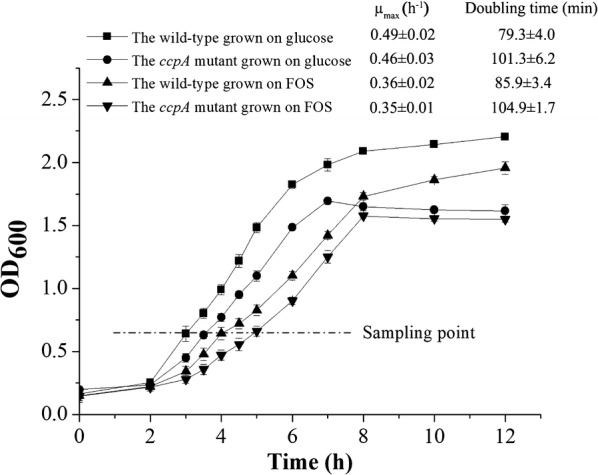
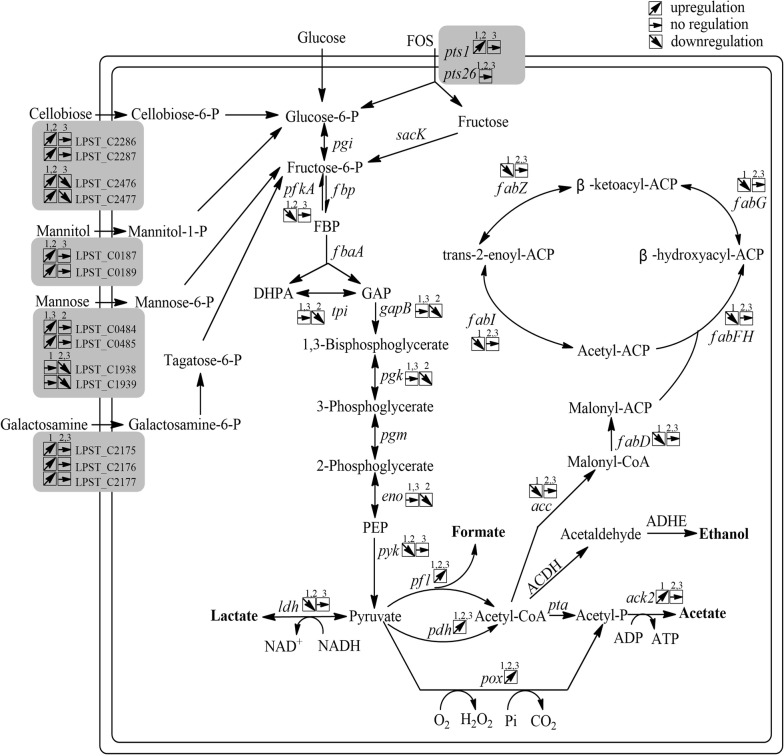
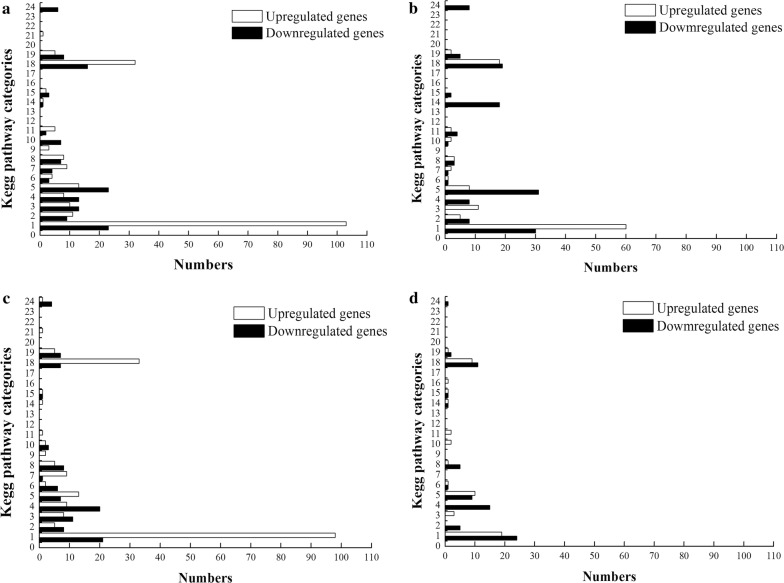
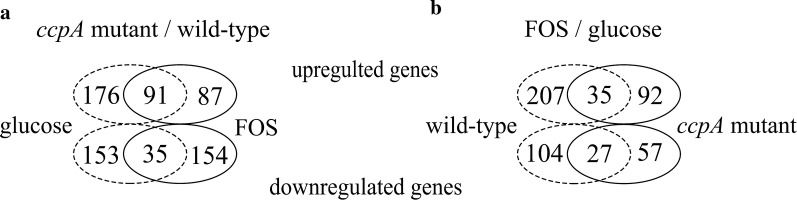
Here a combined transcriptomic and physiological approach was used to survey the global alterations that occurred during the logarithmic growth phase of wild-type and ccpA mutant strains of L. plantarum ST-III using fructooligosaccharides (FOS) or glucose as the sole carbon source. The inactivation of ccpA significantly affected the growth and production of metabolites under both carbon sources. About 15% of the total genes were significantly altered between wild-type and ccpA strains grown on glucose and the value is deceased to 12% when these two strains were compared on FOS, while only 7% were obviously changed due to the loss of CcpA when comparing strains grown on glucose and FOS. Although most of the differentially expressed genes mediated by CcpA are glucose dependent, FOS can also induce carbon catabolite repression (CCR) through the CcpA pathway. Moreover, the inactivation of ccpA led to a transformation from homolactic fermentation to mixed fermentation under aerobic conditions. CcpA can control genes directly by binding in the regulatory region of the target genes (mixed fermentation), indirectly through local regulators (fatty acid biosynthesis), or have a double effect via direct and indirect regulation (FOS metabolism).
Overall, our results show that CcpA plays a central role in response to carbon source and availability of L. plantarum and provide new insights into the complex and extended regulatory network of lactic acid bacteria.
分解代谢物激活蛋白 A(CcpA)是革兰氏阳性菌许多重要细胞过程的主要调节因子。在植物乳杆菌中,CcpA 直接或间接控制着大量参与碳水化合物代谢、需氧和厌氧生长、应激反应和代谢产物生产的基因的转录,但它在应对不同碳源方面的作用仍不清楚。
在这里,采用组合转录组学和生理学方法,使用低聚果糖(FOS)或葡萄糖作为唯一碳源,研究了野生型和 ccpA 突变型植物乳杆菌 ST-III 对数生长期的全局变化。ccpA 的失活显著影响了两种碳源下的生长和代谢产物的产生。在葡萄糖上生长的野生型和 ccpA 菌株之间,约有 15%的总基因发生了显著改变,而在 FOS 上比较时,这一数值下降到 12%,而当比较在葡萄糖和 FOS 上生长的菌株时,由于 CcpA 的缺失,只有 7%的基因明显改变。尽管 CcpA 介导的大多数差异表达基因是葡萄糖依赖性的,但 FOS 也可以通过 CcpA 途径诱导碳分解代谢物阻遏(CCR)。此外,ccpA 的失活导致有氧条件下从同型乳酸发酵向混合发酵的转变。CcpA 可以通过直接结合靶基因的调节区域(混合发酵)、间接通过局部调节因子(脂肪酸生物合成)或通过直接和间接调节的双重作用(FOS 代谢)来控制基因。
总的来说,我们的研究结果表明,CcpA 在植物乳杆菌对碳源和可用性的响应中起核心作用,并为乳酸菌复杂而扩展的调控网络提供了新的见解。