Institute of Bioinformatics and Systems Biology, National Chiao Tung University, Hsinchu, Taiwan.
Graduate Institute of Biomedical Informatics, Taipei Medical University, Taipei, Taiwan.
BMC Genomics. 2018 Dec 31;19(Suppl 10):876. doi: 10.1186/s12864-018-5284-7.
One of the most common and recurrent vaginal infections is bacterial vaginosis (BV). The diagnosis is based on changes to the "normal" vaginal microbiome; however, the normal microbiome appears to differ according to reproductive status and ethnicity, and even among individuals within these groups. The Amsel criteria and Nugent score test are widely used for diagnosing BV; however, these tests are based on different criteria, and so may indicate distinct changes in the vaginal microbial community. Nevertheless, few studies have compared the results of these test against metagenomics analysis.
Vaginal flora samples from 77 participants were classified according to the Amsel criteria and Nugent score test. The microbiota composition was analyzed using 16S ribosome RNA gene amplicon sequencing. Bioinformatics analysis and multivariate statistical analysis were used to evaluate the microbial diversity and function.
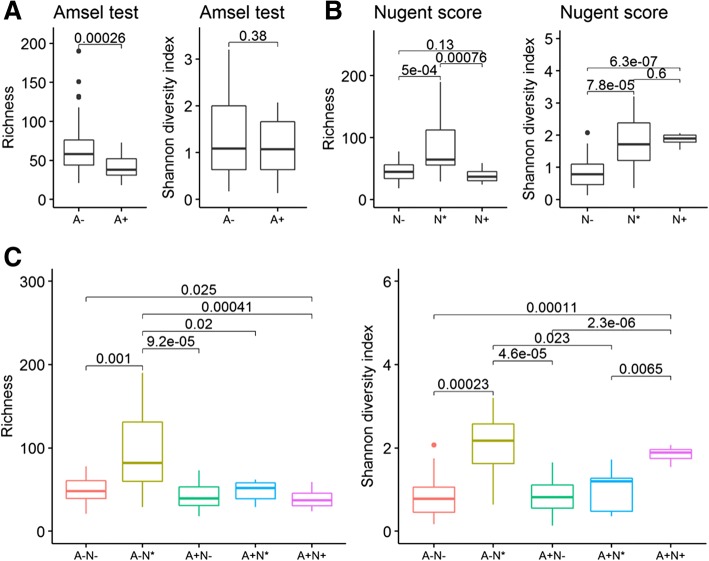
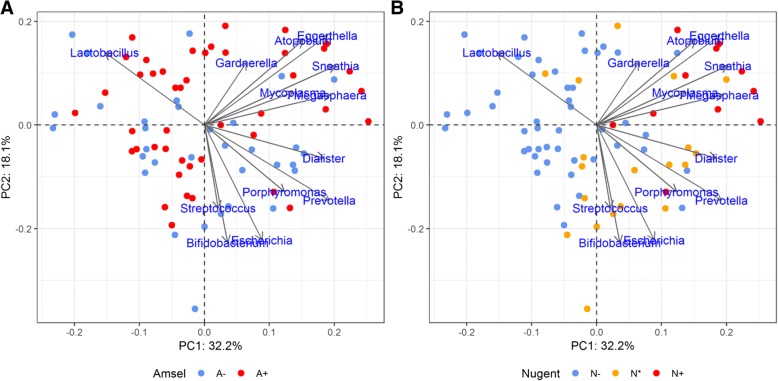
Only 3 % of the participants diagnosed BV negative using the Amsel criteria (A-) were BV-positive according to the Nugent score test (N+), while over half of the BV-positive patients using the Amsel criteria (A+) were BV-negative according to the Nugent score test (N-). Thirteen genera showed significant differences in distribution among BV status defined by BV tests (e.g., A - N-, A + N- and A + N+). Variations in the four most abundant taxa, Lactobacillus, Gardnerella, Prevotella, and Escherichia, were responsible for most of this dissimilarity. Furthermore, vaginal microbial diversity differed significantly among the three groups classified by the Nugent score test (N-, N+, and intermediate flora), but not between the Amsel criteria groups. Numerous predictive microbial functions, such as bacterial chemotaxis and bacterial invasion of epithelial cells, differed significantly among multiple BV test, but not between the A- and A+ groups.
Metagenomics analysis can greatly expand our current understanding of vaginal microbial diversity in health and disease. Metagenomics profiling may also provide more reliable diagnostic criteria for BV testing.
细菌性阴道病(BV)是最常见和最常复发的阴道感染之一。诊断基于“正常”阴道微生物组的变化;然而,正常微生物组似乎因生殖状态和种族而异,甚至在这些群体中的个体之间也是如此。Amsel 标准和 Nugent 评分试验广泛用于诊断 BV;然而,这些测试基于不同的标准,因此可能表明阴道微生物群落的不同变化。尽管如此,很少有研究将这些测试的结果与宏基因组分析进行比较。
根据 Amsel 标准和 Nugent 评分试验对 77 名参与者的阴道菌群样本进行分类。使用 16S 核糖体 RNA 基因扩增子测序分析微生物群落组成。采用生物信息学分析和多变量统计分析评估微生物多样性和功能。
根据 Nugent 评分试验(N+),仅 3%的 Amsel 标准(A-)诊断为 BV 阴性的参与者被诊断为 BV 阳性,而超过一半的 Amsel 标准(A+)诊断为 BV 阳性的患者根据 Nugent 评分试验(N-)被诊断为 BV 阴性。13 个属在根据 BV 试验定义的 BV 状态(例如,A-N-、A+-N-和 A+-N+)之间的分布存在显著差异。四种最丰富的分类群(乳杆菌属、加德纳菌属、普雷沃菌属和埃希氏菌属)的变化是造成这种差异的主要原因。此外,根据 Nugent 评分试验(N-、N+和中间菌群)分类的三组之间的阴道微生物多样性存在显著差异,但 Amsel 标准组之间没有差异。许多预测微生物功能,如细菌趋化性和细菌上皮细胞入侵,在多个 BV 试验之间存在显著差异,但在 A-和 A+组之间没有差异。
宏基因组分析可以极大地扩展我们对健康和疾病中阴道微生物多样性的现有认识。宏基因组分析也可能为 BV 检测提供更可靠的诊断标准。