An Hye Sun, Ko Suhui, Bang Ji Hwan, Park Sang Won
Infection Control Office, Boramae Medical Center, Seoul, Korea.
Department of Internal Medicine, Boramae Medical Center and Seoul National University College of Medicine, Seoul, Korea.
Infect Chemother. 2018 Dec;50(4):319-327. doi: 10.3947/ic.2018.50.4.319.
Lancet-related needlestick injuries (NSIs) occur steadily in clinical practices. Safety-engineered devices (SEDs) can systematically reduce NSIs. However, the use of SEDs is not active and no study to guide the implementation of SEDs was known in South Korea. The lancet-related NSIs may be eliminated to zero incidence using a SED lancet with effective sharp injury protection and reuse prevention features.
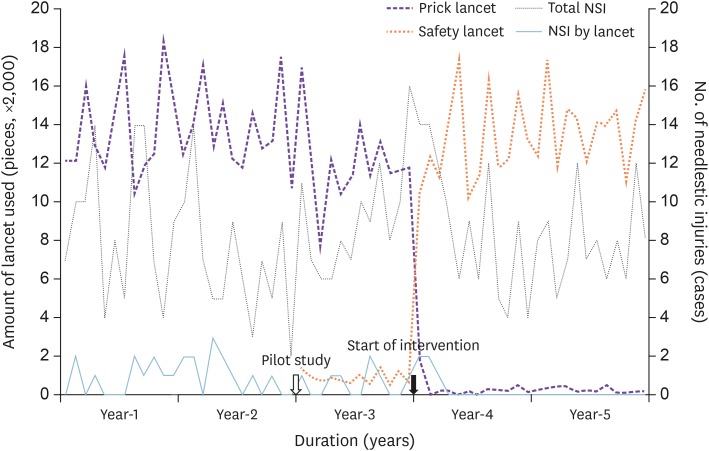
We implemented a SED lancet by replacing a conventional prick lancet in a tertiary hospital in a sequential approach. A spot test of the new SED was conducted for 1 month to check the acceptability in practice and a questionnaire survey was obtained from the healthcare workers (HCWs). A pilot implementation of the SED lancet in 2 wards was made for 1 year. Based on these preliminary interventions, a hospital-wide full implementation of the SED lancet was launched. The incidence of NSIs and cost expenditure before and after the intervention were compared.
There were 29 cases of conventional prick lancet-related NSIs for 3 years before the full implementation of SED lancet. The proportion of prick lancet-related NSIs among yearly all kinds of NSIs during two years before the pilot study was average 11.7% (22/188). Pre-interventional baseline incidence of all kinds of NSIs was 7.01 per 100 HCW-years. After the full implementation of SED lancet, the lancet-related NSIs became zero in the 2nd year ( = 0.001). The average direct cost of 18,393 US dollars (USD) per year from device and post-exposure medical care before the intervention rose to 20,701 USD in the 2nd year of the intervention. The incremental cost-effectiveness ratio was 210 USD per injury avoided.
The implementation of a SED lancet could eliminate the lancet-related NSIs to zero incidence. The cost increase incurred by the use of SED lancet was tolerable.
在临床实践中,与柳叶刀相关的针刺伤(NSIs)持续发生。安全工程设备(SEDs)可以系统性地减少针刺伤。然而,SEDs的使用并不积极,且在韩国尚无指导SEDs实施的研究。使用具有有效锐器损伤防护和防止重复使用功能的SED柳叶刀,与柳叶刀相关的针刺伤发病率可能降至零。
我们在一家三级医院采用循序渐进的方法,通过更换传统采血针来实施SED柳叶刀。对新的SED进行了为期1个月的现场测试,以检查其在实际应用中的可接受性,并向医护人员(HCWs)进行了问卷调查。在2个病房对SED柳叶刀进行了为期1年的试点实施。基于这些初步干预措施,在全院范围内全面推行SED柳叶刀。比较了干预前后针刺伤的发病率和成本支出。
在全面实施SED柳叶刀之前的3年里,有29例与传统采血针相关的针刺伤。在试点研究前两年中,每年各类针刺伤中与采血针相关的针刺伤比例平均为11.7%(22/188)。干预前各类针刺伤的基线发病率为每100名医护人员年7.01例。在全面实施SED柳叶刀后,第二年与柳叶刀相关的针刺伤发病率降为零(P = 0.001)。干预前每年因设备和暴露后医疗护理产生的平均直接成本为18393美元,在干预的第二年升至20701美元。每避免一例损伤的增量成本效益比为210美元。
实施SED柳叶刀可将与柳叶刀相关的针刺伤发病率降至零。使用SED柳叶刀导致的成本增加是可承受的。