Department of Epidemiology and Biostatistics, CUNY Graduate School of Public Health and Health Policy, City University of New York, 55 West 125th Street, New York, NY, 10027, USA.
CUNY Institute for Implementation Science in Population Health, City University of New York, 55 West 125th Street, New York, NY, 10027, USA.
BMC Public Health. 2019 Jan 3;19(1):7. doi: 10.1186/s12889-018-6345-1.
Truckers in sub-Saharan Africa are at higher risk of contracting HIV than the general population. HIV self-testing may be a way to increase testing rates in this high-risk population. The objective of this randomized controlled trial was to assess whether informing truckers who do not test for HIV regularly about the availability of HIV self-testing kits at roadside wellness centers in Kenya using text messages would increase HIV testing rates compared to the current program in which they are sent text messages about the availability of HIV testing in general.
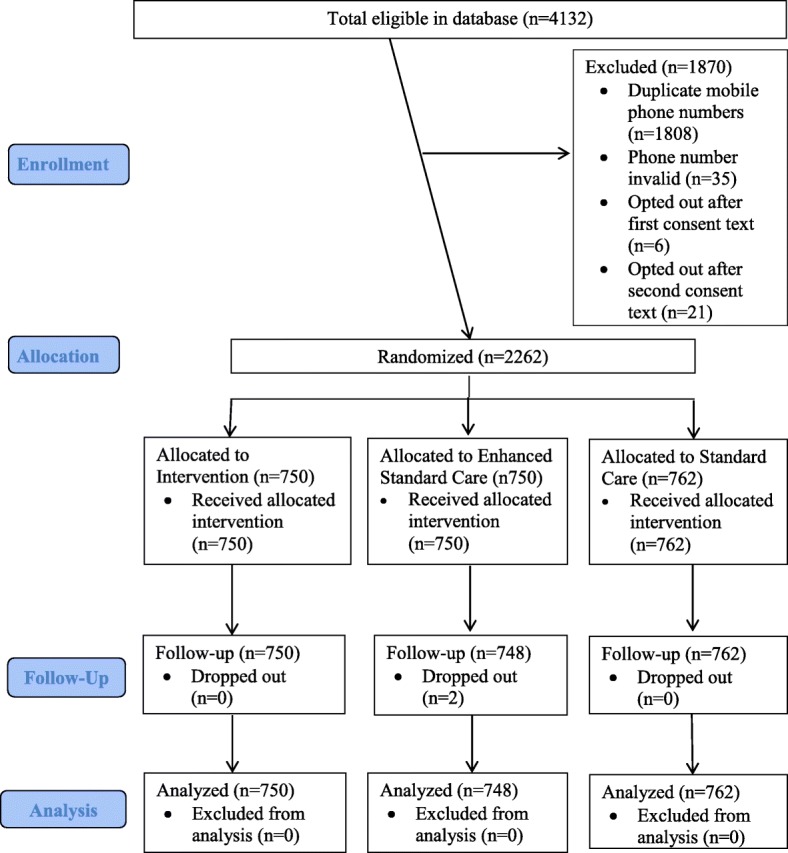
A sample of 2262 male truckers registered in the North Star Alliance electronic health record system who, based on these records, were not testing for HIV regularly were randomized to one of three study groups in which they were sent text messages about the availability of (1) oral HIV self-test kits at all 8 North Star Alliance Kenya clinics that was sent three times (intervention), (2) HIV testing in general (not self-testing) at all North Star Alliance clinics sent three times (enhanced standard of care [SOC]), or (3) HIV testing in general (not self-testing) at all North Star Alliance clinics sent one time (SOC). We looked at HIV testing over a 2-month study period following the first text.
Truckers in the intervention group were significantly more likely to test for HIV compared to those in the enhanced SOC (OR = 2.7, p = 0.009). There was no difference in HIV testing between those in the enhanced SOC and the SOC groups. Of those in the intervention group who tested, 64.5% chose the self-test and 35.5% chose the standard provider-administered blood-based HIV test. Although the intervention more than doubled HIV testing rates, because HIV testing rates were so low in this population (by design as we selected irregular testers), even in the intervention group more than 96% of participants did not test.
Announcing the availability of HIV self-testing via text message increased HIV testing rates among truckers who were not regularly accessing HIV testing. However, self-testing is only a partial solution to increasing testing rates in this hard to reach population.
This trial was registered prior to enrollment at the Registry for International Impact Evaluations (RIDIE STUDY ID: 582a2462ae2ab): http://ridie.3ieimpact.org/index.php?r=search/detailView&id=492 . It was also registered after completion at ClinicalTrials.gov ( ClinicalTrials.gov Identifier: NCT03662165): https://clinicaltrials.gov/ct2/show/NCT03662165?term=NCT03662165&type=Intr&cond=HIV&rank=1 .
撒哈拉以南非洲的卡车司机感染艾滋病毒的风险高于一般人群。艾滋病毒自我检测可能是提高这一高危人群检测率的一种方法。本随机对照试验的目的是评估通过短信告知不经常接受艾滋病毒检测的卡车司机,肯尼亚路边健康中心提供艾滋病毒自我检测试剂盒,是否会比目前的方案(即向他们发送有关一般艾滋病毒检测可用性的短信)提高艾滋病毒检测率。
从北方之星联盟电子健康记录系统中随机抽取 2262 名未定期接受艾滋病毒检测的男性卡车司机作为样本,根据这些记录,他们被随机分为三组,分别收到三条关于(1)北方之星联盟肯尼亚所有 8 个诊所提供的口服艾滋病毒自我检测试剂盒的短信(干预组)、(2)北方之星联盟所有诊所提供的一般艾滋病毒检测(非自我检测)的短信(增强型标准护理[SOC]),或(3)北方之星联盟所有诊所提供的一般艾滋病毒检测(非自我检测)的短信(SOC)。我们观察了首次短信后的 2 个月研究期内的艾滋病毒检测情况。
与增强型 SOC 组相比,干预组卡车司机接受艾滋病毒检测的可能性显著更高(OR=2.7,p=0.009)。增强型 SOC 组和 SOC 组之间的艾滋病毒检测没有差异。在干预组接受检测的人中,64.5%选择了自我检测,35.5%选择了标准的由提供者进行的基于血液的艾滋病毒检测。尽管该干预措施使艾滋病毒检测率翻了一番,但由于该人群的艾滋病毒检测率如此之低(由于我们选择了不规则的检测者,因此故意如此设计),即使在干预组中,也有超过 96%的参与者未接受检测。
通过短信宣布提供艾滋病毒自我检测服务,提高了未定期接受艾滋病毒检测的卡车司机的艾滋病毒检测率。然而,自我检测只是提高这一难以接触的人群检测率的部分解决方案。
本试验在登记前在国际影响评估登记处(RIDIE 研究 ID:582a2462ae2ab)注册:http://ridie.3ieimpact.org/index.php?r=search/detailView&id=492。在完成后,它也在 ClinicalTrials.gov 上注册(ClinicalTrials.gov 标识符:NCT03662165):https://clinicaltrials.gov/ct2/show/NCT03662165?term=NCT03662165&type=Intr&cond=HIV&rank=1。