Feig Michael, Nawrocki Grzegorz, Yu Isseki, Wang Po-Hung, Sugita Yuji
Department of Biochemistry and Molecular Biology, Michigan State University, East Lansing, MI, 48824 USA.
Quantitative Biology Center, RIKEN, Kobe, Japan.
J Phys Conf Ser. 2018;1036. doi: 10.1088/1742-6596/1036/1/012010. Epub 2018 Jun 27.
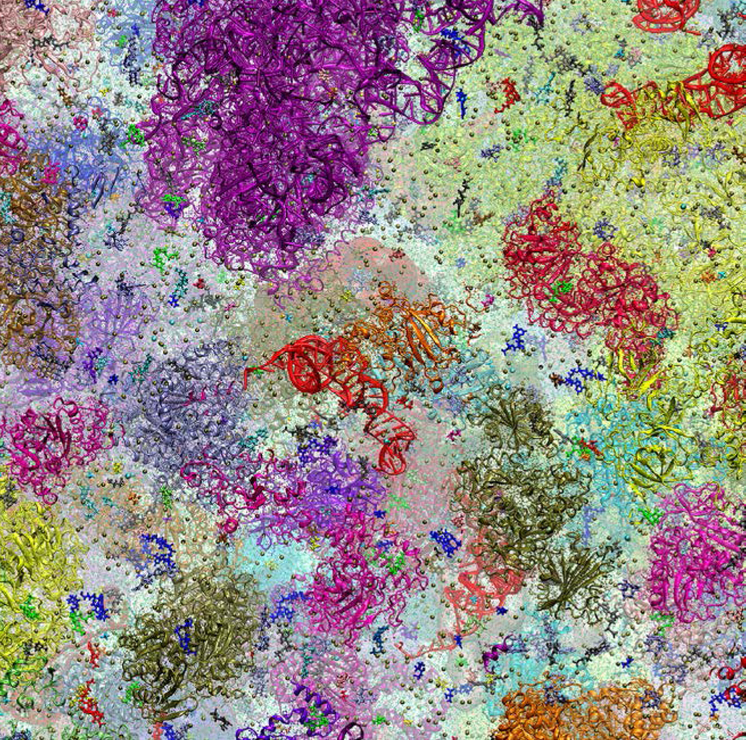
Computer simulations are widely used to study molecular systems, especially in biology. As simulations have greatly increased in scale reaching cellular levels there are now significant challenges in managing, analyzing, and interpreting such data in comparison with experiments that are being discussed. Management challenges revolve around storing and sharing terabyte to petabyte scale data sets whereas the analysis of simulations of highly complex systems will increasingly require automated machine learning and artificial intelligence approaches. The comparison between simulations and experiments is furthermore complicated not just by the complexity of the data but also by difficulties in interpreting experiments for highly heterogeneous systems. As an example, the interpretation of NMR relaxation measurements and comparison with simulations for highly crowded systems is discussed.
计算机模拟被广泛用于研究分子系统,尤其是在生物学领域。随着模拟规模大幅增加至细胞水平,与正在讨论的实验相比,在管理、分析和解释此类数据方面如今存在重大挑战。管理挑战主要围绕存储和共享从太字节到拍字节规模的数据集,而对高度复杂系统的模拟分析将越来越需要自动化机器学习和人工智能方法。此外,模拟与实验之间的比较不仅因数据的复杂性而变得复杂,还因解释高度异质系统的实验存在困难而变得复杂。例如,本文讨论了核磁共振弛豫测量的解释以及与高度拥挤系统模拟的比较。