Institute of Health Research, University of Exeter Medical School, St Luke's Campus, Exeter, UK.
Health Research, Lancaster University, Furness Building, Lancaster, UK.
BMC Psychiatry. 2019 Jan 7;19(1):7. doi: 10.1186/s12888-018-1997-z.
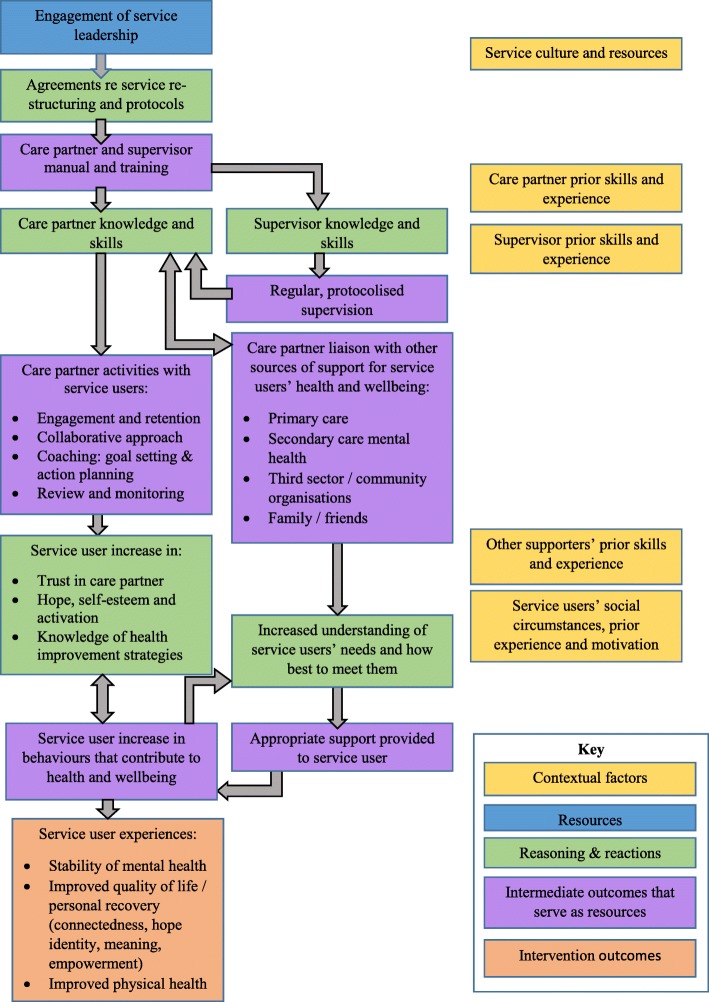
Many people diagnosed with schizophrenia, bipolar or other psychoses in England receive the majority of their healthcare from primary care. Primary care practitioners may not be well equipped to meet their needs and there is often poor communication with secondary care. Collaborative care is a promising alternative model but has not been trialled specifically with this service user group in England. Collaborative care for other mental health conditions has not been widely implemented despite evidence of its effectiveness. We carried out a formative evaluation of the PARTNERS model of collaborative care, with the aim of establishing barriers and facilitators to delivery, identifying implementation support requirements and testing the initial programme theory.
The PARTNERS intervention was delivered on a small scale in three sites. Qualitative data was collected from primary and secondary care practitioners, service users and family carers, using semi-structured interviews, session recordings and tape-assisted recall. Deductive and inductive thematic analysis was carried out; themes were compared to the programme theory and used to inform an implementation support strategy.
Key components of the intervention that were not consistently delivered as intended were: interaction with primary care teams, the use of coaching, and supervision. Barriers and facilitators identified were related to service commitment, care partner skills, supervisor understanding and service user motivation. An implementation support strategy was developed, with researcher facilitation of communication and supervision and additional training for practitioners. Some components of the intervention were not experienced as intended; this appeared to reflect difficulties with operationalising the intervention. Analysis of data relating to the intended outcomes of the intervention indicated that the mechanisms proposed in the programme theory had operated as expected.
Additional implementation support is likely to be required for the PARTNERS model to be delivered; the effectiveness of such support may be affected by practitioner and service user readiness to change. There is also a need to test the programme theory more fully. These issues will be addressed in the process evaluation of our full trial.
ISRCTN95702682 , 26 October 2017.
在英国,许多被诊断为精神分裂症、双相情感障碍或其他精神病的患者主要在初级保健机构接受医疗服务。初级保健医生可能无法满足他们的需求,并且与二级保健机构的沟通往往也很差。协作式护理是一种很有前途的替代模式,但尚未在英国针对该服务使用者群体进行专门试验。尽管协作式护理对其他心理健康状况的有效性已得到证实,但它并未得到广泛实施。我们对协作式护理的 PARTNERS 模式进行了形成性评估,旨在确定实施过程中的障碍和促进因素,确定实施支持需求,并检验初步方案理论。
PARTNERS 干预措施在三个地点小规模实施。从初级和二级保健医生、服务使用者和家属中使用半结构化访谈、会议记录和录音辅助回忆收集定性数据。采用演绎和归纳主题分析;将主题与方案理论进行比较,并用于为实施支持策略提供信息。
干预措施中未按预期一致实施的关键组成部分是:与初级保健团队的互动、使用辅导和监督。确定的障碍和促进因素与服务承诺、照顾者技能、主管理解和服务使用者动机有关。制定了实施支持策略,包括研究人员促进沟通和监督以及为医生提供额外培训。干预措施的一些组成部分并未按预期实施;这似乎反映了实施干预措施的困难。对与干预预期结果相关的数据进行分析表明,方案理论中提出的机制已按预期运作。
PARTNERS 模式可能需要额外的实施支持;这种支持的有效性可能会受到医生和服务使用者改变意愿的影响。还需要更全面地测试方案理论。这些问题将在我们的全面试验的过程评估中得到解决。
ISRCTN95702682,2017 年 10 月 26 日。