Yang Youcai, Miskovich Tara A, Larson Christine L
Key Laboratory of Adolescent Health Assessment and Exercise Intervention of Ministry of Education, East China Normal University, Shanghai, China.
Department of Psychology, University of Wisconsin-Milwaukee, Milwaukee, WI, United States.
Front Psychol. 2018 Dec 13;9:2570. doi: 10.3389/fpsyg.2018.02570. eCollection 2018.
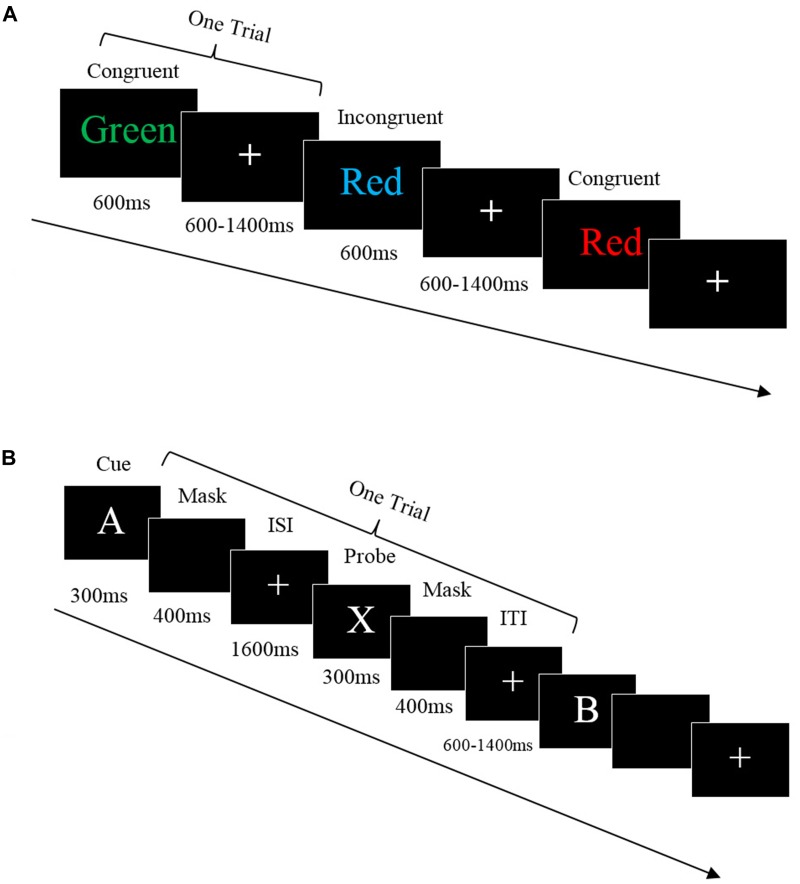
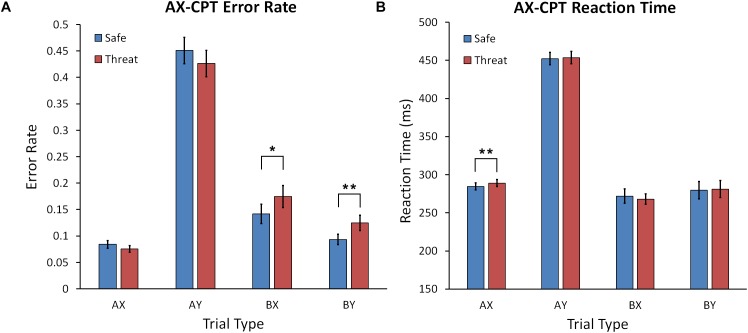
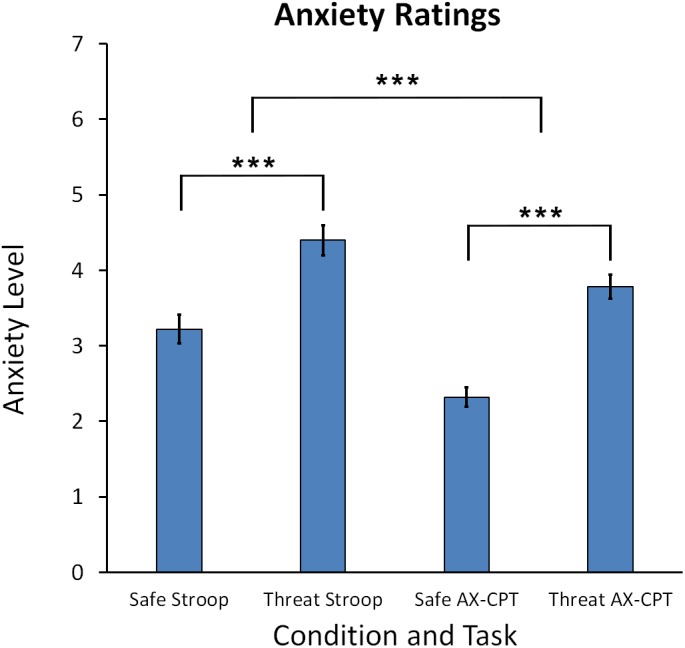
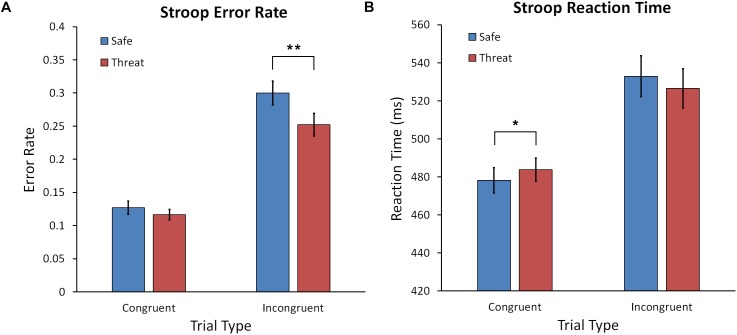
Cognitive control is a construct that prioritizes how we process stimuli and information to flexibly and efficiently adapt to internal goals and external environmental changes. The Dual Mechanism of Control (DMC) theory delineates two distinct cognitive control operations: proactive control and reactive control (Braver, 2012). Anxiety has been posited to differentially affect proactive and reactive control, due to its influence on working memory and attention allocation (Eysenck et al., 2007; Fales et al., 2008). However, no study has yet directly compared the influence of anxiety on proactive and reactive control in the same individuals. In this study, we examined how state anxiety affected proactive control, using the AX-continuous performance task (AX-CPT), and reactive control, using the classic Stroop task. Based on theory and previous investigations, we expected that state anxiety would enhance reactive control but impair proactive control. Consistent with our predictions, we found that state anxiety, induced with a threat of shock manipulation, inhibited proactive control on the AX-CPT test, but increased reactive control in the Stroop task. Anxiety may impair proactive control in contexts requiring goal maintenance by occupying limited working memory capacity, whereas it may enhance reactive control via facilitated attention allocation to threat and engaging the conflict monitoring system to quickly modify behavior.
认知控制是一种概念,它优先考虑我们如何处理刺激和信息,以便灵活高效地适应内部目标和外部环境变化。双重控制机制(DMC)理论描绘了两种不同的认知控制操作:主动控制和反应控制(布拉弗,2012年)。由于焦虑对工作记忆和注意力分配的影响,人们认为焦虑会对主动控制和反应控制产生不同的影响(艾森克等人,2007年;法尔斯等人,2008年)。然而,尚无研究直接比较焦虑对同一人群中主动控制和反应控制的影响。在本研究中,我们使用AX连续性能任务(AX-CPT)检验了状态焦虑如何影响主动控制,并使用经典斯特鲁普任务检验了其对反应控制的影响。基于理论和先前的研究,我们预期状态焦虑会增强反应控制,但会损害主动控制。与我们的预测一致,我们发现,通过电击威胁诱导的状态焦虑在AX-CPT测试中抑制了主动控制,但在斯特鲁普任务中增加了反应控制。焦虑可能会通过占用有限的工作记忆容量,在需要维持目标的情境中损害主动控制,而它可能会通过促进对威胁的注意力分配并激活冲突监测系统以快速改变行为来增强反应控制。