Qiao Lei, Xu Lei, Che Xianwei, Zhang Lijie, Li Yadan, Xue Gui, Li Hong, Chen Antao
College of Psychology and Sociology, Shenzhen University, Shenzhen, China.
Key Laboratory of Cognition and Personality of Ministry of Education, Faculty of Psychology, Southwest University, Chongqing, China.
Front Hum Neurosci. 2018 Aug 14;12:328. doi: 10.3389/fnhum.2018.00328. eCollection 2018.
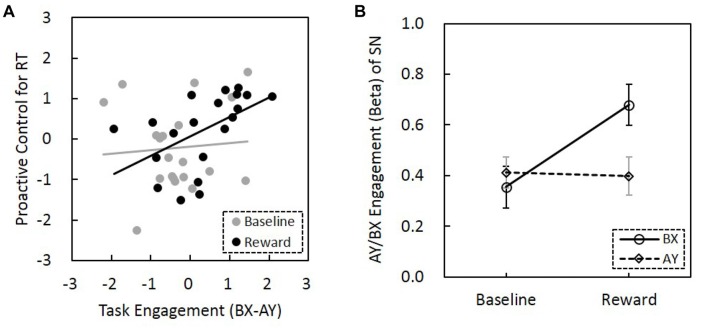
It has been shown that reward motivation can facilitate proactive control, a cognitive control mode that is characterized of prior preparation and sustained holding of the goal-relevant information in working memory. However, it remains to be established the neural networks that may be involved in this promotion effect. In this study, participants underwent the AX-Continuous Performance Task (AX-CPT) that measures relative proactive control during functional magnetic resonance imaging (fMRI) scanning. We employed independent component analysis to decompose multiple brain networks and identified the task related network. Results showed that the salience network (SN) was engaged in the AX-CPT protocol. Importantly, our data demonstrated that reward modulated the association between task engagement of SN and proactive control, whereby the positive correlation was particularly observed in the reward condition. Moreover, reward modulated task engagement of the SN in a proactive manner, which may contribute to the behavioral proactive performance. Overall, our data suggest the involvement of SN in the reward facilitation effect of proactive control.
研究表明,奖励动机可以促进主动控制,这是一种认知控制模式,其特点是在工作记忆中预先准备并持续保留与目标相关的信息。然而,尚待确定可能参与这种促进作用的神经网络。在本研究中,参与者在功能磁共振成像(fMRI)扫描期间进行了AX连续性能任务(AX-CPT),该任务测量相对主动控制。我们采用独立成分分析来分解多个脑网络并识别与任务相关的网络。结果表明,突显网络(SN)参与了AX-CPT实验方案。重要的是,我们的数据表明奖励调节了SN的任务参与与主动控制之间的关联,由此在奖励条件下特别观察到正相关。此外,奖励以主动的方式调节了SN的任务参与,这可能有助于行为上的主动表现。总体而言,我们的数据表明SN参与了主动控制的奖励促进作用。